22 October 2026
Best coffee grinder for French press: how coarse you need to go, and which one actually delivers
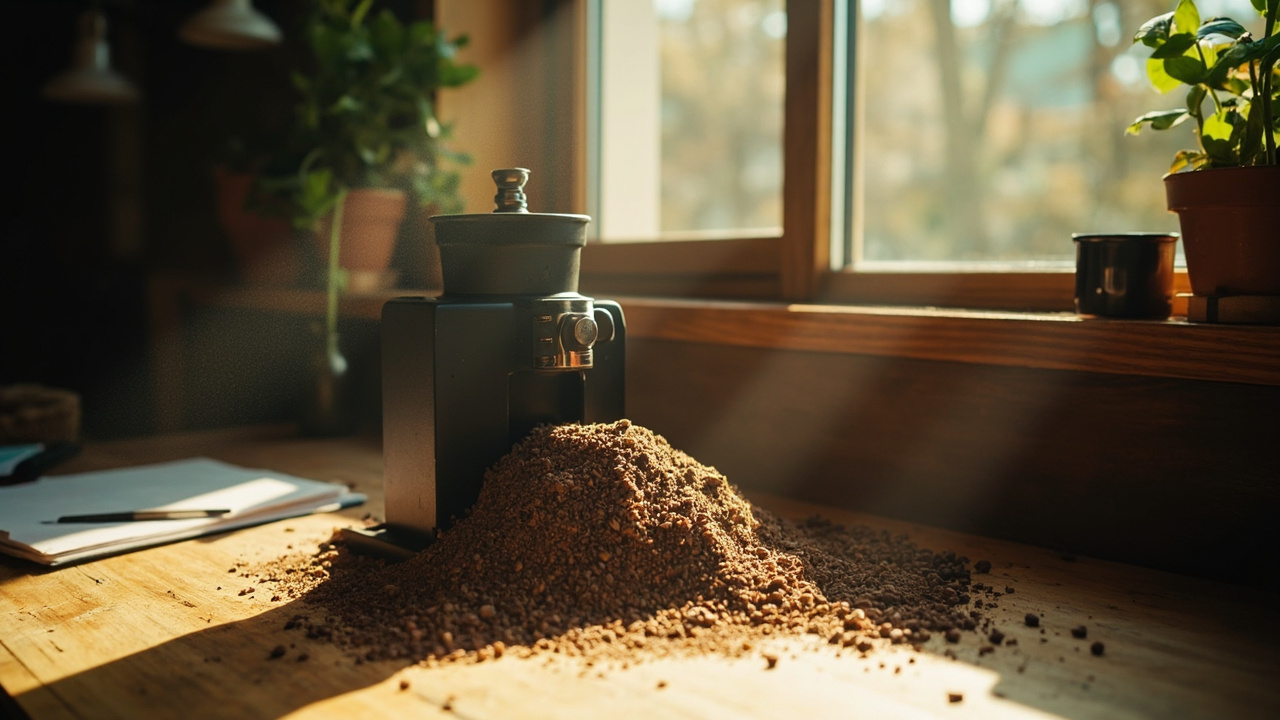
French press forgives a lot — wrong water temperature, slightly off ratio, even a kettle that pours too fast. But a sloppy grinder is the one thing it does not forgive, because a French press is an immersion brew with a metal mesh, and every too-fine particle ends up in the cup as silt. The best coffee grinder for French press is the one that delivers a coarse, even grind without overpaying for espresso features you will never touch. Here is what "coarse" actually means in micrometres, how to test it at home in five minutes, and which kind of grinder — hand or electric, conical or flat — gets you there without a €600 mistake.
Table of contents
- Key takeaways
- Why French press is the easiest brew method to get wrong with the wrong grinder
- What grind size French press actually needs (and why "coarse" is not coarse enough)
- Hand grinder vs electric grinder for French press: which one is enough
- Burr shape and alignment: does conical vs flat matter at coarse settings?
- How to test your French press grind at home in five minutes
- Common French-press grinder mistakes (and the cheap ones to skip)
- Sources
Key takeaways
- French press wants a grind around 1000 µm, the texture of raw sugar or coarse breadcrumbs; anything finer and silt slips through the mesh.
- Burr grinders beat blade grinders for French press because they cut to a target size instead of shattering beans into a mix of powder and chunks.
- The shop’s current electric grinders are listed at €249–€620, so compare the available models within that range and check each product’s grind adjustment before buying for French press.
- A hand grinder is genuinely enough if you brew one or two presses a day and want a quieter, cheaper setup; an electric grinder pays off once you cross about three presses.
- You can verify any grinder's French-press performance in five minutes with a teaspoon of water and a dinner plate — no refractometer required.
Why French press is the easiest brew method to get wrong with the wrong grinder
French press looks idiot-proof: hot water, coarse coffee, four minutes, plunge. The reason it punishes bad grinding is mechanical. A French press filters with a metal mesh, typically around 100 to 200 µm, and a brew ratio of roughly 1:15 means a long, four-minute contact time with no paper to catch fines. Every particle smaller than the mesh ends up in the cup, and that is what people taste as "muddy" or "gritty".
A blade grinder — the propeller kind with a button on top — produces a Gaussian spread of sizes from powder to chunks, and the powder is what ruins the cup. A burr grinder, even an inexpensive one, cuts beans to a much tighter range. The mesh still lets some through, but the bed sits cleanly on top of the plunger and the cup tastes like coffee instead of sediment.
This is also why "coarse" looks different on every grinder: the burr set, the motor's lowest stable speed and the way grounds clump all change the cup. A grinder that is excellent for espresso at 200 µm can still be terrible for French press at 1000 µm if its coarse end is poorly calibrated.
What grind size French press actually needs (and why "coarse" is not coarse enough)
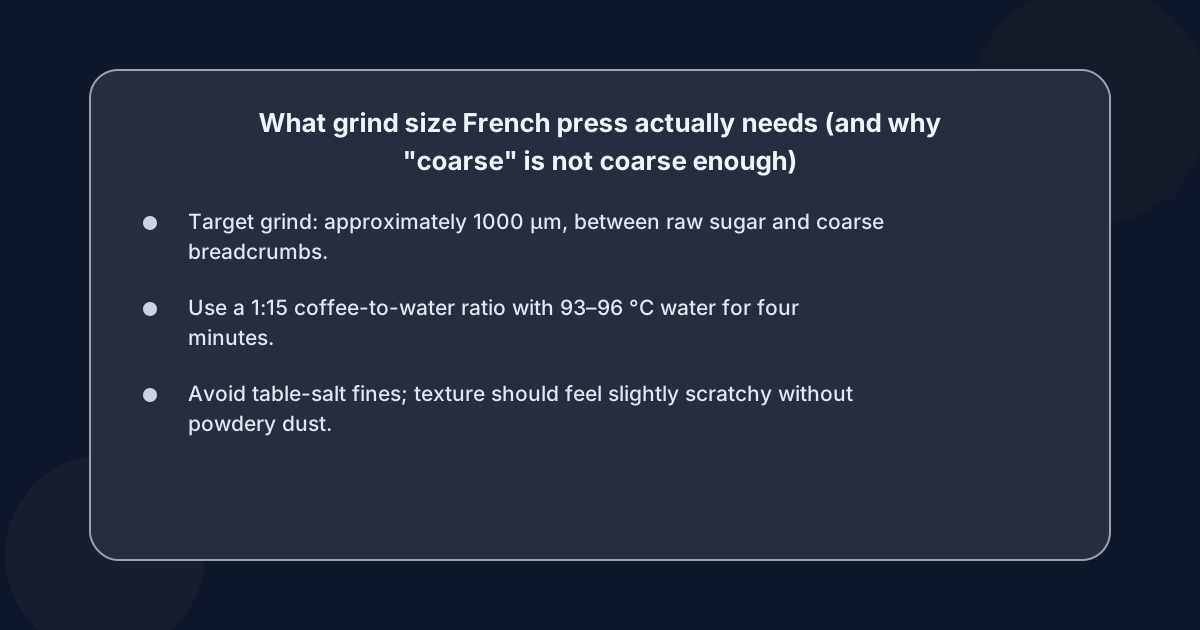 French press wants a grind around 1000 µm, somewhere between the texture of raw sugar and coarse breadcrumbs. The Specialty Coffee Association reference for French press sits in that range, and the practical benchmark most home brewers use is the 1:15 coffee-to-water ratio with water at 93–96 °C and a four-minute steep, as set out in the SCA brew charts.
The problem with the word "coarse" is that it is relative to the grinder you are standing in front of. A setting labelled "coarse" on a blade grinder just means "ran for two seconds" — it is still a mix of sizes. On a burr grinder, the same label usually maps to a real micrometre range, but the number changes between models: the Baratza Encore, for instance, lands at French-press territory between settings 28 and 32 on its stepped dial.
How fine is too fine?
Anything that looks like table salt or finer will clog the mesh, slow the plunge and leave a silty cup. Anything that looks like cracked peppercorns is too coarse and the brew tastes thin and sour. The window is narrower than "coarse" suggests, which is why grinding consistency matters more than absolute size.
A quick way to read the grind in your hand: pinch a small mound between thumb and forefinger. The particles should feel granular, with a slight scratch and no floury dust on the skin. If a fine white dust coats your fingers, the grinder is producing more fines than the mesh can handle, and the cup will taste of sediment no matter how careful the pour.
Hand grinder vs electric grinder for French press: which one is enough
A hand grinder can be sufficient for French press, although grinding time will vary by model, dose and the person grinding. A steel-burr hand grinder with a decent handle will outperform a cheap blade grinder at any price, and it costs less, takes no counter space and is quiet.
The trade-off is volume. One press a day, hand is fine. Two presses, still fine. Three or four, and the morning routine starts to feel like a workout, which is where an electric grinder earns its keep. When comparing electric grinders, check how precisely the coarse end can be adjusted and whether replacement parts are available.
For most home brewers, the right question is not "hand or electric" but "how many presses will I make on a heavy morning". One or two: hand. Three or more, or a household of coffee drinkers: electric. The line moves, and so does the price tag.
- One press a day, mostly weekdays: a hand grinder is enough, and the saving pays for a year of good filters.
- Two presses a day, occasional guests: still hand-friendly, though a steel-burr electric starts to make sense for convenience.
- Three or more presses a day, or a shared household: an electric grinder saves time and arm fatigue, and the coarse adjustment is easier to repeat.
- Pour-over or espresso alongside French press: an electric grinder with a wider range covers more methods without a second machine on the counter.
Burr shape and alignment: does conical vs flat matter at coarse settings?
At espresso settings, conical and flat burrs produce distinctly different cups. At French-press settings the difference shrinks, but it does not vanish. A flat burr tends to produce a more uniform particle distribution, which helps the mesh do its job and reduces silt. A conical burr produces a slightly wider spread but is usually cheaper, easier to align and more forgiving of minor build-up of fines.
Alignment matters more than shape. Prioritize construction, adjustment quality and alignment over burr shape alone; the shop’s electric grinders are currently listed from €249 to €620. Steel burrs last longer than ceramic at coarse settings because ceramic chips at the edge when it meets a stray pebble, and that is the end of the burr set.
Does the brand of burr set matter for coarse grind?
For French press specifically, the burr brand matters less than the alignment, the step between settings and the lowest stable motor speed. A grinder that can hold a coarse setting without "popping" into a finer zone when it warms up is more important than chasing a specific burr geometry.
A quick check before buying: ask whether the burr set is held in place by a screw or by a slip-fit. Screw-mounted burrs can be re-centred at the bench if they drift; slip-fit sets usually cannot, and a small knock can shift the alignment enough to change the cup.
How to test your French press grind at home in five minutes
The fastest way to know whether a grinder is right for French press is the water test, and it needs a teaspoon of water and a white dinner plate.
Drop a small mound of grounds on the plate, sprinkle a teaspoon of water over them, and wait thirty seconds. Good French-press grounds will absorb the water, swell slightly and hold their shape when the plate is tilted. Fines — particles small enough to clog the mesh — will form a paste that smears across the plate. If the plate looks streaked, the grind is too fine for the mesh, even if the grinder dial says "coarse".
A second test is the brew itself. Brew at 1:15, plunge at four minutes, and let the press sit for one more minute before pouring. A clean plunge with light resistance and a clear cup means the grind is right. A heavy plunge that requires force, or a cup with visible sediment at the bottom, means the grind is too fine. If the plunger drops with no resistance and the cup tastes thin, the grind is too coarse.
Common French-press grinder mistakes (and the cheap ones to skip)
The most common mistake is buying a blade grinder because it is cheap, and the second is buying an espresso grinder because it is highly reviewed. Both fail the same way at coarse settings: too many fines, not enough consistency.
Other mistakes worth skipping:
- Grinders with no stepped or stepless adjustment at the coarse end. If the dial jumps from "fine" to "way too coarse" with nothing in between, French press is a guess.
- Grinders that vibrate or "walk" on the counter. Coarse grinds take longer, and a wobbly base is a noisy base.
- Grinders without a reliable coarse calibration. A grinder that drifts after a few months of use will slowly migrate toward espresso territory and you will not notice until the cup goes muddy.
- Spare parts you cannot get. A grinder with no replacement burrs or gaskets is a consumable itself, which is why stock of filters, baskets, gaskets and burr sets is worth checking before you buy.
Compare the shop’s €69–€189 steel-burr hand grinders with its €249–€620 electric grinders, and consider brewing volume, adjustment quality and the availability of replacement parts. Compare the available hand and electric grinders in the shop. Shipping to the rest of the EU is €6.90, with free delivery over €120. Start by comparing the available hand and electric grinders, then check that the filters and replacement parts they need are stocked.
Sources
- Baratza Encore — French Press Grind Setting Guide (Coffee Grinder Guide)
- French Press Brew Guide: Ratio, Grind, Temp & Steps (Coffee Gear Hub)
- Coffee-to-Water Ratio Chart — Printable Guide for Brew Methods (Craft Coffee Guru)
- French Press Grind Size: Coarse Perfection Explained (Bean Brew Digest)
- French Press Coffee to Water Ratio: Exact Grams by Size (Instacuppas Store)
- Specialty Coffee Association — Coffee Standards (sca.coffee)