5 October 2026
Conical vs flat burr grinders: what actually changes in the cup
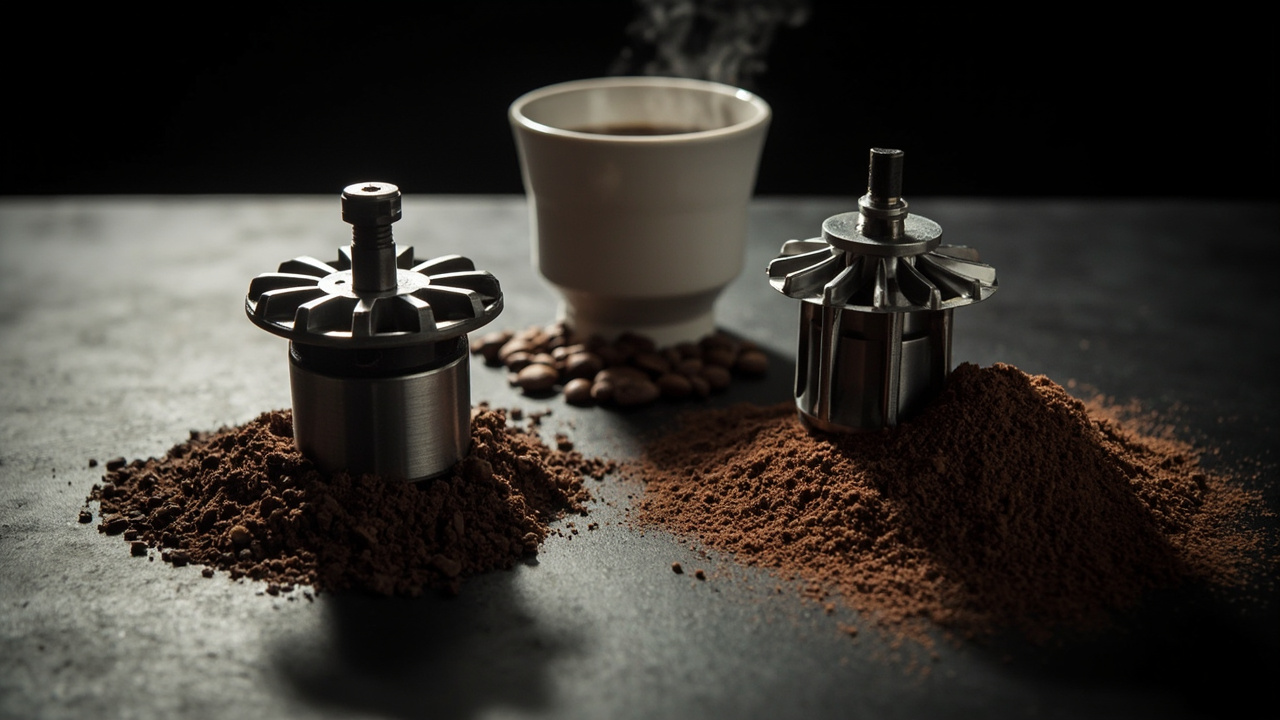
Two grinders can use the same word "burr" and still make noticeably different cups. Here is what the shape actually does once the beans hit it, and how to decide whether the jump from a conical burr grinder to a flat one is worth it for the way you brew at home.
Table of contents
- Key takeaways
- What conical and flat burrs actually are, in plain language
- How the burr shape changes particle distribution — and what that does to taste
- Which brew methods benefit most from flat burrs, and which prefer conical
- Do flat burrs really need more cleaning?
- How long do burrs last, and what does it cost to replace them?
- A quick way to check what burrs are inside the grinder you already own
- Sources
Key takeaways
- Conical burrs sit inside a cone-shaped ring; flat burrs are two parallel rings, and that geometry alone shifts how particles are broken.
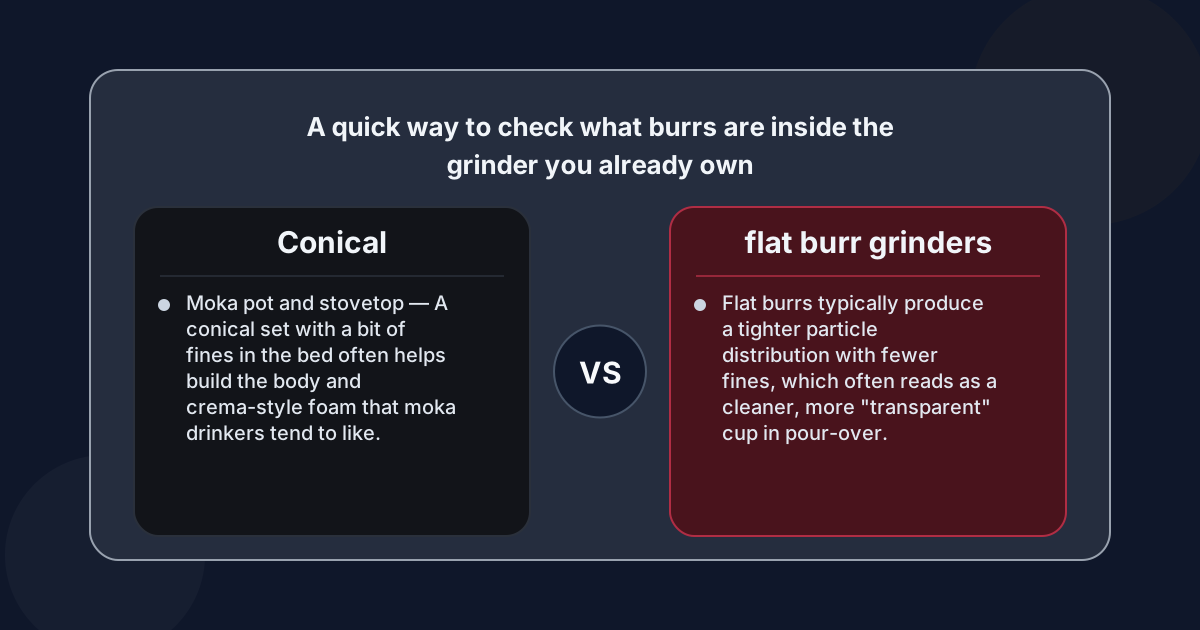
- Flat burrs typically produce a tighter particle distribution with fewer fines, which often reads as a cleaner, more "transparent" cup in pour-over.
- Conical burrs tend to give a slightly broader spread with more fines, which is why many espresso shots from conical machines feel heavier and sweeter in the body.
- Both shapes need the burrs replaced eventually; for a home user, steel burrs usually last somewhere in the 1-to-5-year range, with ceramic at the shorter end.
- You can identify what is inside your grinder by the shape of the burr, the brand marking, or a 30-second test with a marker and a sheet of paper.
What conical and flat burrs actually are, in plain language
A conical burr is a cone-shaped inner burr that sits inside a ring-shaped outer burr; beans drop in from above and are sliced as the cone spins. A flat burr set is two parallel rings, face to face, with the beans fed in from the side and crushed between them. Both are "burr grinders" in the marketing sense, and both crush rather than smash the way a blade does, but the path the bean takes through each design is different, and so is the size spread of the grounds that comes out the other side. The practical consequence is that the same bean, ground to the same nominal setting, tastes like a different coffee depending on which shape did the cutting.
How the burr shape changes particle distribution — and what that does to taste
Conical and flat burrs do not just cut coffee to a single size; they cut it to a range of sizes, and the shape of that range is what the cup hears. Flat burrs typically produce a tighter, more unimodal distribution — most particles sit close to the target size, with fewer very fine dust particles (often called "fines") and fewer large chunks. Conical burrs usually produce a slightly broader spread, with a longer tail of fines. In the cup, that extra fines tail from a conical tends to extract faster and add body, sweetness and a heavier mouthfeel; the tighter distribution from a flat burr tends to read as cleaner, brighter, and more transparent, with origin flavours separated more clearly.
This is also why so many people describe flat burrs as producing "more clarity" in filter coffee and conical burrs as producing "more body" in espresso. The geometry is doing the same job — cutting bean to particle — but the statistical shape of the output is different, and the brew method interacts with that shape.
What grinder burr size do you need?
Burr size matters, but less than burr shape for most home brewers. A 40 mm flat or conical set is the small end of what is worth owning; 50–55 mm is the sweet spot for a single-dosing home setup, and 60–64 mm is closer to what café grinders use. Larger burrs generally grind faster and cooler, which helps if you are pulling multiple shots in a row, but for a single cup of pour-over or one espresso, a well-made 50 mm set will outperform a poorly made 64 mm set every time.
Which brew methods benefit most from flat burrs, and which prefer conical
There is no universal winner; the brew method sets the brief.
- Pour-over and filter coffee — A flat burr's tighter distribution tends to shine here. Fewer fines means a cleaner cup, more separation between origin notes, and less of the muddy, over-extracted edge that fines can give a long brew. If you drink mostly V60, Chemex, or batch filter, a flat-burr grinder is often worth the upgrade.
- Espresso — Both shapes work, but they characterise the shot differently. A conical tends to give a heavier, sweeter shot with more perceived body, which is why many traditional Italian machines ship with conical sets. A flat burr tends to give a more uniform shot with clearer acidity and more distinct notes, which is why flat burrs dominate modern specialty cafés. The choice here is as much about taste preference as it is about quality.
- French press, AeroPress, and immersion brews — The grind is coarse and the brew is forgiving, so the particle distribution argument matters less. A good conical will usually match a good flat at this end of the spectrum.
- Moka pot and stovetop — A conical set with a bit of fines in the bed often helps build the body and crema-style foam that moka drinkers tend to like.
The honest answer to do flat burrs taste better is: not universally, and not in every brew. They taste different, and the difference is most audible in methods that reward clarity.
Do flat burrs really need more cleaning?
Flat burrs are slightly fussier about cleanliness, mostly because their geometry makes stale grounds easier to spot in the cup. The flat, parallel cutting faces create a small dead space at the edges where fines can lodge, and because the particle distribution is tighter to begin with, any retention or stale grinds from a missed cleaning will throw the distribution off more visibly. Conical burrs hide retention better, both in the burr chamber and in the cup.
In practice, neither needs to be disassembled every week. A sensible rhythm for a home user is to brush out loose grounds weekly, run grinder cleaning tablets through the burrs roughly once a month, and do a full disassembly and brush-down every three to six months. The visual cue is straightforward: if the grounds coming out look uneven, or the cup has started to taste flat and stale even with fresh beans, the burrs and the chute are telling you they are due.
How long do burrs last, and what does it cost to replace them?
Burr life depends on the burr material, how much coffee you grind, and how you treat the grinder. Steel burrs are the most common in home flat and conical grinders, and for typical home use they generally last somewhere in the one-to-five-year range; heavier daily users will see the lower end, occasional weekend brewers the upper end. Ceramic burrs are harder in absolute terms but more brittle: they are often pitched as lasting 3–5 years for a home user, though they can chip if a stone gets into the hopper. The signs that burrs are worn are practical: shots pull faster than they used to, the grind setting has to creep finer to hit the same extraction, the particle spread visibly widens, and the cup loses definition.
Replacement cost varies widely by grinder. Many mid-range electric grinders sell replacement burr sets as a spare part at a price that is a meaningful but not catastrophic share of the original machine. Hand grinder burrs are usually the cheapest to replace, and are often the first thing that gets swapped on a long-serving hand grinder. The useful rule of thumb is to price the replacement burr set before you buy the grinder, the same way you would price a spare battery before buying a camera. For the warranty and what is covered if a burr fails earlier than expected, the Returns, warranty and repairs page spells out how wear parts and manufacturing faults are handled differently, which is worth reading before you file anything as a fault.
A quick way to check what burrs are inside the grinder you already own
 You do not have to open the burr chamber to identify the shape; in most cases you can tell from the outside or with a 30-second test.
- Look up the model. Most manufacturer pages list burr type, burr size, and burr material in the specifications. If the spec sheet says "conical steel burrs" or "flat 50 mm steel", that is the answer.
- Look at the hopper from above. If you can see a cone-shaped piece pointing down into the burrs, the grinder is conical. If the burrs sit flat and parallel, with a side feed, it is a flat set. This is the fastest test and works without tools.
- Mark and grind test. Draw a line on a sheet of white paper with a marker, then grind a small amount of coffee onto it. Flat burrs leave a tight, narrow band of grounds; conical burrs leave a slightly wider spread, with a visible tail of fine dust on either side. It is not a lab measurement, but it is enough to tell which geometry you are running.
- Check the brand marking. Most burrs are stamped with a part number, a size in millimetres, and sometimes a material code. If the burr is removable, take it out, read the marking, and you have a definitive answer in one glance.
If you cannot identify the burrs from any of the above, write to the manufacturer with the serial number, or take a clear photo of the burr chamber with the hopper removed and send it to a person who knows the model. A focused photograph and the order number are usually enough to get a confident answer back; the Contact the shop page explains what to include if the answer needs to come from a workshop rather than a support inbox.
For a reader who is about to act on this, the Grinders, brewers, filters and spares page lists the grinders currently in stock, with the burr shape and burr material called out for each model, so you can match what you have just learned about your brewing method to the geometry that suits it.
Sources
- Burr Wear Timeline: When to Replace Burrs — Complete Home Barista
- How Long Do Coffee Grinder Burrs Last? — All Kitchen Tips
- How To Clean A Burr Grinder — Coffee File
- Burr Cleaning: The Right Frequency (and the Signs You're Late) — Ash Grind
- Flat vs. Conical Burr: The Physics of Particle Distribution — Coffee Scholars
- Burr Grinder Cleaning: Complete Coffee Grinder Maintenance Guide — Complete Home Barista