2 October 2026
Hand grinder vs electric grinder: which one should you actually buy?
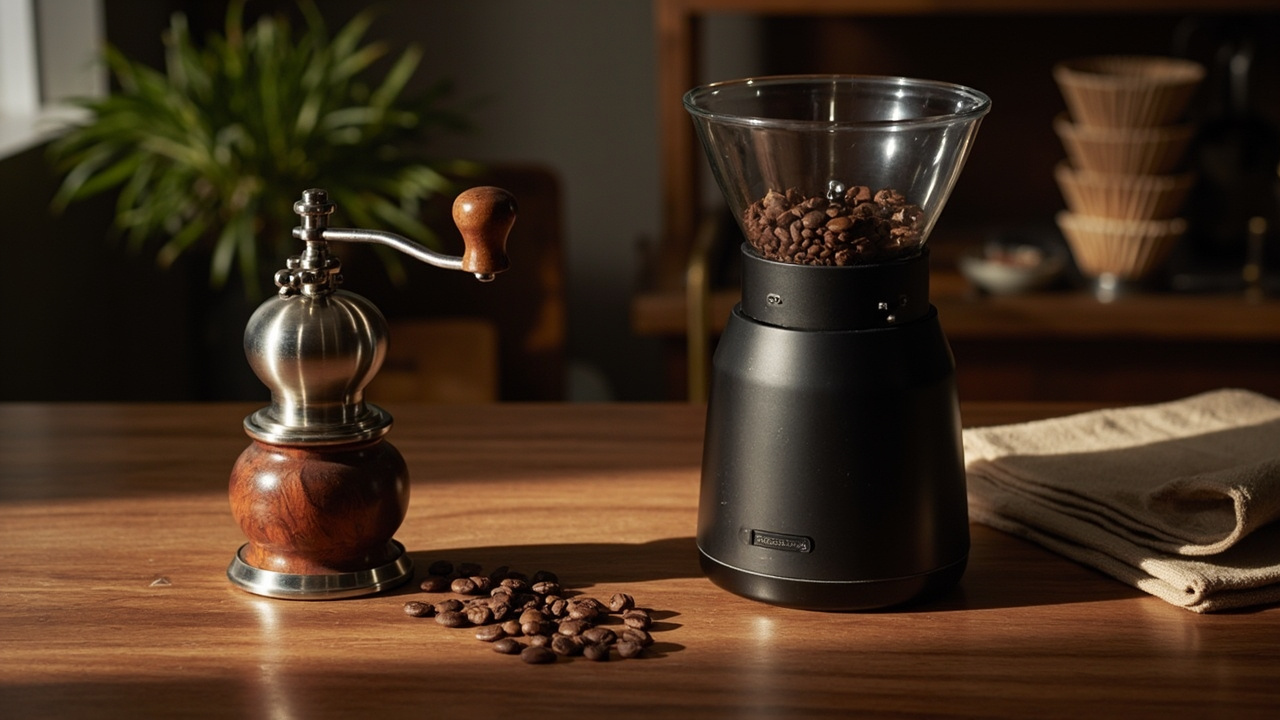
A hand grinder and an electric grinder both make coffee. The hand grinder vs electric grinder question gets answered badly online because most comparisons treat it as a price question, when it is really a habit question: how many cups, at what time, for whom, and what brew method.
If you are choosing between a hand grinder and an electric grinder in 2026, the short version is this. For espresso, for households making back-to-back cups, or for anyone with a wrist problem, an electric grinder is the honest answer. Everything below explains why, with the trade-offs spelled out instead of waved away.
Table of contents
- Key takeaways
- What actually changes between a hand grinder and an electric grinder
- Is a hand grinder good enough for espresso?
- How long does grinding by hand really take — and does it get tiring?
- Which electric grinders make sense under €500, and which are overkill?
- Hand grinder vs electric grinder: a simple decision rule by use case
- What to do if you change your mind after you buy one
- Sources
Key takeaways
- Hand grinders can pull espresso, but only specific models (steel conical burrs, stepped or stepless adjustment narrow enough to hit a target in a 5–10 g dose) — the wrong hand grinder is the most common way home baristas ruin a shot.
- A 20 g V60 dose takes about 35–55 seconds of cranking on a 1Zpresso JX or Comandante C40; espresso doses take 60–90 seconds and are where most people give up.
- The honest decision rule: pick hand if you brew one or two cups a day and care more about clarity than convenience; pick electric if you brew two or more cups, share the kitchen, or pull espresso more than twice a week.
What actually changes between a hand grinder and an electric grinder
The two grinders do the same job in different ways, and the difference shows up in three places: the burrs, the workflow, and the price you pay for the burrs. A hand grinder is mostly burrs and a handle, with a small body around them; an electric grinder is mostly a motor, a gearbox, and a hopper, with a burr set at the bottom.
What you feel at the counter is different too. A hand grinder forces you to be present: you weigh the beans, you turn the handle, you notice when the grind slips coarser because the dose is finishing. An electric grinder takes a button-press and a wait. The taste difference is not imaginary; it is the difference between adjusting by feel on every cup versus pressing the same button and hoping the burrs are still aligned. Both can produce excellent coffee, but the electric grinder hides drift, while the hand grinder exposes it.
The third difference is what happens when something goes wrong. A hand grinder has almost nothing to break: a bearing wears, a burr set gets blunt, a handle loosens. A replacement burr set for a 1Zpresso is roughly the cost of a new entry-level grinder; the same repair on a Baratza Encore is a known, documented job. If you are the kind of person who would rather fix a thing than send it back, a hand grinder is the friendlier object. If you would rather have someone else fix it, that is what warranty and repair terms are for, and the answer to that is "what does the shop actually do when it goes wrong," not "is the brand good."
What does the burr set actually do, and why does it cost so much?
The burrs are two steel cones (or two flat steel discs, in flat-burr grinders) that shear the coffee bean into particles. The size of those particles, and how even the distribution is, is what determines flavour extraction. Cheap stamped-steel burrs produce a wide range of particle sizes, with fines that over-extract and boulders that under-extract, and the cup tastes muddy or sour as a result. Good conical or flat burrs, heat-treated and machined to tight tolerances, produce a narrow distribution, and the cup tastes clean.
This is why a hand grinder with good burrs can outperform an electric grinder with mediocre ones at half the price. The burrs are the single most expensive part of the grinder to make well, and the hand grinder spends almost all of its budget on them.
Is a hand grinder good enough for espresso?
 Yes, but only a specific kind. The question "are hand grinders good for espresso" has a misleading answer online because most hand grinders on the market are designed for pour-over, with burr geometries and adjustment steps that are too coarse for espresso. To pull a shot at 9 bar, you need to dial in to a narrow range — often a couple of notches on a stepped grinder, or a few degrees of turn on a stepless one — and many hand grinders simply do not have the resolution. A V60 has a forgiving extraction window of about 30 seconds; an espresso shot has one of about 5 seconds. That difference is what kills most "hand grinder for espresso" attempts.
The hand grinders that genuinely work for espresso share three features. They have steel conical burrs (the geometry holds its setting under the pressure of grinding), a stepped or stepless collar that adjusts in fine increments (each step should be roughly 15–25 microns, not 50–100), and a magnetic catch cup or a static-reducing grounds bin so that the 18 g dose does not stick to the walls and leave you half a gram short. The 1Zpresso JX-Pro and the JX-Pro S are the usual recommendations; the Comandante C40 with the Red Clix upgrade is the alternative for people who do not mind spending more. The Timemore Chestnut X is the budget end of the espresso-capable category.
What they will not do, even when set up correctly, is grind 18 g of espresso in under a minute. Plan on 60–90 seconds of cranking per dose, and accept that as the price of admission. The honest comparison is not "hand grinder vs electric grinder for espresso" but "hand grinder for espresso, on a quiet morning, once a day" — that is the use case it is built for.
Can a hand grinder replace a Niche Zero or a Eureka for everyday espresso?
Not really, and pretending otherwise is how people end up grinding coffee at 6:30 a.m. and hating it by Christmas. A hand grinder is a deliberate, slightly ceremonial object; an electric grinder is a tool that disappears. If you are making two flat whites every morning at 6:45, the right answer is an electric grinder and a one-line routine, not a hand grinder and a workout.
The one situation where the hand grinder wins on espresso is the travel or holiday setup: a hand grinder, an AeroPress, and a handpresso or a Wacaco Nanopresso fit in a small bag and produce something genuinely good in a hotel room. For that, the JX-Pro S is the default.
How long does grinding by hand really take — and does it get tiring?
It depends on the dose, the grind size, and the grinder. For a 15 g V60 dose at a medium-fine setting, a 1Zpresso JX-Pro takes about 30–40 seconds, a Comandante C40 takes about 40–55 seconds, and a Timemore Chestnut C2 takes about 45–60 seconds. The slower end of the range is still fast enough that "how long does a hand grinder take" is not really the question — 40 seconds of cranking is a small cost for most people.
Espresso is where the cost climbs. An 18 g espresso dose on a fine setting is 60–90 seconds on the same grinders, and the resistance goes up sharply as the setting tightens. This is also the dose where the wrist starts to feel it. A 30-second V60 grind is a non-event for most adults; a 90-second espresso grind is a small workout, and doing it twice a morning gets old fast.
The honest answer to "does it get tiring" is that it does, and the tiredness scales with dose, fineness, and frequency. One V60 a day is fine. Two espressos a day is where most people switch, not because the grinder fails, but because the routine does.
Is a hand grinder better for travel than an electric one?
Yes, by a wide margin. A hand grinder weighs 400–800 g, fits in a side pocket, and needs no power. An electric grinder needs a wall socket or a battery pack, takes up counter space, and is the most awkward part of any travel kit. If you travel with a hand grinder, an AeroPress, and a small kettle, you can make genuinely good coffee in any hotel room, any Airbnb, and most offices. This is one of the quietest reasons people own a hand grinder even when they also own an electric one.
Which electric grinders make sense under €500, and which are overkill?
For espresso, the question "electric grinder for home espresso under 500" has a narrower honest answer. The Baratza Encore ESP is the budget pick; the DF54 (or DF64 with steel burrs) is the single-dose pick; the Niche Zero is above the budget but is the grinder most home baristas end up at if they stick with the hobby past year one.
What is overkill at this price point: grinders with built-in scales that do not calibrate well, grinders with touchscreens that lag, and grinders with app connectivity that adds nothing to the cup. The grinder is a mechanical object; the burrs are what matter.
1Zpresso vs Baratza — how do they actually compare?
The 1Zpresso vs Baratza comparison is not really fair to either, because they are different objects: 1Zpresso makes hand grinders, Baratza makes electric ones. The real comparison is 1Zpresso JX-Pro vs Baratza Encore ESP, which is the hand-grinder-plus-electric-grinder question, not a brand question. The 1Zpresso wins on flavour, the Baratza wins on routine, and the choice is which one you care about more.
For someone brewing only V60, the JX-Pro is the better purchase. For someone brewing V60 in the morning and espresso in the afternoon, or for two people in the kitchen, the Encore ESP is the better purchase. The 1Zpresso K-Ultra at the top of the hand range, and the Baratza Vario with steel burrs at the top of the electric range, are the "if money is no object" answers, but neither is necessary to make excellent coffee.
Hand grinder vs electric grinder: a simple decision rule by use case
The hand grinder vs electric grinder decision is a use-case question, not a price question. Below is the rule most home coffee drinkers end up following, written out so you can apply it to your own morning.
If you brew espresso more than twice a week, if you share the kitchen with another person, if you have a wrist or shoulder problem, or if you make coffee for guests, buy an electric grinder. The Baratza Encore ESP is the budget pick; the DF54 or Eureka Mignon Filtro is the mid-range pick; the Niche Zero is the "if I am staying in this hobby" pick. The 1Zpresso hand grinders are still the better burrs, but the routine will beat you before the burrs do.
If you are somewhere in between, the honest move is to buy a hand grinder first, use it for three months, and see whether the routine holds. Most people who do this either fall in love with it (and never buy an electric grinder) or quietly give up on it (and buy an Encore ESP). Either outcome is fine, and the hand grinder will still be useful as a travel grinder even if you end up with an electric on the counter. The shop that stocks hand grinders, electric grinders, and the filters and spares to keep both running is the kind of place that does not mind you figuring it out at your own pace — that is the difference between a warehouse that ships boxes and a shop that stocks gear it would use itself.
What if you pull espresso at home and also travel?
This is the case for owning two grinders, and it is more common than it sounds. The home setup gets the electric — a Baratza Encore ESP, a DF54, or a Niche if the budget stretches. The travel setup gets a hand grinder — a 1Zpresso JX-Pro S for espresso on the road, or a Q2 for filter. This is also the setup that small specialty coffee shops tend to recommend, because it is the one they use themselves.
What to do if you change your mind after you buy one
Changing your mind is normal. Most home coffee drinkers buy a grinder, use it for a few months, and discover that their actual routine is different from what they expected. Some people who bought hand grinders end up wanting the convenience of electric; some who bought electric end up wanting the burr quality of a hand grinder for the weekend V60. Neither outcome is a failure, and the right answer is to make the change without treating the first purchase as a mistake.
If you bought from a shop with a sensible returns policy, the path is straightforward: most unused gear can come back within 30 days, in its packaging, with the accessories it shipped with, and the refund is processed within a few working days of inspection. Used grinders, including hand grinders that have been cranked a few times, are usually still returnable under warranty if they are faulty, which is a different process and starts with an email to the workshop. Wear parts — burrs, gaskets, filters — are consumables and are not covered; everything else is, for two years. Shipping costs on a return are usually covered by the buyer unless the item arrived damaged.
If you bought second-hand, or from a shop with a stricter policy, the path is different: the grinder becomes your travel grinder, your office grinder, or your guest-room grinder, and the new grinder takes its place. This is also why buying a hand grinder first is the lower-risk move: even if you end up with an electric, the hand grinder is still useful, and you have not wasted the purchase.
The boring truth is that the grinder you actually use is the right grinder. The grinder sitting in a cupboard because the routine did not stick is the wrong one, regardless of how good its burrs are. Buy the one that fits the morning you actually have, not the morning you wish you had. If the routine changes, change the grinder. If the grinder changes, change the routine. And if something goes wrong with either, ask a person, not a chatbot — the answer is usually a photograph, an order number, and a one-line email.