9 October 2026
Is a Refurbished Coffee Grinder Worth It? What Warranty Actually Covers

Open-box grinders are everywhere, and the discounts are tempting. The catch is not the price, it is the difference between a machine a workshop has actually serviced and one that has simply been repackaged. Whether a refurbished coffee grinder is worth it comes down to three things: who checked it, which parts they replaced, and what the paperwork promises if something fails six months from now. Get those three right and a serviced electric grinder at a meaningful discount to new is often the best upgrade you can make.
Table of contents
- Key takeaways
- What "refurbished" actually means on a coffee grinder (and why sellers use three different words for it)
- Which parts are checked vs which are just cleaned
- What warranty has to cover for a refurbished coffee grinder to be a safe buy
- Should you buy a refurbished espresso grinder or spend the same money on a new hand grinder?
- The 5 questions to ask the seller before you pay
- Red flags: signs a "serviced" grinder is just a wiped-down return
- Sources
Key takeaways
- A "refurbished" grinder is only as good as the bench that worked on it — manufacturer-refurbished, seller-refurbished and open-box are three different promises, not three synonyms.
- Burrs, motors, electronics and switchgear are checked and replaced as needed; casings, hoppers and minor trim are usually cleaned rather than repaired.
- Two-year parts-and-labour cover on the parts that actually fail is the minimum to make a refurbished espresso grinder a safe buy; one-year or cosmetic cover is a deal-breaker.
- A serviced electric grinder usually beats a new hand grinder at the same money for anyone pulling more than two espressos a day.
What "refurbished" actually means on a coffee grinder (and why sellers use three different words for it)
In specialty coffee, "refurbished", "seller-refurbished", "open-box" and "certified pre-owned" are four labels for a single idea: a machine that has been used, returned or display-damaged and is being resold. They are not interchangeable. The difference between a refurbished coffee grinder worth buying and one to walk past is which label the seller is allowed to use, and what is on the checklist behind that label.
Manufacturer-refurbished means the original maker took it back, stripped it, replaced anything worn, re-calibrated the burrs, and resold it with the same warranty a new unit carries. Breville, for instance, runs its warranty and repairs through its own Warranty & Repairs channel, which is the model a true manufacturer refurbishment should look like. Seller-refurbished means a third party — often a retailer or a workshop — has done the work, and the warranty is theirs, not the brand's. Open-box is the lightest category: the unit may be untouched, or it may simply be a return that has been repackaged with no service at all.
The reason sellers lean on three words is that each one implies a different level of risk. Open-box implies "as new, with a small cosmetic blemish". Refurbished implies "used, fully checked, parts replaced as needed". Certified pre-owned usually implies the same as refurbished but often with a brand endorsement. If a listing does not say which one it is, assume the lightest: repacked and styled. In practice, the category a unit ends up in is set by the bench that handles the paperwork: a manufacturer refurbishment has a maker's serial trace, a seller refurbishment has a workshop's checklist, and an open-box listing has neither.
Which parts are checked vs which are just cleaned
A genuine refurbishment touches the parts that wear out. On an electric grinder that list is short and specific: the burrs, the motor brushes or bearings, the electronic control board, the on/off switch and the thermal fuse. Everything else — the hopper lid, the grounds container, the trim, the paintwork — gets cleaned, not repaired. That split is the giveaway: a checklist that names every cosmetic panel but does not name the burrs has not been near the parts that fail first.
The burrs are the headline. On a flat-burr grinder the cutting surfaces have to be either replaced or re-aligned; a re-sharpened flat burr produces more fines and a less even particle curve, which is exactly what you bought the upgrade to avoid. On a conical burr the rule of thumb is the same: replace rather than resharpen, and re-align the inner and outer cones to the original gap. Any refurbishment that does not mention what was done to the burrs has not been done properly. Worth noting that wear on conical burrs is slower than on flat burrs, so a conical at 200 kg of cast grind is a much safer bet than a flat at the same number.
The motor and electronics are the second checkpoint. A motor that draws the right current at idle but trips a buzz pair under load is a motor whose bearings are starting to fail; a workshop that has run the grinder under load for ten minutes and checked the amp draw has done the work. A workshop that has wiped the casing and called it serviced has not. The same logic applies to the switchgear: a rocker switch that has been cycled a few hundred times on the bench reads differently under a meter from one that has been wiped with a cloth and put back in the box.
What warranty has to cover for a refurbished coffee grinder to be a safe buy
A warranty that names the parts is a warranty worth reading. A warranty that says "one year, manufacturer defects" without saying which parts are excluded is, in practice, a warranty that excludes the parts most likely to fail. Burrs, gaskets and filters are consumables; almost every brand lists them as wear items rather than warranty items, including Baratza, whose warranty terms explicitly carve out normal wear, improper cleaning, foreign objects in the beans and uses outside the intended application.
For a refurbished coffee grinder to be a safe buy, three things have to be true of the warranty. First, it has to run at least one year, ideally two. Two years parts-and-labour is what this shop offers on everything that is not a consumable, and what any refurbishment should at least match. Second, it has to cover the burrs, the electronics and the motor — the three systems that fail first. Third, the repair has to be done somewhere with the parts in stock, not sent back to a distributor on a six-week round. For reference, Baratza's standard limited warranty is two years from the original purchase date, which is the floor any refurbishment should match or beat.
Anything less is not really a warranty, it is a return window. A 30-day return is the consumer's last line of defence — it catches the unit that was already broken when it was shipped. The warranty is what catches the failure that appears once the burrs have run in. If the seller cannot produce both, the discount is smaller than it looks. A refurbisher who can name the parts, the term and the bench in writing has done the paperwork half of the job requires.
Should you buy a refurbished espresso grinder or spend the same money on a new hand grinder?
For someone pulling two or three espressos a day, a refurbished electric grinder at the same money is almost always the better buy, because the burr set on a serviced electric is larger, the grind is more repeatable, and the time saved per shot pays back the price difference inside a year.
The case for a new hand grinder is real, and it is worth naming. A new hand grinder carries the full manufacturer warranty with no carve-outs, has burrs that have never been touched, and ships in a box that has never been opened. For a once-a-day plunger drinker, or for a buyer who treats grinding as part of the ritual, the new hand grinder is the cleaner choice. The case against it is that at the same money you are usually buying last year's burr geometry in a smaller housing, not this year's.
For someone with a real espresso machine on the bench, the serviced-versus-new comparison rarely goes the other way. The trade-off is effort against equipment class, not money. It is also worth weighing the long tail: a serviced electric with the burr set already run-in will hold its grind setting across the first hundred shots more cleanly than a new hand grinder, whose burrs are still bedding in and whose setting drifts a click at a time until they have settled.
In the middle of the market, a shop that sells open-box grinders with the parts stocked for them, a two-year parts-and-labour cover on everything that is not a consumable, and an in-house bench rather than a distributor's phone queue is one route through this question. That model is what a small specialty-coffee Grinders, brewers, filters and spares like ecommerce is built around: stock the gear the workshop would use, mark down the returns that have actually been serviced, and back the work with a warranty the workshop can honour.
The 5 questions to ask the seller before you pay
These are the five questions that catch almost every bad buy before the money changes hands. If a seller can answer all five in writing, the grinder is probably worth the discount. If any answer is vague, walk.
-
Who actually serviced it, and what is their name? A workshop, a brand, or "we" are not the same answer. Ask for the business or the technician.
-
What parts were replaced, and which were only cleaned? The list should name burrs or burr alignment, plus any electronics, motors, switches or gaskets that were touched. A list that only mentions "cleaned and tested" means nothing was touched.
-
Who holds the warranty, and how long does it run? Two years parts-and-labour is the standard to beat. Anything shorter is a flag, especially for the burr set and the electronics.
-
What is the return window if the unit is not as described? Thirty days is normal for a change of mind; a refurbishment should match that, and the Returns, warranty and repairs process should not depend on the original manufacturer. Confirm that a return can be started by email with the order number, with the unit in its original packaging, rather than through an RMA process that takes a week to issue.
-
What evidence is there that the burrs were re-aligned, not just re-fitted? A bench that can produce a grind analysis or a before-and-after particle distribution chart has actually measured the work. A bench that cannot has probably not done it.
A sixth question worth asking on an export-style listing is how shipping works: who pays return shipping if the unit fails inside the warranty, and is the unit shipped with a tracking link on the day it leaves. The shop's own Delivery times and what shipping costs terms answer both for its own orders — a same-day cut-off at 14:00 on working days, tracked courier, and a fixed-price structure that does not change with order size — and the same expectations should apply to any other seller of a refurbished unit. The right framing is to ask the questions before paying, not after, because once the unit is on a slow boat from a third country the answers become theoretical.
Red flags: signs a "serviced" grinder is just a wiped-down return
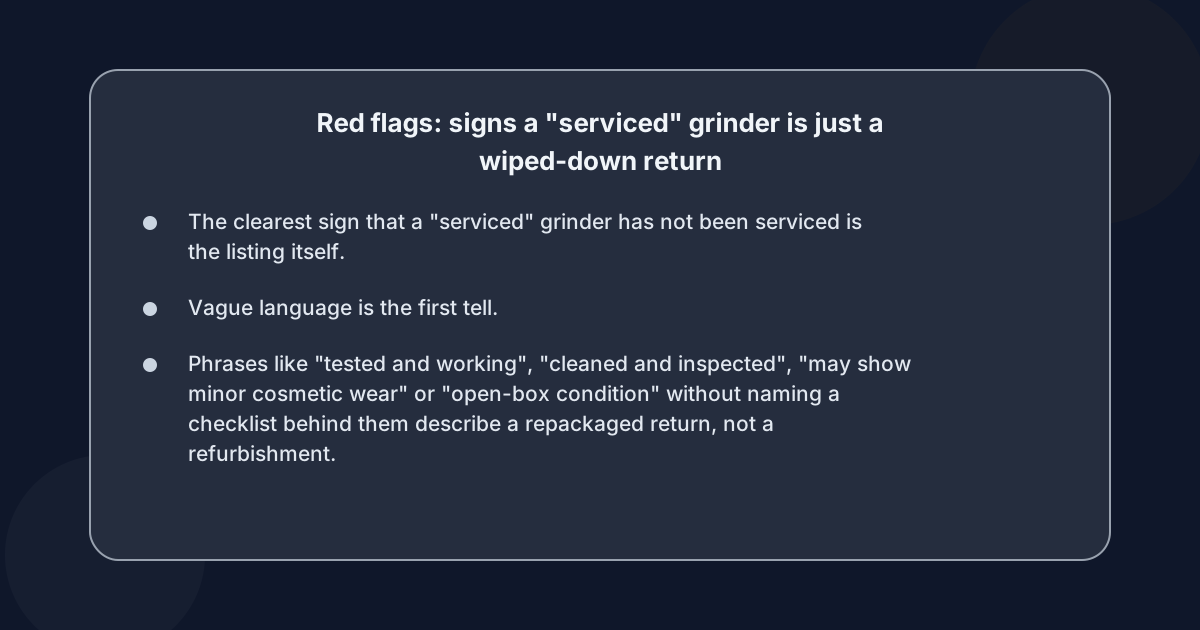 The clearest sign that a "serviced" grinder has not been serviced is the listing itself. Vague language is the first tell. Phrases like "tested and working", "cleaned and inspected", "may show minor cosmetic wear" or "open-box condition" without naming a checklist behind them describe a repackaged return, not a refurbishment. A workshop that has actually replaced a burr set or a control board writes that down, because it is the work that justifies the markup on the listing.
The second tell is the price. A genuine refurbishment costs more than an open-box unit of the same model, because parts and labour have gone into it. If the discount is the same on every unit in a seller's catalogue, the refurbishment premium is fictitious. The third tell is the photos. A grinder that has been re-burred will usually show fresh burrs in the listing photos, with the inner and outer cones free of the polish that comes from thousands of shots. A grinder that has only been wiped down will still show the original burrs, often photographed wet.
The fourth tell is the warranty. A unit that comes with "all sales final", "no returns", or a 14-day window where the seller pays nothing is a unit the seller has not stood behind. A unit that comes with the full manufacturer warranty at the original purchase date is the closest a buyer gets to buying new with a discount, and the most likely path is a manufacturer refurbishment. A unit that comes with the seller's own warranty has probably been serviced by the seller. Anything else has not been serviced at all.
The last tell is the burrs themselves. If a grinder has been re-burred, the burrs click into alignment at the same factory gap as a new unit. If they have been re-sharpened, the grind will pull finer at the same number but the particle distribution will be wider, and the cup will taste flatter. Any seller who cannot tell you which of those two jobs was done has not been honest about the work, and the listing is not safe at any price. A fifth tell worth naming, since it shows up often on marketplaces: a listing that ships from a different postcode than the business address on the warranty page is usually a drop-ship, and a drop-shipped refurbishment is rarely a serviced one.