
SEO content workflow for a one-person marketing team

Most solo marketers do not have a content problem — they have a workflow problem. There is a backlog of good ideas, a calendar that slips every month, and a publishing step that lives in the gap between "the draft is done" and "the URL is live". That gap is where rankings go to die, and it is also where a single-person team can be overhauled by changing four or five habits. A reliable seo content workflow for one person is less about writing faster and more about deciding in advance what gets written, in what order, and what proves it worked. The rest of this post lays out the cadence, the per-post checklist, and the monthly review loop that turn a scattered blog into something a solo marketer can actually keep running.
Table of contents
- The shape of a workflow that one person can actually run
- Quarterly: turn buyer questions into a dated plan
- Weekly: pick the next post, not the next topic
- Per post: brief, draft, metadata, publish — in that order
- Per month: read Search Console and re-prioritise the queue
- What to hand off first when you finally get help
- Frequently asked questions
- Sources
The shape of a workflow that one person can actually run
A workflow that survives contact with one human has to be predictable on the worst week, not just the best one. The cadence below is what most one-person teams can hold for a year without burning out, and it scales almost linearly when a second person eventually shows up.
- Quarterly — turn buyer questions into a dated plan, one row per post, eight decisions per row.
- Weekly — pick the next post, not the next topic. The plan already chose the topic; the week only chooses which row moves.
- Per post — brief, draft, metadata, publish, in that fixed order. No skipping steps.
- Monthly — read Search Console, re-prioritise the queue, kill what is not earning its keep.
Two non-negotiables sit underneath that cadence. First, every post is written for one query that the site already has a chance to win, decided before the draft exists. Second, the publish step is a single mechanical action — push the post, push the metadata, Submit the URL in Search Console. — done on the day the plan says it will be done. Both are easier to honour when the plan has been written down, which is why the next section starts with a quarterly content plan template rather than with writing tips.
The same shape applies whether the team is one person or ten. If you ever do grow, the workflow above is the same one an agency running several client blogs would use per site — separate calendars, separate reviews, the same per-post steps.
Quarterly: turn buyer questions into a dated plan
A quarterly plan is the difference between "we should write about X" and "the post for X publishes on 14 March". The planning session is one sitting, two to three hours, and produces a spreadsheet where every row is a decision, not a topic.
Each row should carry at least these eight fields, in this order:
- Target query — one search the page has to win, written the way real people type it.
- Search intent — informational, commercial or transactional. Intent decides the shape of the post, not the word count.
- Supporting terms — the related questions the post should also answer, without competing with its own primary query.
- Outline — three to six headings, so the post has a spine before it has prose.
- Meta title and description — written for the search result, not for the brand. The query goes in the title.
- Internal links — the pages on your own site this post should point at, and the page that should link back.
- Format and depth — guide, comparison, tutorial or listicle, matched to what the query is actually asking for.
- Publish date — a date, not a week. Nothing in the queue is undated.
The order matters. Filling them top-down forces the harder decisions first — which query, which intent — and leaves the cosmetic decisions for last. A topic without a target query is not a row; it is an idea. The eight decisions per row are unpacked in more detail in the SEO content plan guide, which is worth keeping open during the planning session.
A practical volume for one person is one post per week, give or take, with two buffer weeks per quarter for the posts that need a rewrite or a deeper source. That is roughly forty rows per year, which is enough to build topical authority on two or three sub-themes without the calendar ever becoming a wish list.
Weekly: pick the next post, not the next topic
The most common solo marketer mistake is choosing a topic on Monday and writing it on Wednesday. That sounds productive, but it skips the part of the workflow that produces rankings: deciding which row the week should advance.
The weekly ritual is short and should stay short:
- Monday morning (30 minutes). Open the plan. The next undated row whose publish date falls in the next seven days is this week's post. Move every other good idea to a "later" tab.
- Tuesday–Thursday (three to four hours of focused writing). Draft against the row's outline. Do not redesign the outline mid-draft.
- Friday (45 minutes). Add metadata, internal links, and image alt text. Schedule the publish for the date on the row.
The point of "pick the next post, not the next topic" is that the heavy thinking happened in the quarterly session. The week only has to do the typing and the publish step. This is also where a solo marketer's seo workflow small team habit breaks: the urge to chase a fresh trend mid-week. Trends are row additions in the next quarterly plan, not rewrites of this week's row.
If a post finishes early, do not start the next one. Bank the time. Two buffer slots per quarter are what pay for the post that needed an extra source or a second draft.
Per post: brief, draft, metadata, publish — in that order
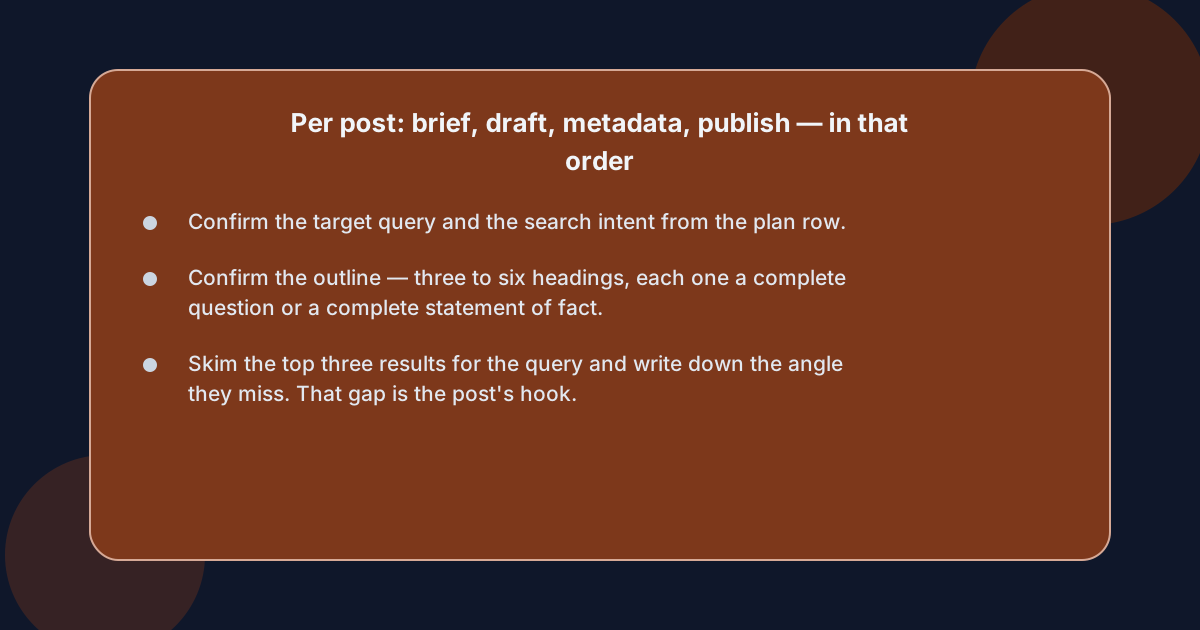 A per-post checklist is the difference between a post that ranks in six months and a post that ranks never, because most ranking failures happen before the draft is written. Treat each post as a small project with four stages and a single definition of done for each.
1. Brief (15 minutes, done before drafting)
- Confirm the target query and the search intent from the plan row.
- Confirm the outline — three to six headings, each one a complete question or a complete statement of fact.
- Skim the top three results for the query and write down the angle they miss. That gap is the post's hook.
- List the two or three internal pages this post will link to, and the one page that should link back.
2. Draft (two to three focused hours)
- Write to the outline, not past it. New headings mid-draft mean the brief was wrong.
- Cover each supporting term once, in the section it naturally belongs to. Do not add a "FAQ about keyword variants" section to chase variants.
- Add one concrete example, number, or screenshot per heading. Generic posts are the ones that never earn links.
3. Metadata (15 minutes, after the draft is done)
- Meta title with the query in it, under roughly 60 characters.
- Meta description that restates the query and promises the answer, under roughly 155 characters.
- URL slug that is the query in plain English, not a date or a category.
- Image alt text that describes the image, not the post.
4. Publish (15 minutes, on the scheduled date)
- Push the post live with the metadata already in place.
- Submit the URL for indexing in Search Console.
- Confirm the post appears in the sitemap.
- Mark the row as published in the plan.
Skipping stage 3 is the single most common reason a post underperforms. The page ranks for a slightly different query than the one the post actually answers, and the click-through rate never recovers. Treat metadata as part of the post, not as decoration.
Per month: read Search Console and re-prioritise the queue
The monthly review is where your content workflow instead of a publishing treadmill. Set a recurring ninety-minute slot in the calendar and treat it as a meeting with yourself.
The monthly SEO reporting checklist has four parts, in this order:
- Coverage. Which queries from the plan now have a page on the site, and which are still uncovered? Uncovered rows get earlier dates in the next quarterly refresh.
- Crawl and index. For each post published in the last 90 days, check whether it has been crawled and indexed. A post that is not indexed is not a ranking post yet. Request indexing for the ones that have stalled.
- Impressions and clicks. Look at the queries each post actually shows up for, not the ones the post was written for. New queries the post is earning are the most valuable signal in the entire workflow — they tell you what to write next.
- Re-prioritise. Move any row whose supporting terms are already earning impressions on another page to the back of the queue. Move any row that fills a gap the Search Console data exposed to the front.
Two practical details make the monthly review stick. First, Search Console data is delayed by two to three days, so the numbers you see on day one of the month are really last month's data; build that lag into the report rather than chasing noise. Second, the review outputs exactly two artefacts: a redated plan and a short note of "what to write next quarter". Anything beyond that is procrastination.
What to hand off first when you finally get help
The first hire or freelancer does not start by writing. They start by removing the steps that have been quietly eating the solo marketer's week. A clean hand-off keeps the workflow intact and gives the new person a job they can actually do.
In rough order of what to delegate first:
- The publish step. Pushing the post, the metadata, the image, the indexing request, and the sitemap update. It is mechanical, it is teachable in an afternoon, and it is the step that most often slips on a busy week.
- The metadata stage. Writing titles, descriptions, slugs, and alt text against a brief the marketer has already approved. This is where the per-post checklist pays for itself.
- The first draft from a brief. Only after steps 1 and 2 are owned by someone else does it make sense to hand the drafting itself to a writer. By that point the marketer is reviewing against a fixed brief, not chasing a vague topic.
- The quarterly planning session. Last, and only if the new person has seen two full cycles. Planning is the part of the workflow that is hardest to replace and the easiest to do badly.
What stays with the marketer throughout is the editorial direction: which queries matter, which gaps to fill, which posts to retire, and the monthly Search Console review that decides it. That is also where the editorial direction — the workflow was designed to make the remaining work the part that only the marketer can do.
Frequently asked questions
How many posts per week should a one-person team publish?
One post per week is the realistic ceiling for most solo marketers, with two buffer weeks per quarter for rewrites and deeper sources. Forty rows per year is enough to build topical authority on two or three sub-themes without the calendar becoming a wish list. Going faster almost always means the publish step starts slipping, and the publish step is the one that decides whether the post ranks.
What should a quarterly content plan include for one person?
Each row should carry eight decisions: target query, search intent, supporting terms, outline, meta title and description, internal links, format and depth, and a publish date. Topics without a target query are not rows — they are ideas for the next planning session. A complete walk-through of these fields is in the SEO content plan guide.
How do I measure whether the SEO content is working as a solo marketer?
Use a short monthly Search Console review, not a dashboard. For each post published in the last ninety days, check whether it has been indexed, which queries it is earning impressions for, and whether any of those queries are new. Two artefacts come out of the review: a redated plan and a short note on what to write next quarter. Search Console data lags by two to three days, so build that delay into the report rather than reacting to it.
When is it worth hiring help for a one-person content operation?
When the publish step is the part that slips most often. The first hand-off should be the mechanical publish work — pushing the post, the metadata, the indexing request, and the sitemap update. Drafting should be the last thing delegated, because it only works once everything upstream is owned by someone else.
Does a one-person SEO workflow scale when the team grows?
Yes, if it was built on a plan rather than on a to-do list. The cadence in this post — quarterly plan, weekly pick, per-post checklist, monthly review — is the same shape an agency uses per client site, with separate calendars and separate reviews. The growth move is to multiply the cadence, not to redesign it.
See the eight decisions that should sit on every row of your plan in the SEO content plan guide, and copy the cadence into your own calendar.