
What an automated SEO content service actually does for you

Most "automated content" tools stop at the draft. The differentiator is whether someone else also publishes the post to your domain, on a date you picked. An automated SEO content service is a software product that plans, writes, and publishes search-optimised articles to a blog on your own website, with editorial decisions made in advance and a calendar you control — not a chatbot that hands you a text file.
Table of contents
- Key takeaways
- What 'automated SEO content' usually means in this market
- What gets automated vs what stays a human decision
- How the plan is built before any writing starts
- How publishing on your own domain works end to end
- What an automated service will not do for you
- How to evaluate one before you commit
- Frequently asked questions
- Frequently asked questions
- Sources
Key takeaways
- The plan is the product: every post is scoped by a target query, search intent, supporting terms, outline, meta title and description, internal links, and a publish date before any writing starts.
- Publishing happens on your domain, not on the vendor's, so SEO value accrues to the site you actually sell from.
- A serious service separates what it automates (research, drafting, metadata, scheduling) from what stays a human decision (query choice, outline shape, brand voice, approvals).
- Free-tier content on a vendor subdomain cannot rank the way content on your own apex or subdomain can, because authority is a property of the publishing domain.
- The right questions to ask are about the plan, the publish path, and the post-publish reporting — not about word counts or "AI models".
What 'automated SEO content' usually means in this market
An automated SEO content service is software that produces search-optimised articles on a schedule, from a plan you approve, and publishes them to a blog hosted on a domain you control. In practice it combines four jobs that used to be done by separate freelancers and tools: keyword and query research, content planning, article writing with metadata, and publishing to a site the vendor does not own.
The term covers a spectrum. On one end are tools that only generate text on demand and leave publishing, scheduling, internal linking, and on-page metadata to the user. On the other end are end-to-end platforms that read your existing site, propose a plan, draft each post to a fixed brief, and ship the finished article with images and meta tags to your CMS on a date you approve. The four secondary terms that buyers search for — automated SEO blog writing, AI SEO content platform, SEO content as a service, and hosted SEO blog on your domain — describe different slices of that spectrum. They overlap, but they are not the same thing, and the differences decide what you actually get.
What gets automated vs what stays a human decision
The work splits cleanly along a fault line between repeatable production work and one-off judgement calls. The repeatable side is what an automated SEO content service is for; the judgement side is what it is not for.
What it does automate: pulling the queries a site already answers, finding the ones it is missing, drafting the outline and the supporting terms for each post, writing the article to that brief, generating the meta title and description, producing or sourcing the images, building internal links to pages that already exist on the site, and pushing the finished post to the blog on the date in the calendar. None of those steps is unique once the brief is set, which is why they scale.
What it does not automate: choosing which queries matter for the business, deciding the angle a post should take when several are possible, signing off on the plan before writing starts, accepting that a post is on-brand, and approving publication. A platform can surface all of those decisions, but a human still has to make them — or the calendar fills with content nobody approved. The plan is the moment those decisions are made, while changing them is still cheap. A working seo content plan lists every post as eight decisions made in advance, from target query to internal links to publish date.
How the plan is built before any writing starts
The plan is built by reading the site you connect and the queries it already serves, then turning the gaps into dated posts. Three steps matter, and they happen in this order.
First, the service reads the publicly served pages and the sitemap of the site you connect, so it knows what the blog already covers and which queries those pages are aimed at. Second, it cross-references that against a query source so it can see which searches the site is missing — terms with demand that none of the current pages answer well. Third, each gap becomes a row in a dated editorial calendar: target query, search intent, supporting terms, outline, meta title, meta description, internal links, and a publish date. Nothing in that row is left vague, because vague rows turn into vague posts.
This is also where the cost conversation starts to make sense, because the work before the draft is most of the work. When you compare two quotes for SEO content, the meaningful difference is usually what sits behind each line — whether the supplier is doing this pre-writing work, or whether they are charging per word and skipping it.
How does the service decide which queries to target first?
It ranks the gaps by the strength of the signal that the site can win the query — usually a mix of existing relevance, topical proximity to pages already ranking, and the cost of producing the post (a thin listicle is cheap; a primary-source comparison is not). The output is a calendar, not a backlog: every row has a date, so capacity is visible before the writing starts.
How publishing on your own domain works end to end
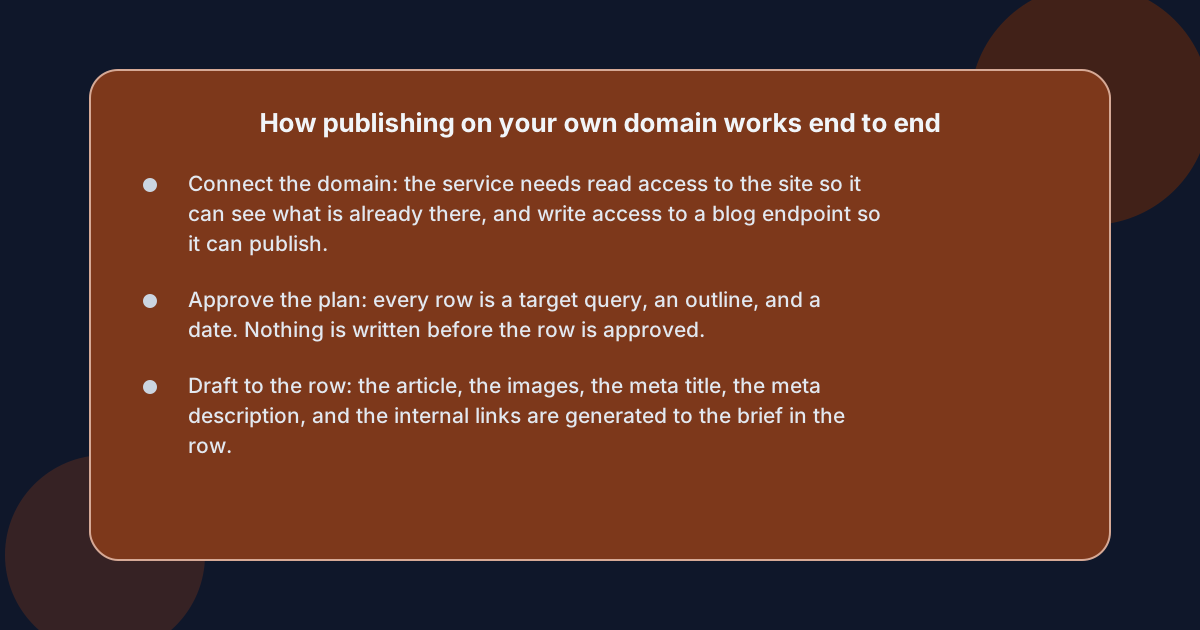 The end-to-end flow has six steps, and the order is not negotiable. Skip a step and the post either does not rank, or it ranks on the wrong site.
- Connect the domain: the service needs read access to the site so it can see what is already there, and write access to a blog endpoint so it can publish.
- Approve the plan: every row is a target query, an outline, and a date. Nothing is written before the row is approved.
- Draft to the row: the article, the images, the meta title, the meta description, and the internal links are generated to the brief in the row.
- Review window: a human reads the post, requests changes if needed, and approves it for publication.
- Publish on the date: the post goes live on the connected domain at the time the row says.
- Report after publish: search-console data for the post feeds back into the next planning cycle, so the next batch is informed by what the last batch did.
A well-built SEO content brief is the part that makes the rest of the loop work., because publishing is the moment the work becomes indexable. Drafts in a vendor dashboard do not rank.
What does "your own domain" actually look like in practice?
It means the blog lives on a subdomain or subdirectory you control, on a domain that already has authority with search engines — not on a vendor property. The article URL ends in your brand, the analytics fire into your account, and the backlinks the post earns accrue to your site. That is why free content on a vendor URL is not a substitute, even if the writing is identical.
What an automated service will not do for you
A clear list is useful, because most mismatched expectations come from overpromising on either side.
- It does not pick the business strategy. The service can find queries and rank them, but it cannot tell you which product line to build content around.
- It does not guarantee rankings, traffic, or revenue. Search engines decide what ranks; the service can only do the work that makes ranking possible.
- It does not replace legal, financial, or compliance review for posts that touch regulated topics. A draft is a draft.
- It does not invent first-party facts it cannot verify. If a post needs a number from your business, that number has to come from you.
- It does not publish without your approval. The approval gate is the contract: if a row is approved and the date passes, the post ships.
That last point is the one most often skipped in pitches, and it is the one that decides whether a service is actually automated end to end, or only automated up to the draft. Approval is a workflow, and the workflow has to be designed.
How to evaluate one before you commit
Five questions are worth asking before you sign anything, and they map one-to-one to the steps above. A "yes" to each one is a working service; a "no" is a gap you will fill yourself.
- Can I see the full plan before any writing starts, and is each row scoped to a single query with intent, outline, meta and links?
- Where do the posts live when they go live — on my domain, on a subdomain I control, or on yours?
- Who approves publication, and is there a review window between the draft and the publish date?
- What happens to the post after it is indexed — is there a reporting view that ties each row to its search-console numbers?
- If a post underperforms, can it be updated or retired, and does the calendar adjust?
The same five questions also expose the difference between a tool and a service. A tool hands you the draft; a service takes responsibility for the loop. A short SEO content workflow you can run as one person is a useful reference for the loop a platform has to fit into., or whether you are about to add a second loop on top of it.
Frequently asked questions
What is an automated SEO content service?
An automated SEO content service is a software platform that plans, writes, and publishes search-optimised articles to a blog on your own domain, using a pre-approved editorial calendar. The defining feature is that publishing happens on your site on a date you set, not that text is generated faster.
How is it different from an AI writing tool?
An AI writing tool produces text on demand and stops there. An automated SEO content service adds the layers that decide whether the text is useful: a per-post plan with a single target query, meta tags, internal links, images, a review step, and a scheduled publish to your own domain.
Does an automated service actually rank posts?
It can do the work that makes ranking possible — query targeting, on-page optimisation, internal linking, and publishing on an authoritative domain — but no service can guarantee a position in search results, because search engines decide ranking. The contract is about the work, not the outcome.
Will the content live on my domain or on the vendor's?
On yours, on a subdomain or subdirectory of a domain you already own. That is what makes the content compound in search over time, because authority is a property of the publishing domain, not of the writer.
How much of the process should be automated?
The repeatable parts: query research, outline drafting, writing to the brief, meta tags, image selection, internal linking, and scheduled publishing. The non-repeatable parts — choosing the queries that matter, approving the plan, reviewing the draft — stay human, because they are judgement calls.
Frequently asked questions
What is an automated SEO content service?
An automated SEO content service is a software platform that plans, writes, and publishes search-optimised articles to a blog on your own domain, using a pre-approved editorial calendar. The defining feature is that publishing happens on your site on a date you set, not that text is generated faster.
How is it different from an AI writing tool?
An AI writing tool produces text on demand and stops there. An automated SEO content service adds the layers that decide whether the text is useful: a per-post plan with a single target query, meta tags, internal links, images, a review step, and a scheduled publish to your own domain.
Does an automated service actually rank posts?
It can do the work that makes ranking possible — query targeting, on-page optimisation, internal linking, and publishing on an authoritative domain — but no service can guarantee a position in search results, because search engines decide ranking. The contract is about the work, not the outcome.
Will the content live on my domain or on the vendor's?
On yours, on a subdomain or subdirectory of a domain you already own. That is what makes the content compound in search over time, because authority is a property of the publishing domain, not of the writer.
How much of the process should be automated?
The repeatable parts: query research, outline drafting, writing to the brief, meta tags, image selection, internal linking, and scheduled publishing. The non-repeatable parts — choosing the queries that matter, approving the plan, reviewing the draft — stay human, because they are judgement calls.