
How long SEO content actually takes to show results

Most timelines you read online are either too optimistic to sell you a tool or too pessimistic to sell you an agency. The honest answer to how long does seo take to show results is that meaningful, measurable movement rarely shows up before month three, gets interesting between months three and six, and only starts compounding somewhere in the second half of the year. New pages take longer than old ones, low-competition queries move faster than head terms, and the cadence you publish at is the single biggest lever you actually control.
Table of contents
- Key takeaways
- The honest shape of an SEO results curve
- What 'results' means: impressions, clicks, and leads
- Months 1 to 2: what a publishing cadence does to your site
- Months 3 to 6: when queries start ranking and earning clicks
- Months 6 to 12: how compounding actually shows up
- What slows it down and what speeds it up
- A simple way to read your own progress
- Frequently asked questions
- Sources
Key takeaways
- Expect a crawl and index cycle of days to weeks before Google even knows a new page exists; ranking is a separate, slower process on top of that.
- The first signal of progress is usually impressions in Search Console, not clicks — impressions can climb in months two and three even when clicks stay flat.
- Clicks from queries you deliberately target tend to arrive between months three and six for low-competition terms, and between months six and twelve for anything competitive.
- Compounding shows up when older posts start ranking for queries you never planned for, which is why a steady seo content plan matters more than any single post.
- Publishing cadence is the variable that actually moves the curve; the gap between "one post a month" and "two posts a week" is visible in the data within a quarter.
The honest shape of an SEO results curve
The SEO results curve is not a straight line, and it does not start at zero traffic on day one and finish at a million visitors on day 365. It is closer to three flat-ish phases followed by one that bends upward: a crawl-and-index phase where nothing visible happens, an early-signals phase where impressions quietly accumulate, a click phase where real visits start to land, and a compounding phase where old posts begin doing work you did not plan for. Understanding that shape is what keeps you from quitting at month two or overspending at month ten.
The reason the curve looks like this is that Google has to find the page, decide it is worth indexing, evaluate it against everything else on the topic, test it with searchers, and only then start giving it placement. According to Google Search Central, crawling and indexing are the entry conditions for ranking — they are not the same thing as ranking, and they happen on a different timeline. Ahrefs' study of ranking pages found that the average age of a top-10 result is over two years and the average age of a number-one result is closer to three, which is why realistic timelines for new content are measured in months, not weeks.
A useful mental model: months one and two are about Google learning your site, months three to six are about Google testing your pages, months six to twelve are about Google deciding which queries to keep you on, and beyond that is where the curve actually bends.
What 'results' means: impressions, clicks, and leads
Before you can read a timeline, you have to agree on what "results" means, because the three common answers move on completely different schedules. An impression is a time your page appeared in a search result, whether anyone clicked or not; a click is a visit; a lead is someone who did something you care about, like signing up or buying. Each one is a different layer of the funnel and each one arrives later than the last.
This distinction matters because most frustration with SEO timelines comes from measuring the wrong thing. If you only watch clicks, the first two months look like nothing happened. If you only watch leads, the first six months can look like nothing happened. Impressions are the leading indicator; clicks follow them with a lag; leads follow clicks with another lag, and that lead lag is shaped by your offer and your page, not by Google.
For a brand-new page on a domain Google already trusts, the order tends to be: impressions in weeks two to six, clicks from months three to six on long-tail queries, broader clicks from months six to twelve, and leads — if the page is built to convert — somewhere inside that window or just after it.
Months 1 to 2: what a publishing cadence does to your site
In the first one to two months, almost no individual post is going to rank for anything that matters, and that is normal. What you are actually doing in this window is training your own publishing system and giving Google a reason to keep coming back to your domain. The work that matters here is cadence, internal linking, and making sure every post is technically clean enough to be crawled and indexed.
A consistent publishing cadence is the variable that shows up in the data fastest. A site that ships two posts a week for eight weeks has given Google ninety-six new reasons to crawl it; a site that ships two posts in eight weeks has given it two. Both are technically "publishing SEO content," but the crawl budget, the index footprint, and the internal-link graph of the first site are an order of magnitude larger. If you are running content for multiple clients, this is also where a per-site calendar starts to pay off, because running every client's blog from one plan is really about not letting any single site's cadence drift.
You should expect to see your first impressions in this window — usually small numbers, often on queries you did not target, sometimes on snippets of your title or on a question you answered in passing. That is not a failure; that is the curve starting.
When does Google even know my new post exists?
Google usually finds a new post within days if your sitemap is healthy and your home page links to the category or tag page that links to the post, but "found" is not the same as "indexed." Indexing can take days to weeks, and it depends on perceived quality signals, duplication, and how often Google crawls your site. Google Search Console's URL Inspection tool is the only honest way to confirm whether a specific URL is currently in the index.
Months 3 to 6: when queries start ranking and earning clicks
This is the window where the publishing-cadence-first approach starts to become visible to other people, not just to you. Somewhere in months three to six, pages you published in month one start to rank on page two or three for their target queries, and a meaningful share of them move to page one for the long-tail variants you covered inside the post. You will see clicks rise first on the queries with the lowest competition — the four- and five-word questions, the specific how-tos, the comparisons.
The thing that surprises most teams in this phase is that the queries bringing clicks are often not the headline query of the post. The headline query might still be stuck on page three, while a subheading you treated as supporting copy is quietly pulling in a click a day. That is normal and it is one of the strongest signals that your content is being understood by Google as covering a topic, not just a single string of words.
Realistically, by the end of month six, a well-run blog on a domain with some existing authority should be seeing a steady, low-volume stream of organic clicks — dozens a day is a healthy number, hundreds a day is excellent for a site that started from near-zero six months earlier.
Months 6 to 12: how compounding actually shows up
Months six to twelve are where the curve stops looking flat and starts looking like a curve. Two things are happening at once: the posts you wrote in months one and three have had time to accumulate internal links, backlinks, and behavioural signals, and the cumulative size of your site means Google is treating you as a topical source rather than a one-off publisher. Both effects compound.
The first sign of compounding is that older posts start ranking for queries you never wrote a target keyword for. You wrote a beginner's guide in March, and by October it ranks for a comparison query, a how-to query, and a "vs" query you have never built a page around. The second sign is that new posts you publish rank faster than the ones you published in month one, because the domain now has the history and the internal-link density to support them. This is the one-person SEO content workflow pattern that turns content from a cost into an asset.
By month twelve, the honest benchmark for a focused, consistently published blog is that organic traffic should be a meaningful share of total traffic, that several posts should be ranking in the top ten for non-branded queries, and that you should be able to point to specific posts that drive leads, not just sessions.
What slows it down and what speeds it up
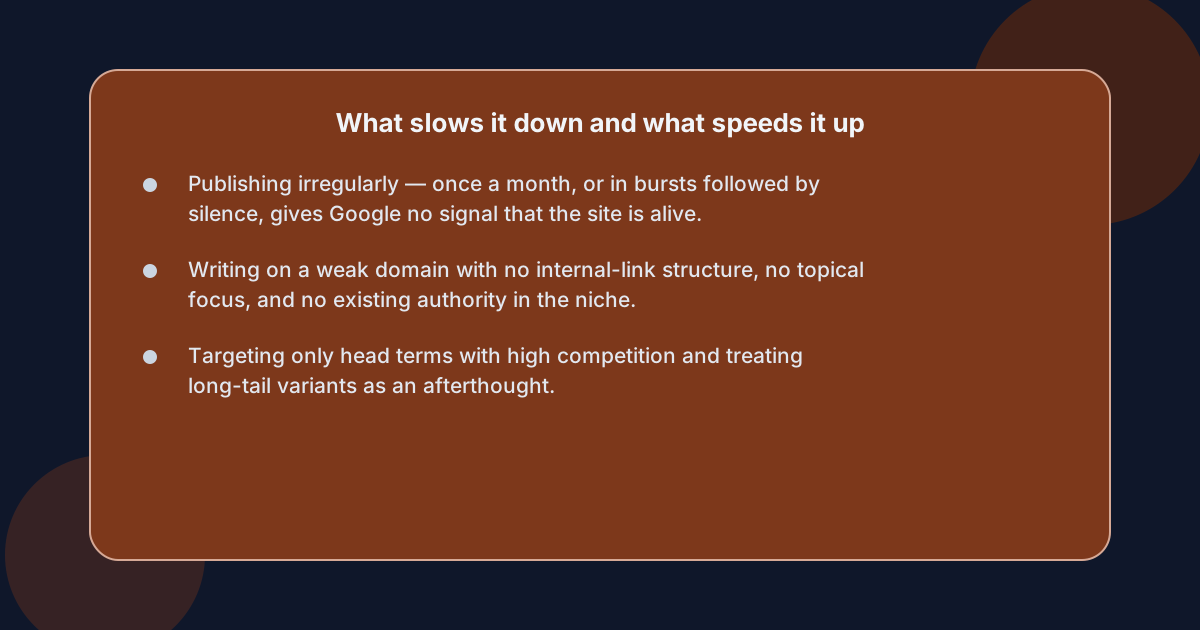 Every realistic SEO timeline has the same shape, but the speed of the curve varies by a factor of three or four between a fast-moving site and a slow one. The variables that move the timeline are well known, and most of them are under yours, not Google's.
The things that reliably slow SEO down:
- Publishing irregularly — once a month, or in bursts followed by silence, gives Google no signal that the site is alive.
- Writing on a weak domain with no internal-link structure, no topical focus, and no existing authority in the niche.
- Targeting only head terms with high competition and treating long-tail variants as an afterthought.
- Letting technical issues pile up: slow pages, broken internal links, canonicals pointing at the wrong URL, or pages blocked from indexing.
- Rewriting or moving URLs on a live post before it has had time to rank, which resets the clock.
The things that reliably speed it up:
- A planned cadence you can actually keep, even if it is modest — two posts a week beats eight posts in week one and zero in week three.
- A clear topical focus per section of the site, so every post reinforces the others instead of competing with them.
- Internal links from older, more authoritative posts to newer ones, which is one of the few signals you fully control.
- Targeting the long-tail version of a query first and building the post so it can rank for the head term later.
- Publishing on a domain with a clean history, real traffic, and a sitemap that Search Console can read.
None of this is a hack. It is what the curve looks like when the inputs are right.
How long for blog posts to rank on a brand-new domain?
For a brand-new domain with no existing authority, double every number above. Crawling still happens in days, indexing in weeks, but the first meaningful clicks from non-branded queries tend to land somewhere between months six and twelve, and the compounding phase often does not really start until year two. The fastest way to shorten that is to start with very specific, low-competition queries and to publish more often than feels comfortable, because cadence substitutes for authority in the early months.
A simple way to read your own progress
The reason timelines feel dishonest is that most of them measure the wrong thing on the wrong date. A clean way to read your own progress is to fix the metric in advance, log it monthly, and resist the urge to change the question when the answer is slow. The metrics that matter, in order of when they show up, are:
- Indexing rate: what percentage of pages you published are actually in Google's index four weeks later. If this is below 80 percent, nothing else matters yet.
- Impressions over time: total impressions in Search Console, broken out by query. This is the leading indicator and it should be growing even when clicks are flat.
- Average position for target queries: tracked per post, not averaged across the site. A post moving from position 34 to position 14 is real progress that does not yet show up in clicks.
- Click volume on long-tail queries: the first click signal, usually appearing before the headline query starts to rank.
- Click volume on target queries: the headline metric, usually arriving last and only after the previous four have moved.
If you do this once a month for twelve months, you will see the shape of the curve described in this article — flat, then impressions, then long-tail clicks, then target clicks, then compounding. You will also see exactly which months your publishing cadence slipped, because those months show up as a flat spot in the impressions line two months later.
The last thing worth saying is that an SEO timeline is not a sales pitch and not a warning. It is a description of what happens when a working publishing system meets a real search engine, and the only honest way to shorten it is to publish more, link better, and pick queries you can actually win.
Frequently asked questions
How long does SEO take to show results on a new website?
For a brand-new domain, expect three to six months before meaningful impressions turn into clicks on non-branded queries, and six to twelve months before traffic becomes a real channel rather than a trickle. The first month or two are almost entirely about Google learning the site, not about ranking anything.
How long for blog posts to rank for competitive keywords?
Competitive head terms — single-word or two-word queries with thousands of monthly searches — usually take twelve months or more for a new post to crack the top ten, and that is on a domain with existing authority. On a new domain, plan for eighteen to twenty-four months, and build the post to win the long-tail variants in the meantime.
Does publishing more often make SEO work faster?
Yes, within limits. Going from two posts a month to two posts a week will visibly move the curve within a quarter, because Google crawls more often, your topical coverage grows faster, and you have more internal links to give. Going from two posts a week to ten a week has diminishing returns once the underlying topical structure and authority cannot support the volume.
Why do some sites seem to rank in weeks while others take months?
Usually because the fast-ranking sites already had authority, backlinks, and a topical focus before they started, while the slow ones are either new, off-topic, or fighting against technical debt. There is also a survivorship bias in the "I ranked in two weeks" stories, because the hundreds of posts that did not rank in two weeks are not the ones being shared.
When should I give up on a post that is not ranking?
Do not give up before month six. A post that has been live for six months, has internal links pointing to it, has been re-crawled recently, and is still on page three for its target query is probably targeting a query it cannot win, and the right move is usually to redirect it, merge it into a stronger post, or rewrite it around a more realistic query — not to delete it.