
SEO Blog Post Writer: What They Do and How to Brief One

An SEO blog post writer sounds like a single job title, but it's actually a stack of responsibilities — research, briefing, drafting, optimization and iteration — that most teams split across several people. Knowing what the role really covers is the first step to hiring, briefing or becoming one, because the gap between "writer" and "SEO blog post writer" is the gap between a post that goes live and a post that earns traffic.
Table of contents
- Key takeaways
- What does an SEO blog post writer actually do?
- SEO blog post writer vs. content writer vs. copywriter — what's the difference?
- The SEO blog post writer's workflow, from query to published post
- What good output from an SEO blog post writer looks like (and what it doesn't)
- How to write an SEO blog post brief a writer will actually follow
- Common mistakes SEO blog post writers make — and how to avoid them
- Frequently asked questions
- Sources
Key takeaways
- An SEO blog post writer owns the whole path from a single target query to a published, measurable post — not just the draft.
- The role blends research, structure, on-page optimization and editorial judgment; treating it as "writing with keywords" is the most common cause of underperforming posts.
- A usable brief beats talent alone: target query, search intent, outline, meta data and internal links decided before the draft starts.
- Good output is identifiable on the page — answer-first structure, intent matched to format, no orphan sections, metadata written for the click.
- The biggest mistakes are made before a word is drafted: a vague brief, a competing outline, or a target query that the site already covers badly.
What does an SEO blog post writer actually do?
An SEO blog post writer is the person who turns one target query into one published post that earns organic traffic — owning the research, the structure, the on-page signals and the metadata, not just the prose. In small teams the role also covers editorial planning, internal linking and the loop back from search-console data after publication.
The job is closer to product work than to copywriting: every decision is made against the search result the page has to win. That means starting from a specific query written the way people type it, identifying what the reader actually wants when they type it, and shaping an outline that delivers that before it delivers anything else. Meta title, meta description, heading hierarchy, internal links and the answer to the supporting questions all sit inside the brief rather than the draft, because they are cheap to change at the planning stage and expensive to change after publication.
Three things distinguish the role from generic writing:
- It is tied to a search query, not to a topic. A blog writer can take a brief like "write about caching"; an SEO blog post writer takes a brief like "write the page that wins 'seo blog post writer job description'".
- It treats the search result as a competitor. The first ten results, the featured snippet, the "People also ask" questions and the AI summaries are the reference set. The post has to be more useful than them, not just longer.
- It closes the loop. A draft that ships without being measured against clicks, impressions and average position is half a job — the same query and the same outline will quietly drift out of date otherwise.
That scope is why a useful SEO content plan lists the decisions per post — query, intent, supporting terms, outline, meta data, internal links, format and publication date — before anyone is asked to write a sentence.
SEO blog post writer vs. content writer vs. copywriter — what's the difference?
The three titles overlap in practice but carry different promises: a content writer produces editorial that informs or engages, a copywriter writes to make the reader do something, and an SEO blog post writer writes specifically to win a defined search query and earn organic traffic over time.
The distinction matters most when teams are deciding who owns what. A homepage rewrite is copywriting: the goal is a click, a signup or a sale. A feature announcement is content writing: the goal is context, story and brand. A post that targets "how to brief an SEO blog writer" is the third thing — the goal is to rank for that query, satisfy the reader, and pull them into the rest of the site. Conflating the three usually produces a post that reads well but does not rank, or a page that ranks but does not convert.
The table below summarizes where the responsibilities actually split. It is deliberately qualitative, because the practical boundaries vary by team and by seniority.
| Responsibility | Content writer | Copywriter | SEO blog post writer |
|---|---|---|---|
| Picks the topic | Often | Rarely | No — assigned from the plan |
| Wins a search query | Sometimes | Rarely | Yes — the central job |
| Owns meta title and description | Sometimes | Sometimes | Yes |
| Builds the outline from search results | Sometimes | Rarely | Yes |
| Closes the loop with search-console data | Rarely | Rarely | Yes |
| Writes to convert in-page | Sometimes | Yes | Only where the brief asks for it |
| Sets publication date and target query | No | No | Yes |
In agencies and small marketing teams the roles are routinely merged onto one person. That is fine if the brief is tight; it is expensive if the brief is loose, because the SEO half of the job is the part that quietly disappears under deadline pressure.
The SEO blog post writer's workflow, from query to published post
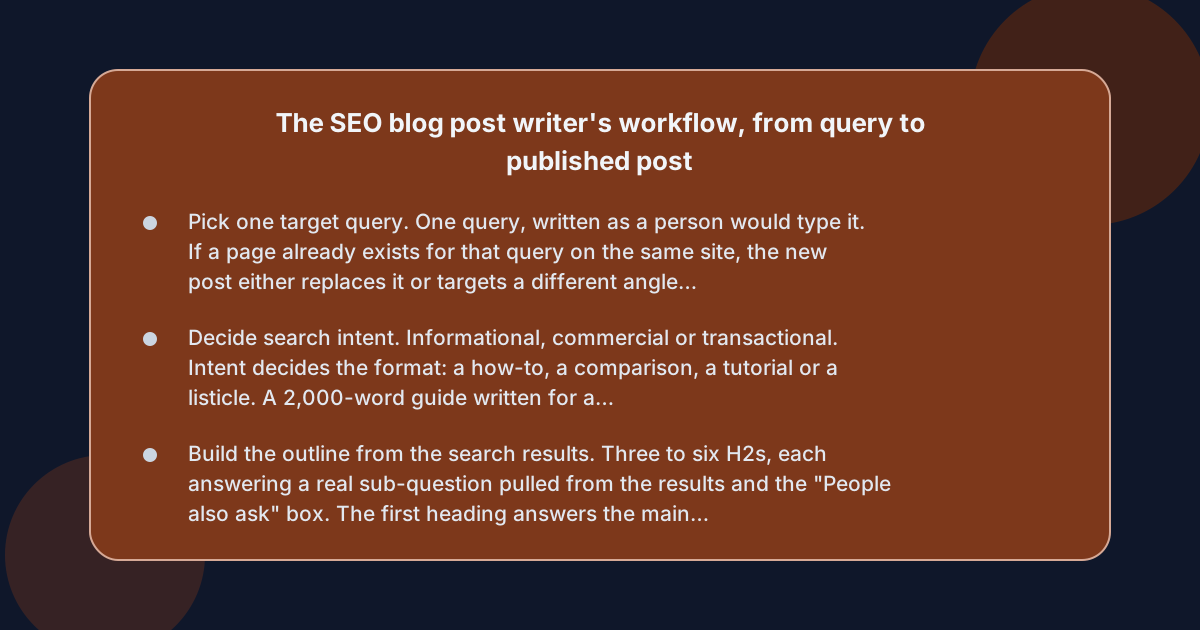 A reliable SEO blog writing workflow has seven stages, and the first three happen before any prose is written. Skipping straight to the draft is the single most common reason a post reads well and ranks nowhere.
- Pick one target query. One query, written as a person would type it. If a page already exists for that query on the same site, the new post either replaces it or targets a different angle — it does not compete.
- Decide search intent. Informational, commercial or transactional. Intent decides the format: a how-to, a comparison, a tutorial or a listicle. A 2,000-word guide written for a transactional query will lose to a 600-word product page, every time.
- Build the outline from the search results. Three to six H2s, each answering a real sub-question pulled from the results and the "People also ask" box. The first heading answers the main query directly — that is the candidate for a featured snippet.
- Draft to the outline. Every heading earns its place by answering the sub-question it promises. Off-topic asides, repeated points and section intros that delay the answer all cost ranking signals.
- Layer on-page signals. Meta title and description, internal links to the pages the site actually serves, structured data where relevant, and image alt text. These are decided in the brief, not improvised at the end.
- Publish on the planned date. Canonical URL, sitemap update and (where possible) a Search Console request for indexing — equity stays on the domain the post lives on.
- Measure and iterate. Clicks, impressions and average position after a few weeks. Queries the post is gaining impressions for but not clicks point to a metadata problem; queries where it ranks on page two point to a depth or structure problem.
The same workflow runs at different cadences. A solo founder publishing two posts a month runs it on a notebook. A team publishing twenty runs it inside an editorial calendar where each entry already carries the query, intent, outline and date — which is what a real blog editorial line looks like once the planning is out of the writer's head and onto the page.
What good output from an SEO blog post writer looks like (and what it doesn't)
Good output is recognizable before you finish reading it: the first paragraph answers the query, the headings map to the questions a real person asked, and the post links to pages the site actually wants to send traffic to. It also ends with the meta data written for the search result, not for the brand.
Concrete signals to look for:
- The target query appears in the first 100 words, in at least one heading, and in the meta title — written as prose, not pasted as a phrase.
- Each H2 is a complete, self-contained answer to a sub-question, so the section still makes sense quoted out of context (that is how featured snippets are extracted).
- Internal links point at pages the site serves and that the reader would actually want next — a relevant product page, a sibling post, a documentation page — not at the homepage or the contact form.
- Meta title and description are written for the click in the search result, not for the brand name. Google's own guidance is that a meta description should summarise the page accurately enough that a reader knows what they will get if they click (Google Search Central, "How to write quality meta descriptions").
- The post is dated, the outline is dated, and the publication date is on the calendar — because posts that drift past their date are the ones that quietly lose to fresher results.
What good output does not look like is easier to spot in the wild than to describe in the abstract. It is a post that opens with two paragraphs of scene-setting before the first heading; an outline where two H2s answer the same question; a meta description that starts with the brand name and a generic tagline; a post that links only to other posts on the same topic and never to the page the reader is meant to take next. None of these are writing problems — they are planning problems that survived into the draft.
How to write an SEO blog post brief a writer will actually follow
A brief that gets followed is the brief that makes the draft easy to write. It decides everything that is expensive to change later — query, intent, outline, metadata, internal links and date — and leaves only the prose for the writer. The cheapest version is a one-page template; the strongest version is a row in an editorial calendar where every field is already filled in.
A usable template has nine fields. None of them is optional:
- Target query. One query, written as a person types it.
- Search intent. Informational, commercial or transactional — and the format that matches it (how-to, comparison, listicle, tutorial).
- Supporting questions. The "People also ask" entries and the sub-questions the post should also answer, so it does not have to be rewritten when a new one appears.
- Outline. Three to six H2s, each phrased as the answer to a sub-question.
- Meta title. Written for the click, with the query in it.
- Meta description. A 1–2 sentence summary that earns the click.
- Internal links. The pages the post should link to — usually one to a relevant product or service page, one to a sibling post, one to a documentation page.
- Format and depth. A reference post the writer can match in shape — not in wording.
- Publication date. A date attached to the entry, not to the draft.
If a brief arrives with the query and the deadline but nothing else, the writer will spend the first half of the project re-doing the planning you skipped. That is the part of SEO content cost that most quotes hide: the cheapest line on a quote is usually the one with the least brief behind it.
Two small rules make a brief noticeably more usable. First, give the writer the search result, not just the query — what the current page-one results look like, which ones are weak, which one the post has to beat. Second, name the page the reader should land on after this one, so internal linking is a decision, not an afterthought.
Common mistakes SEO blog post writers make — and how to avoid them
Most SEO blog post writer mistakes are made in the planning stage, not in the prose. The draft is where they show up; the brief is where they were created. Catching them early is the difference between a post that earns traffic for two years and a post that quietly decays on page two.
The five mistakes that come up most often:
- Vague target query. "Write about content marketing" is not a target query. A query has to be specific enough that one page can win it. If the brief cannot name the query, the post cannot be measured.
- Outline that competes with itself. Two H2s answering the same question, or an H2 that rephrases the title. The search result treats those as one signal, not two.
- Metadata written for the brand, not the click. Meta titles that lead with the company name and meta descriptions that read like taglines both lose impressions to results that describe what the page actually contains. Google's own guidance is to keep titles descriptive and concise (Google Search Central, "Influence your title links in Google Search").
- Internal links that go nowhere useful. Links only to other posts on the same topic, or to the homepage, are a missed chance to point the reader at the page the site actually wants them to take next.
- No loop back from search-console data. Posts that ship without anyone checking which queries they are appearing for — and which they are not — drift out of date. A 30-minute check, six weeks after publication, catches most of the rot.
The through-line is that an SEO blog post is a product with a query and a date, not an essay with a topic. Once the brief is treated that way, most of the common mistakes stop being tempting.
Frequently asked questions
What does an SEO blog writer do on a typical day?
An SEO blog writer spends the day moving posts through the workflow: researching the target query, building or refining the outline, drafting to the outline, writing metadata and internal links, and reviewing search-console data for posts already live. In smaller teams the same person also picks queries, runs the editorial calendar and publishes on the planned date.
How is an SEO blog post writer different from a content writer?
A content writer produces editorial that informs, engages or supports a brand — often without a specific search query attached. An SEO blog post writer is tied to a specific target query and is responsible for winning that query in organic search, which means owning the outline, the meta data, the internal linking and the loop back from search-console data.
What skills should an SEO blog post writer have?
The core skills are query research, search-intent analysis, outline construction from the current search results, on-page optimization (titles, headings, internal links, structured data), and the editorial judgment to know when a post is finished. Writing ability is necessary but not sufficient — most of the role is decided before the draft starts.
How do you brief an SEO blog writer well?
A good brief fixes the target query, the search intent, the outline, the meta title and description, the internal links and the publication date in advance, and gives the writer the current page-one results to beat. Anything left undefined in the brief is something the writer will have to decide under deadline pressure, and the SEO half of the job is usually the part that gets dropped first.
How much does it cost to hire an SEO blog writer?
The cost is driven by what is in the brief, not by word count. Per-word rates buy the least amount of thinking; per-article pricing tied to a brief is more comparable between suppliers; monthly retainers buy a cadence at a lower rate per piece. The cheapest line on a quote is usually the one with the least brief behind it.