
How to Build Buyer Personas for SEO Content

Buyer personas for SEO content help you connect each target query to a real person, buying stage, and business need. They turn broad audience assumptions into decisions about which searches to target, what information to include, and how to structure a page that attracts qualified buyers.
Table of contents
- Key takeaways
- What Are Buyer Personas in SEO Content?
- How to Identify the People Searching for Your Product
- How to Turn a Buyer Persona Into an SEO Content Plan
- What Information Should Every Buyer Persona Include?
- How to Validate and Update Buyer Personas?
- Frequently asked questions
- Sources
Key takeaways
- Build buyer personas from observed customer language, sales questions, support interactions, and search behavior—not demographics alone.
- Give every persona one primary search intent, a distinct set of problems, and clear content opportunities.
- Connect each persona directly to keyword research, content briefs, internal links, and conversion paths.
- Use a shared SEO buyer persona template so marketers can compare personas and act on them consistently.
- Review personas quarterly using search and sales evidence, then merge or split them when behavior no longer supports the original assumptions.
What Are Buyer Personas in SEO Content?
Buyer personas for SEO content are evidence-based audience profiles that connect a target customer to a specific search need, buying stage, objection, and content opportunity. Unlike a general audience description, a useful persona explains whom you are addressing, what they are trying to accomplish, and which page should help them move forward.
The purpose is not to create a detailed fictional biography. It is to make content decisions more consistent. A persona should help a writer decide which queries belong in a post, what questions to answer, which supporting pages to link, and what kind of evidence will make the page credible.
For example, consider a business selling project management software. “Small business owner” is too broad to guide keyword research. A more useful profile might be an operations manager at a 50-person company who currently relies on spreadsheets. Their searches would likely be problem-led, comparison-led, or solution-led rather than focused only on the software category.
A strong content strategy separates three connected but distinct elements:
- The audience member: the role, context, and goals of the person searching.
- The search intent: what the person expects the page to resolve.
- The content opportunity: the topic, format, and internal link that best satisfy that need.
This distinction matters because the same audience can search for different things at different times. A prospective buyer looking for a software category may need a comparison; an existing customer investigating an alternative may need migration guidance. One generic persona page for both groups would create diluted targeting.
Audience personas for content marketing become useful when they alter the editorial plan. If a persona has an urgent operational problem but a long, risk-sensitive evaluation, the content sequence should begin with educational material and move toward evidence, comparison, and evaluation guidance.
How to Identify the People Searching for Your Product
Identifying the people searching for your product requires evidence from three directions: what customers say, what buyers do, and what they type into search engines. Any one source can mislead you.
Which customer evidence should you collect?
Begin with records that already contain language from real buyers. Useful sources include:
- Sales-call notes and lost-deal interviews
- Support tickets and onboarding questions
- Email inquiries and chat transcripts
- Search queries submitted through your website
- Customer reviews, testimonials, and community discussions
- Interviews with customers who recently purchased
Look for repeated situations, triggers, and words rather than isolated statements. If several customers describe “getting approval from finance,” that phrase may reveal both a real obstacle and the language potential customers use in their research.
Avoid treating a CRM field as sufficient evidence. Job titles, company sizes, and industries can help organize data, but they rarely explain why someone searches. The useful details are behavioral: what changed, what became difficult, what deadline appeared, and what outcome the buyer needs.
How do search data and sales data fit together?
Buyer persona keyword research works best when search demand and commercial relevance are considered together. A query may have substantial volume but weak fit with your product. Another may have modest volume but express a problem your solution resolves.
Start with a broad export of relevant queries and classify each one by:
- Search intent
- Likely persona
- Funnel stage
- Topic or subtopic
- Current content gap
- Sales relevance
The classification should be based on observed language, not just your preferred narrative. Search-result pages, competitor articles, and sales conversations can reveal whether a term means something different in your market.
B2B buyer personas for SEO work particularly well at the level of a situation rather than an industry. “A marketing director at a financial services company” is still broad. “A marketing director who needs to prove campaign ROI to a CFO” gives the content planner a problem, evidence requirements, and buying concern to work with.
When should you create separate personas?
Create separate personas when different groups have materially different search behavior, purchasing authority, objections, or definitions of value. Keep them together when they use similar language, research in the same way, and make decisions through the same process.
A useful separation test asks four questions:
- Do they search for the same underlying problem?
- Do they need the same proof before buying?
- Do they evaluate similar alternatives?
- Does one sales message work for both groups?
If the answers are mostly yes, separate personas may create more maintenance than value. If the answers are mostly no, splitting prevents generic content and allows each page to answer a more specific need.
How to Turn a Buyer Persona Into an SEO Content Plan
A buyer persona becomes valuable when it produces editorial decisions. Each persona should map to a defined group of queries, a content role, a sequence of pages, and measurable signals of relevance.
Build a query-to-persona map
Create a table with one row per meaningful search theme. A useful SEO buyer persona template includes the following fields:
| Field | Decision it supports |
|---|---|
| Persona | Who the page should address |
| Core job or problem | Why the search matters |
| Primary intent | What the searcher expects to accomplish |
| Priority query | The main search the page should target |
| Supporting queries | Related questions the page should cover |
| Buying stage | Awareness, consideration, evaluation, or retention |
| Required proof | Evidence the reader needs |
| Content format | Guide, comparison, tutorial, or landing page |
| Internal links | Supporting and conversion paths |
| Conversion destination | The next relevant page or action |
Do not force every query into a persona merely to fill the table. Queries with weak persona fit can remain separate, especially when they have little commercial relevance.
Assign one page a clear job
Every page should have one dominant job. It might introduce a problem, explain a solution, compare options, demonstrate implementation, or address an objection. When one page tries to perform several jobs, its message becomes less coherent even if every section is useful.
A practical rule is to give each post one primary query and several supporting terms. If two personas require materially different pages, split them. If one person needs two related questions answered, combine them when the intent and structure remain coherent.
Sequence content around the decision
Personas rarely convert after one isolated page. Map the questions that precede a purchase:
- Recognize and quantify the problem
- Understand possible solutions
- Evaluate the options against specific criteria
- Verify implementation, risk, and fit
- Decide on the next step
This sequence helps distinguish pages that attract traffic from pages that move a qualified prospect toward a decision. It also reveals where internal links should connect informational content with solution pages.
When the same process applies to multiple buyer groups, a structured SEO content planning guide can keep query, intent, format, publication date, and internal-link decisions consistent.
Who should perform this work?
The work is best suited to a small team combining SEO strategy, customer research, and subject-matter expertise. In a growing company, that may mean an SEO strategist works with sales and customer success; in a smaller organization, the content lead may own the process with input from the founder or sales manager.
For teams that want to automate the repeatable planning and publishing work, xt4b finds missing buyer searches, plans and writes articles, and publishes them on the customer’s own domain after review. It is not intended for teams that want an entirely autonomous publishing pipeline without editorial control. Readers can create an account when the workflow is appropriate for their operation.
What Information Should Every Buyer Persona Include?
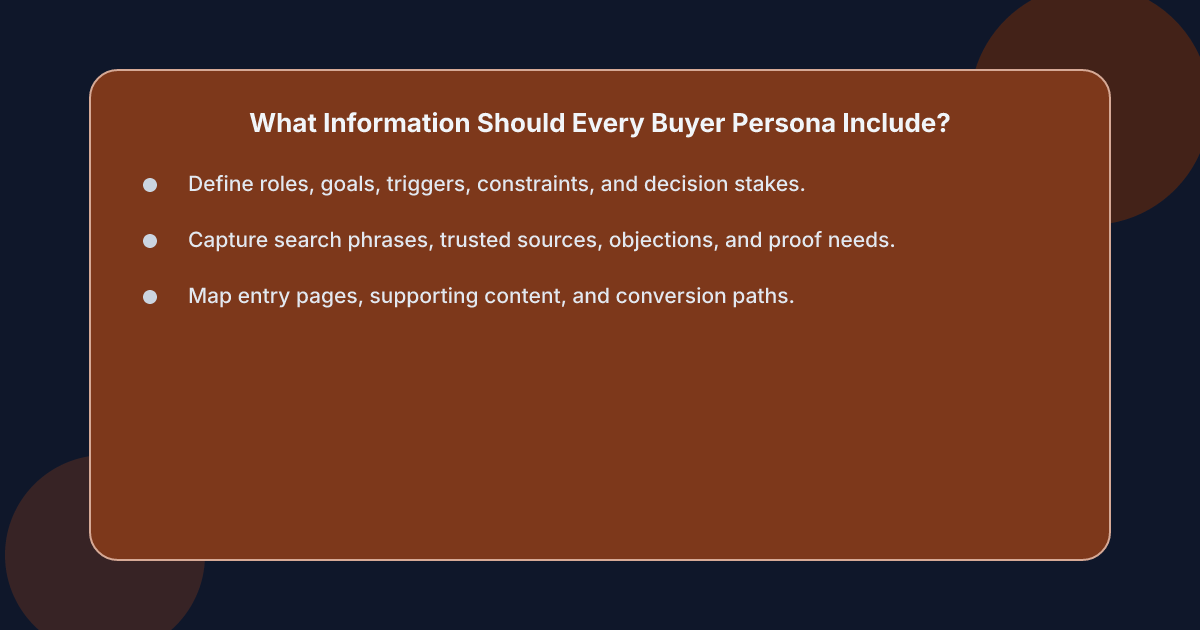 Every buyer persona should include enough evidence to guide keyword selection, content structure, and conversion decisions. Demographic fields are optional; goals, constraints, search behavior, and decision criteria are essential.
Context and role
Document the person’s role, seniority, industry or environment, and the stage at which they encounter the problem. Avoid assumptions presented as facts. Phrase uncertain details as hypotheses that require validation.
Useful context includes:
- The customer’s immediate responsibility
- The business goal they support
- The team or stakeholder involved in the decision
- The trigger that creates urgency
- The cost of leaving the problem unresolved
Goals, challenges, and objections
Record the outcome the person wants, the obstacles preventing progress, and the concerns that appear in evaluation. For B2B personas, operational constraints often matter more than age or location.
A strong problem statement follows this structure:
When [situation] occurs, [person] needs to [desired outcome], but [barrier] makes this difficult.
This format produces language that can guide headings and examples. It also helps identify whether the underlying query is educational, commercial, or transactional.
Search behavior and language
Document the phrases the persona uses, the sources they trust, the questions they ask, and the content they consume during research. Include vocabulary from sales calls and support conversations because this language may differ from the terms used internally.
Avoid prescribing every page format in advance. Use research to identify likely needs, then confirm the format through actual search results and performance evidence. A query asking “how to” may still reward a product-led comparison if that is what the results demonstrate.
Decision criteria and required proof
Explain how the persona evaluates options and what evidence would overcome an objection. Depending on the audience, proof might mean implementation guidance, security documentation, transparent comparisons, customer evidence, or a clear explanation of trade-offs.
Keep the persona practical. A page cannot address every possible concern, but it should list the concerns most likely to influence the next step.
Internal links and conversion paths
Define where the persona enters the site, which supporting pages answer adjacent questions, and what next step is genuinely relevant. If a reader is comparing methods, linking directly to a commercial product page may interrupt the task. A more useful path might connect to a guide, a comparison, and then an evaluation page.
Xt4b's blog is relevant when teams want each article to fit into a larger publishing system rather than operate as an isolated piece.
How to Validate and Update Buyer Personas?
Validate buyer personas by comparing their assumptions with sales conversations, customer behavior, search data, and content performance. A persona is a working model, not a permanent description of the market.
Use sales and customer evidence
Review recent calls, support requests, and evaluations for recurring language. If the persona assumes price is the main objection but conversations consistently identify implementation risk as the decisive concern, revise the profile and the content plan.
Ask sales and customer success teams to flag:
- Questions that appear repeatedly
- Assumptions that consistently prove wrong
- Terms customers use instead of internal terminology
- Objections that remain unresolved
- Differences between first-time and repeat buyers
Check the search data
Review query impressions, clicks, rankings, and on-site behavior for pages associated with each persona. Search demand can change as terminology, products, or audience priorities shift.
Do not use rankings alone to determine whether a persona is valid. A page can rank for a broad query while attracting readers with the wrong role or problem. Combine search data with sales feedback and on-site evidence such as the pages visitors continue to read.
Run interviews and message tests
Short interviews can test assumptions that operational data cannot reveal. Ask recent buyers what triggered their research, what they compared, which evidence they trusted, and what nearly stopped them from proceeding.
Message tests can also reveal whether the proposed persona language feels recognizable. Share a proposed value proposition or article outline with sales representatives, customers, or prospects and ask which benefits and objections they recognize. A weak response may indicate that the persona is too broad or incorrectly framed.
Set a review schedule
Review the persona framework quarterly and after meaningful changes in the product, market, or sales process. During each review:
- Check which assumptions have supporting evidence.
- Compare content performance with persona-defined goals.
- Review new sales and support language.
- Merge personas that behave similarly.
- Split personas whose needs have become materially distinct.
- Revise the associated queries, briefs, and internal links.
A persona should change when the evidence changes. Keeping an outdated framework can be more damaging than having no persona at all because the team may confidently optimize for the wrong customer.
Frequently asked questions
How many buyer personas should a B2B company create?
A B2B company usually needs enough personas to capture distinct buying situations, but not one persona for every job title. Begin with two to four and split them only when search behavior, evidence needs, objections, or decision processes differ materially.
What is the difference between a buyer persona and a target audience?
A target audience describes a broad group that a business wants to reach. A buyer persona adds decision context: the person’s situation, goals, language, search intent, objections, and evaluation criteria. It should therefore produce specific editorial and keyword decisions.
Should buyer personas be based on demographics?
Demographics can be useful when they affect buying behavior, but they should not be the foundation of a content persona. Goals, constraints, triggers, search behavior, and objections usually provide stronger guidance for keyword research and content structure.
How often should buyer personas be updated?
Review personas quarterly and whenever the product, market, pricing model, or sales process changes significantly. Search behavior, customer concerns, and competitor positioning evolve, so an old persona can send content teams toward irrelevant queries.
How do you connect buyer personas to keyword research?
Assign each persona a group of relevant queries, then map each query to an intent, buying stage, content format, and conversion path. Remove overlap where one page can satisfy the same intent, and split pages when different personas need materially different answers.