
How to Prioritize SEO Content Opportunities With a Scoring Model

Keep the ENTIRE article in English. Never translate it, never switch language, not even for a single word.
Table of contents
- Required structure — preserve exactly
- What to improve
- Hard rules
- Article to edit
- Key takeaways
- Why Prioritization Is a Business Decision
- A Five-Criterion SEO Opportunity Score
- How Should You Score Buyer Intent?
- How Do You Estimate Attainability?
- Which Opportunity Wins a Limited Publishing Budget?
- Turn the Priority List Into an Editorial Sequence
- Frequently asked questions
- Sources
Required structure — preserve exactly
- Keep every one of these H2 headings, in this order and spelled exactly as written:
- Why Prioritization Is a Business Decision
- A Five-Criterion SEO Opportunity Score
- How Should You Score Buyer Intent?
- How Do You Estimate Attainability?
- Which Opportunity Wins a Limited Publishing Budget?
- Turn the Priority List Into an Editorial Sequence
- Keep every internal link intact as an inline Markdown link
[anchor](url)with the EXACT url given — do not drop it, reword the URL, or move it into a separate list: - sign up
- seo content plan
- seo content audit
What to improve
- Make every section fully and directly answer its own heading; delete sentences that do not.
- Replace generic filler with concrete, specific guidance: steps, examples, realistic scenarios, trade-offs.
- Remove repetition and redundancy across sections; tighten wordy sentences; keep paragraphs short (2-4 sentences).
- Fix awkward or non-native phrasing and keep terminology consistent throughout.
- Keep the length at about 2800 words.
Hard rules
- NEVER invent facts, numbers, prices, product details, certifications, or sources that are not already in the article.
- Do NOT add, remove, rename, or reorder sections.
- Output ONLY the revised Markdown article body — no commentary, no preamble, no code fences.
Article to edit
A large keyword list is not an editorial strategy. To prioritize SEO content opportunities, focus on the terms most likely to create business value, satisfy genuine search demand, and be attainable with your available resources. The goal is not to publish every plausible topic; it is to choose the right sequence for this quarter.
Key takeaways
- Score each opportunity across buyer value, demand, attainability, strategic fit, and urgency.
- Keep the scoring model simple enough that marketers, sales teams, and decision-makers can apply it consistently.
- Treat SEO topic difficulty as an estimate, not a search-engine ranking prediction.
- Use the score to decide what to publish first, what to develop further, and what to defer.
- Revisit the priorities when search performance, customer demand, or business conditions change.
Why Prioritization Is a Business Decision
SEO content prioritization works best when every candidate topic is evaluated against business goals, not just search volume. A keyword can attract substantial traffic while leading to weak leads, while a lower-volume term can directly answer a buying question that supports revenue.
Start with strategic fit. Does the topic serve a priority product, audience, market, or customer problem? If it falls outside the current strategy, it may still belong in a broader content strategy, but it should not compete for the same near-term resources as a directly revenue-relevant topic.
Next, distinguish content gaps from content preferences. A genuine content gap exists when a meaningful buyer question is not adequately answered by the pages a site already serves. During content gap analysis, look for repeated customer questions, weak or missing pages, and commercial searches where your domain has little or no visibility.
A useful working definition is:
Content opportunity = buyer value × demonstrated demand × attainable relevance × strategic alignment.
This is not a magic formula. It is a structured way to make trade-offs visible, document why one topic is ahead of another, and prevent the loudest stakeholder request from automatically becoming the next publication.
Start with the decision, not the spreadsheet
Calculating scores will not produce a useful decision unless each score leads to a distinct action. Before evaluating terms, define the choices you need to make:
- Publish the article now.
- Develop it but schedule it for a later period.
- Combine it with an existing page instead of creating a new URL.
- Validate demand with sales, customer interviews, or additional research.
- Reject it or keep it in the research backlog.
These actions create a practical decision system and prevent a high-scoring article from displacing a more urgent update to an existing commercial page.
A sound SEO content plan should preserve the reasoning behind each choice. For every entry, record the target query, search intent, supporting questions, outline, internal links, publication date, and opportunity score. That makes the process repeatable and reduces the chance that each quarter begins with the same unresolved keyword list.
A Five-Criterion SEO Opportunity Score
A five-criterion content opportunity scoring model gives each topic a comparable score without pretending that all SEO signals have equal value. Use a simple 1–5 scale, document the evidence for each rating, and calculate a total out of 25.
| Criterion | What it measures | Central question |
|---|---|---|
| Buyer value | Commercial or business impact | Could this attract people who are closer to buying? |
| Demand | Evidence of active interest | Are people searching for this topic? |
| Attainability | Realistic ability to rank and serve the intent | Can the site credibly answer this query? |
| Strategic fit | Alignment with products, audiences, and priorities | Does this support the current strategy? |
| Urgency | Time sensitivity and opportunity cost | Is there a reason to act now? |
1. Buyer value: score the likely next step
Buyer value is not the same as search volume. Evaluate what a typical searcher may need after reading the page:
- Learn about a problem.
- Compare solutions.
- Validate a vendor or approach.
- Request a quote or start a trial.
- Purchase directly.
The closer the searcher is to a valuable business action, the higher the buyer-value score should be. A page serving transactional intent usually deserves greater attention than an awareness article, unless that article supports a strategically important customer journey.
2. Demand: look for evidence, not one metric
Use several signals together:
- Search volume and trend.
- Number of related queries.
- Search-result composition.
- Existing impressions and click-through rate.
- Questions asked by customers or sales prospects.
- Business relevance reported by subject-matter experts.
A topic with moderate volume and concentrated commercial intent can be more valuable than a broad informational topic with a much larger audience.
3. Attainability: compare the site with the competition
Attainability asks whether your site has a credible route to earning meaningful visibility for the query. Review the pages currently ranking, the language they use, the depth of their answers, their authority, and the internal links supporting them.
Do not treat difficulty as a binary verdict. A competitive query can still be worthwhile if your site has unique expertise, a strong product connection, or an existing page with relevant impressions.
4. Strategic fit: include the opportunity cost
A relevant topic loses points if it attracts the wrong audience, conflicts with the offer, or consumes resources needed for a higher-value initiative. Strategic fit also includes content that reduces repeated sales questions, supports onboarding, or clarifies how a product solves a problem.
5. Urgency: separate “important” from “urgent”
Urgency does not automatically mean seasonal demand. It can come from a changing market, an upcoming launch, a weak result approaching decision time, a sales-team request, or an opportunity that will become more competitive.
A worked example
Suppose a B2B software company is considering two articles: a general guide to “content marketing workflow” and a page answering “how to automate content approvals.”
| Criterion | General guide | Content-approval article |
|---|---|---|
| Buyer value | 2 | 5 |
| Demand | 4 | 3 |
| Attainability | 2 | 4 |
| Strategic fit | 3 | 5 |
| Urgency | 2 | 4 |
| Total | 13 | 21 |
The approval article wins because it matches a narrower problem, fits the product’s value, and has a more realistic path to relevance. The general guide may remain valuable later, especially if it can be connected to the more specific topic through an internal link.
Apply a threshold before ranking
The total is a decision aid, not the decision itself. Set a threshold that reflects available capacity. For example:
- 21–25: prioritize for the current publishing cycle.
- 16–20: validate, improve, or schedule after higher-priority work.
- 11–15: retain in the backlog for future consideration.
- 1–10: deprioritize unless new evidence changes the case.
These thresholds are illustrative. A team with spare production capacity may behave differently from one that can publish only one article each week.
How Should You Score Buyer Intent?
Score buyer intent by asking what problem the query represents and what action the reader is trying to take. The useful distinction is not merely whether the phrase contains words such as “buy” or “best.” Intent should reflect the expected journey stage, available evidence, and relationship to the company’s offer.
Which signals indicate commercial intent?
Use the query language, result type, and surrounding evidence together. Strong commercial signals include:
- “For” or “versus” comparisons.
- “Pricing,” “cost,” “features,” or alternatives.
- Vendor or category evaluation queries.
- Implementation, migration, integration, and troubleshooting searches.
- Requests for a demo, quote, template, or consultation.
Informational language does not automatically mean low value. A buyer may search for the problem before comparing solutions, while a customer may need implementation guidance before expanding a subscription. Consider the cumulative journey rather than assigning permanent intent to a single keyword.
Use a four-level intent scale
Score each opportunity from 1 to 4:
- Awareness: the reader wants to understand a problem or concept.
- Evaluation: the reader is comparing approaches, methods, or vendors.
- Decision: the reader is assessing suitability, commercial terms, or readiness to buy.
- Action: the reader is trying to purchase, start, or complete a specific task.
Then adjust the score based on the evidence supporting that classification.
Separate stated intent from demonstrated intent
Search snippets, query modifiers, and search-result types provide clues, but customer language is often more reliable. Review questions from sales calls, support conversations, onboarding sessions, and lost-deal notes.
A query may have low commercial modifiers yet be strongly connected to a buying problem. Conversely, a broad “best” query may have high commercial appearance but weak fit with the products or services you actually offer.
Add a business-fit modifier
Buyer intent should describe the searcher’s likely objective; business fit should describe your ability to serve it. Keep them separate in the worksheet:
- Intent score: How close is the query to evaluation, decision, or action?
- Fit adjustment: Does the reader match the target audience and geography?
- Capability adjustment: Can the company credibly answer the question?
For example, an “enterprise content workflow” query may have strong commercial intent but weak fit for a product aimed mainly at small businesses. It should not automatically outrank a lower-volume problem that fits the actual customer base.
Use intent to choose the page format
Intent should shape the content before length is discussed:
- Awareness: explain the problem, define concepts, and answer foundational questions.
- Evaluation: compare options, outline decision criteria, and explain trade-offs.
- Decision: provide evidence, specifications, use cases, pricing context where appropriate, and next steps.
- Action: remove friction, answer practical questions, and support the intended transaction.
Google’s guidance on creating helpful content emphasizes people-first usefulness and recommends self-assessment against questions such as whether the content is original, accurate, useful, and satisfying. A topic that deserves attention should support a clear audience need, not merely fill a publishing quota. Google Search Central’s helpful-content guidance is a useful editorial check after the opportunity has earned a place in the plan.
A buyer-intent worksheet
Record one row per topic with these fields:
- Target query.
- Supporting queries.
- Searcher role.
- Problem being investigated.
- Likely next action.
- Evidence supporting the intent score.
- Relevant product, service, or sales topic.
- Score from 1–5 for buyer value.
That final field combines intent with business value, which is why it should be reviewed separately from raw demand.
How Do You Estimate Attainability?
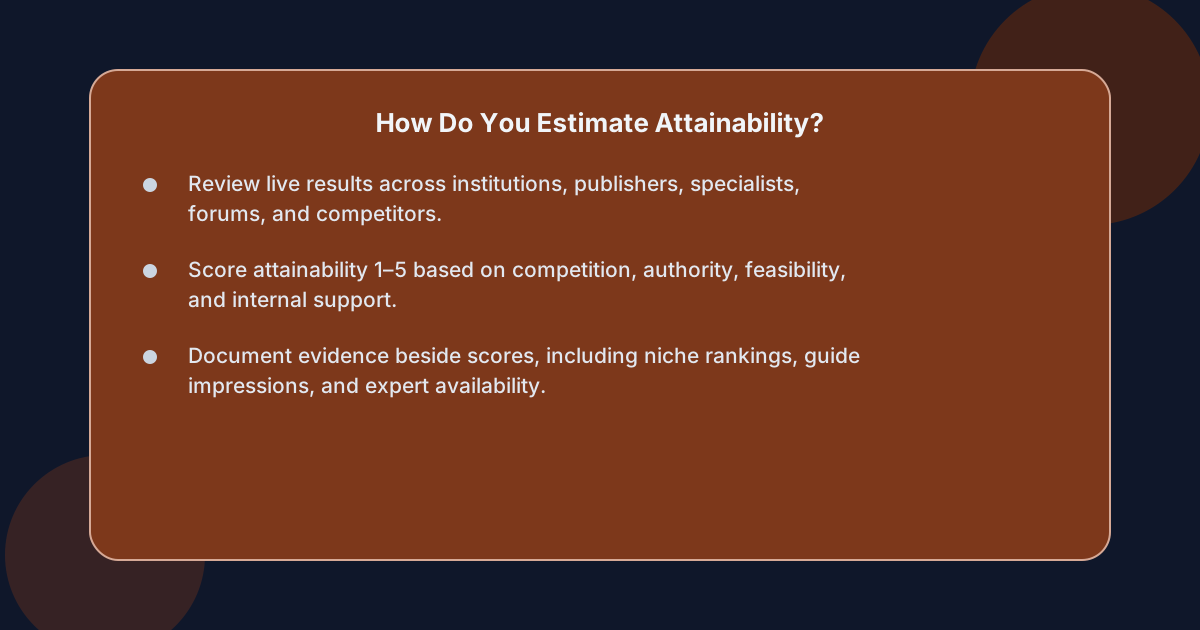 Estimate attainability by comparing the query’s requirements with your site’s current assets, authority, and ability to produce a genuinely useful answer. The goal is not to predict Google’s rankings with false precision; it is to identify opportunities where you have a credible, evidence-based route to visibility.
A practical attainability estimate combines four factors:
- Competition and result-page fit
- Site and topical authority
- Content-production feasibility
- Internal-link and conversion support
1. Competition and result-page fit
Review the current search results. Are they primarily:
- Institutional or government pages?
- Major publishers and media brands?
- Niche specialists?
- Forums, marketplaces, or video platforms?
- Direct competitors?
- Your own domain?
The result-page pattern indicates what Google currently considers useful and competitive. If every leading result is a major publication with extensive original research, your opportunity may require exceptional reporting rather than a conventional explainer.
If the results include weak, outdated, or incomplete answers, a well-researched page may have a better chance of adding value. This is why content gap analysis should examine the actual pages, not only keyword counts.
2. Site and topical authority
Ask what evidence already exists on your domain:
- Relevant pages and their current performance.
- Mentions of the topic in product, support, or company pages.
- Backlinks from relevant sources.
- Expertise among contributors.
- Existing visibility for related, less competitive queries.
A site with meaningful visibility for a cluster of related searches usually has a stronger foundation for that cluster than a site approaching the topic from scratch.
3. Production feasibility
SEO topic difficulty is partly a business constraint. A highly competitive topic may require original research, subject-matter interviews, proprietary data, design work, and several rounds of review. If those resources are unavailable, a more specific query may produce a better return.
Estimate feasibility using four practical questions:
- Can we produce a demonstrably better answer?
- Do we have access to credible experts or data?
- Can the page be supported with appropriate internal links?
- Can we sustain the depth required by the intent?
4. Internal-link and conversion support
Attainability improves when the new article has a logical place within the site architecture. A standalone article with no pathway to a product or service page may earn traffic without supporting the wider journey.
Map the intended links before approval. A commercial guide may link to a product comparison, a deeper technical resource, and a relevant case or service page. A product-led article should also provide enough context for someone who is not yet ready to buy.
Convert uncertainty into evidence scores
Instead of recording a single difficulty label, score attainability from 1–5:
- 1: Highly competitive; little relevant authority; major resource requirement.
- 2: Competitive, but there is a clear content or specialization gap.
- 3: Mixed competition; the site has some relevant assets.
- 4: Moderate competition; strong topic alignment or partial existing authority.
- 5: Clear opportunity; relevant authority, realistic production path, and strong internal support.
Record a short evidence note beside the number. For example: “Results are mostly niche specialists; three relevant guides already earn impressions; subject-matter review available.” This prevents future teams from debating an unexplained score.
Do not confuse attainability with ranking certainty
Even an attainable topic can fail to rank. Search systems consider many signals, and Google notes that its ranking systems use many factors and signals to present relevant, useful results. Attainability therefore expresses relative confidence and resource fit, not a promise of position or traffic.
For difficult topics, consider a staged approach:
- Publish the most specific answer supported by current expertise.
- Strengthen it with original examples, data, or expert review.
- Build related content and internal links.
- Evaluate performance before committing to a broad head term.
Which Opportunity Wins a Limited Publishing Budget?
The winner is usually the opportunity with the strongest combination of buyer value, demand, attainability, strategic fit, and urgency. Raw traffic potential should not override those factors automatically, because rankings are only useful when they bring the right readers to a page the business can act on.
Use the total score as a starting order, then apply a final feasibility check.
Run a tie-breaker test
If two topics have similar totals, compare them against four constraints:
- Pipeline relevance: Which is closer to a qualified customer need?
- Credibility: Which can the organization answer with greater authority?
- Existing momentum: Which already has impressions, links, or a partially built asset?
- Time to value: Which can be produced and published within the available window?
A topic that is slightly lower in total score may still win if it can be delivered faster or built on stronger existing assets.
Consider the whole portfolio
A publishing budget should not consist only of isolated articles. Look for opportunities that reinforce one another.
For example:
- A commercial pillar can establish the main subject.
- A specific evaluation article can capture high-intent searches.
- A technical explainer can answer the next question a reader asks.
- An existing page may need updating instead of creating a new URL.
Choose the topic that closes the most important gap in the customer journey, not merely the topic that produces the highest individual score. Sometimes the best decision is to update a strong page that already attracts impressions rather than publish a new article targeting a broader term.
Separate publishing from development
Budget constraints often make sequencing more important than exclusion. A lower-scoring opportunity may still belong in the roadmap, just later.
A practical quarter might divide work into three groups:
- Now: publish or substantially improve the highest-scoring pages.
- Next: validate the assumptions behind strong but incomplete opportunities.
- Later: retain broader topics for a cluster, an update, or a future period.
Ask whether the manual route fits the capacity
This is where many teams compare an internal editorial process, freelancers, agencies, or software against the work required to maintain a current priority list. xt4b is relevant for teams that want a repeatable process that connects search gaps, dated publishing, a required review step, and publication on their own domain; it is not a substitute for subject-matter judgment or for a business that does not need an automated content pipeline. Teams that can sign up can evaluate whether that operating model matches their actual workflow.
Use a decision table
| Situation | Best decision |
|---|---|
| High score, strong evidence, feasible production | Publish next |
| High score, unvalidated demand | Validate before drafting |
| Moderate score, existing page with impressions | Update or consolidate |
| Moderate score, clear cluster role | Schedule after supporting pieces |
| Low score, negligible business fit | Defer or reject |
| High difficulty, strong expertise and unique data | Consider as a flagship project |
The table prevents the score from becoming a mechanical ranking. It gives the team a documented decision based on evidence, resources, and site architecture.
Turn the Priority List Into an Editorial Sequence
A priority list is not yet an editorial sequence. Convert the selected opportunities into a publication order that accounts for dependencies, audience journey, production time, and existing site structure.
Create a dependency map
For each shortlisted article, record:
- The broader topic or cluster it supports.
- The pages it should link to and from.
- Whether it depends on another article.
- The buyer stage it serves.
- The evidence needed before it can be written.
- Whether an existing URL should be updated.
This prevents two writers from producing overlapping articles and helps you sequence a journey from foundational education toward evaluation and decision support.
Group by purpose, then order within the group
Group approved work by role:
- Foundation: explains a core problem or concept.
- Evaluation: compares approaches and selection criteria.
- Decision: supplies evidence for choosing a solution.
- Activation: helps a reader implement or complete a task.
- Optimization: improves an existing page based on observed results.
Within each group, start with the piece that unlocks the most useful connections. A detailed comparison article may be easier to interpret after readers have encountered a clear explanatory guide, but the order should follow audience need rather than a rigid formula.
Give every article a decision-ready brief
The brief should make the next editorial choices explicit:
- One target query.
- Defined search intent.
- Supporting questions.
- Three to six main headings.
- Evidence to use.
- Expert reviewer.
- Internal links to include.
- Expected reader action.
- Success metric and review date.
A structured SEO content plan can turn the selected topic into a dated, accountable entry rather than an open-ended writing assignment.
Measure outcomes against the hypothesis
The score expresses why you expected an opportunity to perform. Track whether that expectation proves correct.
Useful review measures include:
- Search impressions and clicks.
- Average position for the target query.
- Click-through rate.
- Conversions or qualified leads where tracking permits.
- Engagement with the next logical page.
- Sales or support questions related to the topic.
- Changes to the underlying priority score.
Google’s ranking-system overview is a reminder not to reduce performance to one metric. Its guide to ranking systems explains that search uses many factors and signals. Review the full query set and business outcome rather than reacting to a single ranking movement.
Build a reprioritization rule
The model should remain active after publication. Recalculate when:
- A topic reaches its review date.
- New evidence changes buyer intent.
- An existing page begins gaining impressions.
- A product, audience, or market priority changes.
- Production capacity changes.
A simple rule is to reserve part of each cycle for work triggered by live performance. The rest can follow the quarterly priority list. This keeps the system from becoming either rigidly planned or permanently reactive.
Frequently asked questions
How do I choose SEO topics when search volume is misleading?
Choose topics using multiple signals: buyer value, demonstrated demand, attainability, strategic fit, and urgency. Search volume remains useful, but it should be interpreted alongside query intent, current results, business relevance, and what your site can credibly deliver.
What is the best scoring scale for content opportunity scoring?
A 1–5 scale across a small number of criteria is usually sufficient. It makes topics comparable without suggesting false precision. The most important requirement is that every score has a documented reason and that total scores lead to defined actions such as publish, validate, update, schedule, or defer.
Is keyword difficulty enough to decide what to publish?
No. SEO topic difficulty can estimate competition and production demands, but it does not account for buyer value, strategic fit, site authority, or internal-link support. Use it as one input within content opportunity scoring, not as the final decision.
Should every content gap become a new article?
No. A content gap may be better addressed by updating, consolidating, or reorganizing an existing page. New URLs should earn their place by matching an uncovered intent and fitting the site’s information architecture.
How often should an SEO priority list be updated?
Review the list when evidence changes and at least once per planning cycle. Individual published topics also need performance reviews so that scores can reflect actual impressions, clicks, business outcomes, and changes in customer demand.