
How to Repurpose Competitor Content Without Copying

Every competitor post you admire is really a list of angles in disguise. Pull the angles, drop the wording, and you have a week of original posts in an afternoon. Learning to repurpose competitor content without copying is a matter of reading rival blogs for the questions they answer, not the sentences they use — a habit that turns a blank editorial calendar into a steady queue of dated posts you can plan, write, and ship on your own domain.
Table of contents
- Key takeaways
- Why competitor posts are the easiest source of new ideas
- How do you find competitor angles worth borrowing?
- The angle matrix: turning one rival post into five distinct takes
- How to rewrite a competitor outline so Google treats it as original
- A free, repeatable workflow for recurring competitor mining
- Frequently asked questions
- Sources
Key takeaways
- A competitor's blog post is best read as a list of angles (the questions, comparisons, and objections it covers), not as a template for your own prose.
- A one-page angle matrix lets you turn a single rival post into four to six distinct takes, each aimed at a different intent or supporting term.
- Originality in Google's eyes comes from the angle you choose, the supporting terms you cover, and the internal links you add — not from avoiding overlap with the topic.
- A free content gap analysis (Search Console queries minus existing URLs) gives you a steady stream of "what to write when you have no ideas" candidates without a paid tool.
- A repeatable recurring workflow beats a sporadic burst: read three competitors, fill the angle matrix, pick two gaps, draft, then re-cite.
Why competitor posts are the easiest source of new ideas
Competitor posts are the easiest source of new content ideas because the hard work has already been done for you: someone else tested the topic with an audience, found the angles that earned clicks, and wrote the headings that match the questions buyers actually type. You are not borrowing their words; you are borrowing the list of sub-questions their post had to answer to rank. Once you can see the post as a list of angles instead of a piece of prose, every rival blog on your topic becomes a backlog you can mine in an afternoon.
This is also why a blank editorial calendar is rarely a sign that there is nothing to write about. The opposite is usually true: the topic has been written to death, and the writer is staring at a wall of similar titles without a way to pick a side. The fix is to look at what is already ranking and ask a different question — not "what did they say?" but "which of their angles did they under-serve, or skip entirely?" That question is the start of every honest competitor content ideas exercise, and it is the reason scraping a rival's outline (rather than their paragraphs) is a sustainable habit rather than a shortcut to a thin post.
A second reason the rival-blog habit works: it forces you to read the search result page before you read the post. The titles, dates, and domains that show up for your target query are the market's own shortlist, and they are the same shortlist Google is using to decide what to rank. A writer who reads the page before the post is borrowing a calibrated signal; a writer who reads only the post is borrowing a guess.
How do you find competitor angles worth borrowing?
You find competitor angles worth borrowing by reading the search result page first, picking the three to five posts that have earned clicks and backlinks, and listing the headings, the questions each heading answers, and the supporting terms each heading uses. The list of headings is your angle inventory; the questions behind them are the units you actually repurpose.
Start with the obvious: type your target query into Google, ignore your own site, and look at the top ten results that are not aggregators or PDFs. For each one, open the post and copy the H2 and H3 headings into a single column. You now have a rough census of what the market considers a complete answer — and, more usefully, you have a list of headings the rivals all share (the "table-stakes" angles) and headings only one or two of them use (the angles that signal a specialist).
Then read each post for the questions the headings imply but never spell out. A heading like "Common mistakes" is an angle; the question behind it is "What mistake will I make if I skip this step?" A heading like "Alternatives" hides two angles: "What else works?" and "What does this lose compared to the obvious choice?" Write those questions next to the heading. This is the layer you will repurpose, not the heading itself. It is also the layer that lets you How to find keywords without paid tools without writing a near-duplicate, because two posts built from the same heading but answering different implied questions will read as unrelated to a search engine.
Two quick filters decide which of those questions are worth your time. The first is search intent: if the dominant intent behind the query is informational, keep the questions that start with "how", "why", or "what"; if it is commercial, keep the questions that start with "which", "vs", or "is it worth". The second is your own site: drop any question you have already answered well, and flag any question your existing post touches but does not actually answer. That last list is your next-month backlog, and it is the same list a SEO content cannibalization workflow produces when you run it across Search Console.
The angle matrix: turning one rival post into five distinct takes
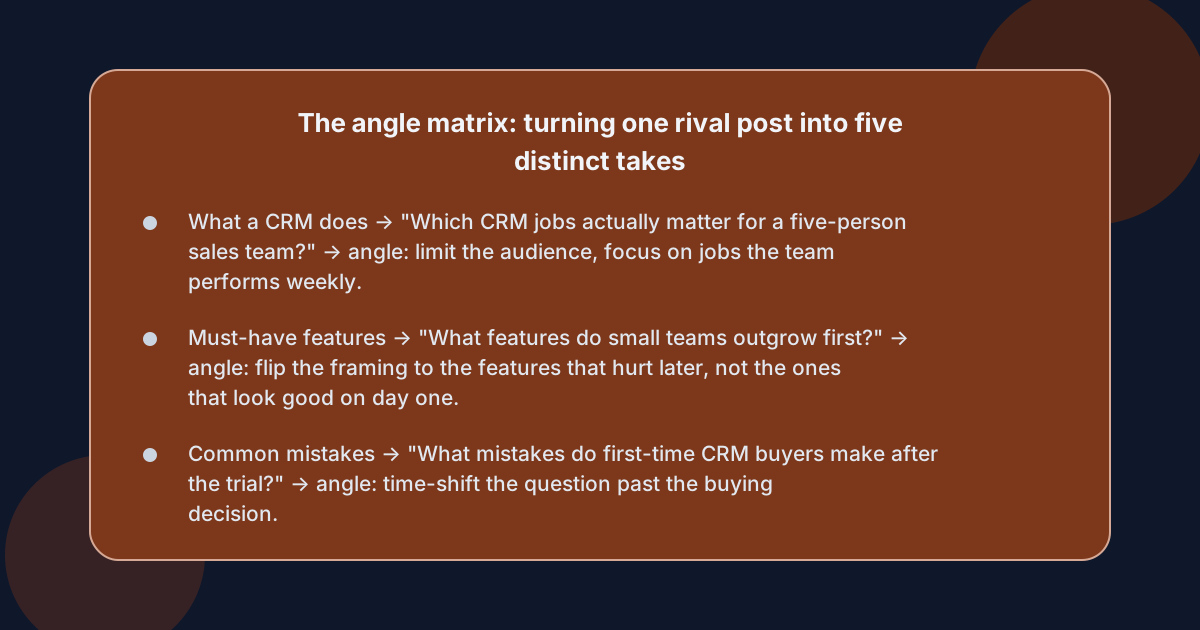 The angle matrix is a one-page table that turns a single rival post into several distinct takes by varying the intent, the audience, the format, and the supporting terms behind the same topic. Used well, the matrix is the difference between writing one post a week and writing the same post four times in a row.
The simplest matrix has four columns: the source heading from the rival post, the implied question behind it, the angle you would take, and the supporting terms you would have to cover to make the angle original. Fill one row per rival heading. Once the table is full, look down the "angle" column and pick the rows where your angle is genuinely different — different intent, different audience, different format, or a different set of supporting terms. Those rows are the takes you actually write.
Which angle variants give you the most distance from the rival?
The angle variants that give you the most distance from a rival post are the ones that change the reader's job-to-be-done, not the ones that just rephrase the heading. A "mistakes" heading becomes four different posts the moment you change the audience: a post for first-time buyers, a post for teams that have already tried once, a post for budget-constrained teams, and a post for teams replacing a legacy tool. None of those are rephrases; each one answers a different implied question, and each one will pull different supporting terms into the outline.
The next-best distance comes from changing the format. A rival's listicle can become a comparison, the comparison can become a decision tree, and the decision tree can become a checklist. The information overlaps; the reading experience does not, and that is what Google's helpful-content systems are looking for. The matrix makes this distance visible: if two of your rows only differ by a synonym, drop one. If two of your rows answer different implied questions for different audiences, keep both.
The third lever is supporting terms. A rival's "alternatives" heading might cover three named tools; your "alternatives" heading can cover the same three plus the two the rival skipped, and frame them through a different decision rule (cheapest, fastest, most accurate). Supporting terms are also what you use to widen a narrow query into a wider one, so a post that targets a single term can quietly cover four or five without diluting the primary intent. This is the same idea behind writing content that earns impressions across many long-tail queries, and it is the lever a small editorial calendar uses to look bigger than it is.
What does a full angle matrix look like for a single rival post?
A full angle matrix for a single rival post has one row per rival heading, an "implied question" column that rewrites each heading as a real searcher question, an "angle" column that names the take, and a "supporting terms" column with three to five terms the rival skipped or under-used. Five rival headings become five rows; from those five rows you keep two to three angles that survive the distance test and write them as separate posts. The matrix is the planning artifact; the posts are the output.
A worked example makes the matrix concrete. Imagine a rival post titled "How to choose a CRM for a small team" with the headings "What a CRM does", "Must-have features", "Common mistakes", "Pricing", and "Alternatives". The matrix turns those into:
- What a CRM does → "Which CRM jobs actually matter for a five-person sales team?" → angle: limit the audience, focus on jobs the team performs weekly.
- Must-have features → "What features do small teams outgrow first?" → angle: flip the framing to the features that hurt later, not the ones that look good on day one.
- Common mistakes → "What mistakes do first-time CRM buyers make after the trial?" → angle: time-shift the question past the buying decision.
- Pricing → "How does CRM pricing change as the team grows from five to twenty?" → angle: pricing as a curve, not a list.
- Alternatives → "When is a spreadsheet the right CRM?" → angle: defend the "do nothing" option as a legitimate comparison.
Five rows, four surviving angles, four posts that do not compete with the rival's page. That is the output of one matrix session, and it is the answer to "what to write when you have no ideas" for at least a month.
How to rewrite a competitor outline so Google treats it as original
You rewrite a competitor outline so Google treats it as original by changing the angle, the implied questions, the supporting terms, and the internal links, not by changing the order of the rival's H2s. Originality in the search result is a function of what the page covers and how it covers it; it is not a function of how different the table of contents looks from the rival's.
The first rewrite layer is the angle. If the rival's outline is a beginner's guide, write a practitioner's guide that assumes the reader has already tried the obvious solution; the headings stay roughly similar, but the depth of the answer changes, and so does the intent. If the rival's outline is a comparison, write a decision tree or a checklist that arrives at the same conclusion through a different path. Either way, the table of contents will look unlike the rival's once the angle changes, because each heading has to justify the new angle.
The second layer is supporting terms. A rival's "mistakes" section might use the term "vendor lock-in" once; yours can use it three times and add the related terms the rival skipped, such as "switching cost", "data export", and "contract terms". The rival's "pricing" section might mention "per seat" once; yours can use the supporting terms "per user", "minimum commitment", and "annual vs monthly". These are the phrases Google's systems use to decide which page is the more complete answer, and they are also the phrases that pull the long-tail impressions a thin post never sees. A SEO content cannibalization workflow surfaces these supporting terms directly: the queries you already earn impressions for but do not rank on are the terms you need in your draft.
The third layer is internal links. Rival posts do not link to your product pages, case studies, or comparison posts; yours do. Add three to five internal links per post, each pointing at a page you actually serve, and each anchored on a phrase that describes the destination, not on the target keyword. This is also the layer that handles cannibalisation: if your site already has a post that targets the same primary query, the rewrite has to either angle so far from the existing post that they can coexist, or the older post has to be retired and 301-redirected. A measure seo content roi review a month after publication will tell you whether the rewrite earned its keep or quietly cannibalised the page it was meant to support.
What signals make a rewritten post look thin to Google?
A rewritten post looks thin to Google when its supporting terms are a subset of the rival's, when its internal links are missing or off-topic, and when its outline could be reordered without changing the answer. The first signal is the easiest to spot: open both posts side by side, list the nouns in the rival's section, and check whether your version covers a strict subset. If it does, you have written a shorter post on the same angle, and Google's helpful-content systems will read it as less complete. The second signal is mechanical and fixable: add the internal links during the rewrite, not after. The third signal is structural: if your headings can be swapped with the rival's headings without changing the post, the angle has not changed, and the rewrite is a paraphrase.
A free, repeatable workflow for recurring competitor mining
A free, repeatable workflow for recurring competitor mining has four steps: pick three competitors, fill the angle matrix for one post each, run a Search Console gap query, and queue the two strongest angles as dated drafts. The whole cycle takes a few hours once the matrix template is in place, and it produces two posts a week from a single session of competitor reading.
The first step is competitor selection. Pick three sites that rank for the queries you want to win, and exclude your own site, the obvious aggregators, and any site that is structurally different from yours (a vendor with a 500-person content team is not a useful benchmark for a five-person operation). For each of the three, find their most recent post on a query you care about. Three posts is the right number: fewer gives you a one-source bias, more adds reading time without adding angles.
The second step is the matrix. Open a single document with the four columns described above, and fill one row per rival heading across all three posts. The merged matrix is the artifact you keep: it is the answer to "what to write this month", and it is also the input to the next step. Aim for fifteen to twenty rows per session; trim to six to ten surviving angles by the end.
The third step is the gap query. Open Google Search Console, filter to the site and to the last ninety days, and export the queries that earned impressions but did not earn clicks, then cross them with the queries the three competitors target. The cross is your How to find keywords without paid tools output: a list of queries the market ranks for, your rivals write for, and your own site touches but does not answer. Pick the two queries that overlap with the most surviving rows in the matrix. Those two are this week's drafts.
The fourth step is the queue. For each of the two drafts, write the post against the angle in the matrix, not against the rival's outline. Publish on the days you have already chosen in the editorial calendar, and add three to five internal links per post. A week later, re-read the post against the rival's and confirm that the supporting terms and the angle survived the rewrite. A month later, check the post's impressions and clicks in Search Console against the queries you targeted, and retire or 301 any post that is cannibalising an older one. This is also the moment the question of who actually does the work gets practical. The manual route is the workflow above, done by you; the agency route is the same workflow done by a third party at a per-article or per-word price; the in-house route is a writer who runs it on a fixed schedule. For a solo marketer or founder who can keep the cadence, the workflow is the cheapest path. For an operator who would rather not own the calendar, the planning, the writing, the review and the publishing at all, sign up to check whether your blog setup is supported — though it is built for steady, search-driven publishing on a domain you own, and it is not the right fit for a one-off campaign with no ongoing content needs.
Frequently asked questions
Is repurposing competitor content the same as copying?
No. Repurposing competitor content means borrowing the angles, the implied questions, and the supporting terms a rival covers, then writing an original post that takes a different angle for a different reader. Copying is reproducing the rival's wording, structure, or unique expressions. Search engines can detect both; only the first builds ranking equity, and only the first scales into a steady editorial calendar.
How often should you mine competitor blogs for new ideas?
A recurring cadence is the sweet spot for most small content operations: one session, three competitors, one angle matrix, two queued drafts. Monthly mining leaves gaps that competitors fill first; daily mining burns time without adding new angles because the rival set is small enough that the same posts rotate through the result page.
What is the fastest content gap analysis you can run for free?
The fastest content gap analysis you can run for free is to export the last ninety days of queries from Google Search Console, sort by impressions, and flag the queries where your site appears on page two or lower. Cross that list with the queries the top three competitors target and you have a prioritised backlog of gaps your rivals already cover, ordered by the demand Google has measured against your own domain.
How do you avoid two of your own posts competing for the same query?
You avoid cannibalisation by giving each post a different angle, a different intent, or a different supporting-term set, and by writing the older post's primary query as the target of a 301 if the new post truly replaces it. A measure seo content roi review a month after publication will surface any post that is splitting clicks with an older one, and a quarterly audit of the editorial calendar is the cheapest way to catch overlap before it costs rankings.