
SEO Content on a Subdomain vs a Subfolder: Which One Should Host Your Blog?

Almost every "subdomain vs subfolder" page you'll find is written for an in-house team that has already chosen — here is the answer for the team that hasn't, and the content pipeline that is about to publish to one of them.
A fresh domain usually comes with a fresh question: do we host the blog at `` or at ` The choice is rarely made on technical merit. It is decided by who is going to publish into it, how often, and how much of the rest of the site the blog needs to lean on to rank. That is what this article is for. The first decision a SaaS founder makes about SEO content on a subdomain versus a subfolder is rarely about either option — it is about who will actually publish, in what rhythm, and with what kind of plan behind each post.
Table of contents
- Key takeaways
- What actually changes between a blog on a subdomain and a blog on a subfolder
- How Google treats the two setups today: crawl, indexing and link equity
- When a subdomain is the right call for an automated content pipeline
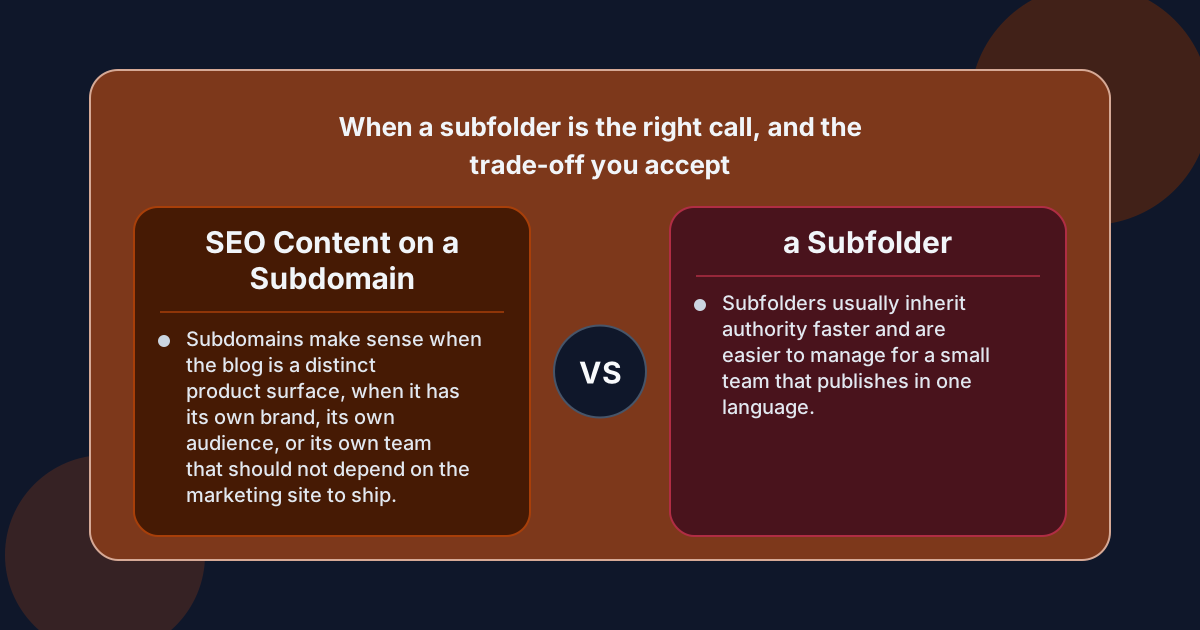
- When a subfolder is the right call, and the trade-off you accept
- Does hosting the blog on its own subdomain hurt your rankings?
- How to set up whichever option you pick without breaking the rest of the site
- Internal linking rules that look different on a subdomain vs a subfolder
- How to measure whether the choice you made is actually moving traffic
- Frequently asked questions
- Sources
Key takeaways
- Google treats a subdomain and a subfolder as separate sites by default — crawl, indexing, and link equity do not automatically flow between them the way they do between two pages on the same host.
- Subfolders usually inherit authority faster and are easier to manage for a small team that publishes in one language.
- Subdomains make sense when the blog is a distinct product surface, when it has its own brand, its own audience, or its own team that should not depend on the marketing site to ship.
- Internal linking rules, measurement, and DNS setup all change between the two — none of the three is set-and-forget.
- The wrong hosting decision rarely costs rankings on its own; what hurts is a publishing cadence the chosen setup cannot actually sustain.
What actually changes between a blog on a subdomain and a blog on a subfolder
A blog on a subdomain lives on its own host, with its own DNS record, its own sitemap, and — from Google's perspective — its own site. A blog on a subfolder is just another directory under the domain you already have. That single architectural fact drives almost every difference that follows: how Googlebot crawls each, how link equity passes between them, how analytics roll up, and how much setup work the choice costs you.
Two consequences follow for almost every small team that weighs the question:
- A subdomain creates a second surface to ship to. DNS, a sitemap, an analytics property, and any monitoring you set up has to be done twice.
- A subfolder keeps everything in one place. One sitemap, one analytics view, one place to add internal links, one set of redirects when the site changes.
The choice is rarely about either of those on its own. It is about who is going to publish, in what cadence, and whether the blog needs to stand on its own or borrow from the rest of the site.
How Google treats the two setups today: crawl, indexing and link equity
For years Google's own documentation has described subdomains as "separate sites" for many practical purposes, and that framing is still accurate in 2026 — though the crawl side has loosened. According to Google Search Central's documentation on site structure, both subdomains and subfolders can rank, and either can host a blog, but the search engine may treat them as related but distinct properties when it comes to signals.
In practice the differences show up in three places:
- Crawl budget. A subdomain has its own crawl budget, separate from the main domain. On a fresh brand, this is rarely a problem, but as the blog grows, a subdomain blog and the main site compete for their own pools of crawl attention rather than sharing one.
- Indexing. Each subdomain needs its own sitemap, its own Search Console property, and its own robots.txt. None of those inherit from `` automatically.
- Link equity. Links from
toare external to Google's view of the subdomain blog, not internal. They pass equity, but they pass it the way a link from any other site would — not the way a link from/aboutto/blog/postdoes. This is the single biggest difference for a small team that already has authority on its main domain.
None of this is a verdict against subdomains. It is a description of what changes when you choose one.
When a subdomain is the right call for an automated content pipeline
A subdomain earns its keep when the blog is meant to function as its own product surface, with its own audience and its own team behind it. The three cases below are the ones that come up most often in 2026 for small SaaS and SMB sites.
Does the blog serve a different reader than the marketing site?
A subdomain is the cleaner choice when the blog is aimed at readers who are not the same people the marketing pages target. A developer tool with a marketing site for buyers and a documentation site for builders is the textbook case: separate audiences, separate surfaces, separate DNS. The blog fits the same pattern when it is aimed at a community the brand's main pages do not address.
A subdomain is also the cleaner choice when the blog is going to host its own brand identity, separate from the company's. A news product, an industry vertical, or a community publication that exists alongside the parent company is a place where a subdomain reads as intentional rather than bolted on.
Will the blog be run by a separate team?
When the blog has its own editor, its own publishing calendar, or its own SEO owner, a subdomain gives that team their own surface to ship to without touching the main site. The marketing site and the blog can change DNS, redesign, or migrate without depending on each other.
For an automated content pipeline, this is the practical case that matters most. A pipeline that writes and publishes on a schedule needs a stable home for the output that does not depend on the main site's release train. A hosted blog on its own subdomain is one of the cleanest ways to give that output a stable address without forcing it through the main site's deployment process.
Is the blog going to span languages that need their own structure?
When the blog needs to serve multiple languages with their own URL patterns, their own hreflang setup, or their own publishing cadence, a subdomain gives each one room to grow without coupling its sitemap to the marketing site. This is the case where the subdomain's "separate site" character is the point, not a cost.
The trade-off you accept here is real too. Blogs that need to rank across languages are usually planned as a single SEO content plan with one entry per query per language, mapping each post to a specific country or dialect before writing. — the choice between a subdomain and a subfolder decides how much of that plan each language owns.
When a subfolder is the right call, and the trade-off you accept
 A subfolder is the right call when the blog is an extension of the main site rather than a separate product, and when the team behind it is small enough that running two surfaces would be a tax they cannot afford.
Is the blog a marketing channel, not a product?
For most SaaS and SMB sites, the blog exists to support the pages it sells from. It earns the queries buyers type before they are ready to talk to sales, and it passes authority into the pages that close. In that setup, the blog is a marketing channel, not a product — and a marketing channel belongs in the same domain as the pages it supports.
A subfolder keeps that link equity path short. Links from a post to /pricing or /features are internal in the strict sense, not external, and they pass equity without the friction of a cross-domain link. For a small team that already has authority on the main domain, this matters more than any other factor in the decision.
Does the team only have capacity for one surface?
A small in-house team usually has capacity for one analytics setup, one Search Console property, one sitemap to submit, one set of redirects to maintain. A subfolder keeps that single surface. A subdomain adds a second one, with its own DNS, its own robots.txt, its own property verification, and its own monitoring.
The trade-off you accept with a subfolder is real. Blogs that need to function as a separate brand will feel cramped in a subfolder because the parent site's design system, navigation, and analytics all silently bleed into the child brand., and a blog that wants to redesign without touching the marketing site cannot. If neither of those is on the roadmap, the subfolder's constraints are not constraints at all — they are just the absence of complexity you do not need.
What does the trade-off look like in practice?
In practice, a subfolder means:
- One sitemap. One robots.txt. One analytics view. One Search Console property. One set of redirects when the site restructures.
- Internal links that are internal in Google's view, not external. Authority from the main domain flows into the blog without an explicit signal.
- A blog that depends on the marketing site's release cadence. If the main site ships on Tuesdays, the blog ships on Tuesdays, because it lives in the same repo, the same CMS, or the same deployment pipeline.
The trade-off is structural simplicity for architectural flexibility. For most small teams in 2026, that trade is worth making unless the blog has a reason to stand on its own.
Does hosting the blog on its own subdomain hurt your rankings?
The honest answer is that it depends on the setup behind it, not on the hostname. A blog on `` can rank as well as one at ` and it can rank worse — but the variable is rarely the subdomain itself.
What the evidence shows
Google's own crawlers have become substantially better at treating subdomains as part of a parent site when the signals point that way: shared verification, shared branding, shared outbound links, and an explicit association through Search Console. According to Google Search Central's documentation on managing multi-property sites, a subdomain can rank independently or be associated with a parent domain, depending on how it is configured.
What does hurt the blog subdomain's seo impact in practice is:
- Forgetting to verify the subdomain as its own Search Console property and treating its data as part of the main domain's.
- Skipping the explicit association between the subdomain and the main domain in Search Console, which leaves Google's view of the relationship to inference.
- Internal links that point from the main domain to the blog subdomain but are not built as deliberate equity passes, the way a link to a separate site would be.
What does not hurt it is the subdomain itself. A well-run blog on its own subdomain will rank alongside a well-run blog in a subfolder, and the difference between the two will be driven by the plan behind each post, the writing, and the cadence — not by the path.
When does a subdomain measurably hurt?
A subdomain measurably hurts when the blog is new and the main domain already has authority. In that case, a subfolder inherits that authority through internal linking the moment the blog goes live. A subdomain does not — it has to earn its own authority through external links, mentions, and the signals Google can collect on its own. The blog's seo hosting subdomain setup does not change this; only the structure does.
For a domain that already has authority, the cost of a subdomain is real but rarely fatal. For a fresh domain with no authority to begin with, the cost is harder to measure because there is nothing to inherit in the first place.
How to set up whichever option you pick without breaking the rest of the site
The setup work is different in each case, and the mistakes are different too. This is the section where most teams that have already chosen lose points they did not have to.
Setting up a subfolder
A subfolder is the lighter setup, and it should stay light:
- CMS or repo. The blog lives in the same CMS, repo, or deployment pipeline as the main site. There is no second system to maintain.
- Sitemap. One sitemap, listing both the main pages and the blog posts. There is no reason to split them.
- Search Console. One verified property for the domain. The blog posts show up in the same property as everything else.
- Analytics. One analytics property, one view, one set of goals. The blog's traffic rolls up alongside the rest of the site's.
- Redirects. When a post's URL changes, one redirect rule, in the same place the rest of the site's redirects live.
The mistake most teams make here is treating the blog as a separate project anyway — a separate pipeline, a separate review process, a separate set of stakeholders. The subfolder's whole point is that none of that needs to exist.
Setting up a subdomain
A subdomain is heavier, and the weight is mostly in the things you have to remember:
- DNS. A separate DNS record for the subdomain, with the right CNAME or A record pointing at the right host. The blog's TLS certificate has to cover the subdomain.
- Sitemap. A separate sitemap, hosted on the subdomain, submitted to its own Search Console property.
- Search Console. A separate verified property for the subdomain, with an explicit link to the main domain as the parent in the property settings.
- Analytics. A separate analytics property, or the same property with a separate hostname filter, depending on how the team wants to measure the blog's traffic.
- Redirects. A separate set of redirects, in a separate file or system, that does not interfere with the main site's redirect rules.
The mistake most teams make here is forgetting one of those, and then discovering months in that the blog's data does not appear in the right place. The setup is not hard. It is just longer than the subfolder's, and it has to be done in full the first time.
Internal linking rules that look different on a subdomain vs a subfolder
Internal linking is the area where the subdomain-vs-subfolder choice shows up most clearly in day-to-day work, because the same link counts as different things depending on where it points.
How internal links behave in a subfolder
In a subfolder, a link from /blog/post to /pricing is internal in the strict sense. It passes equity without friction, it appears in the same analytics view, and Google's crawlers treat it as a link within a single site. The same is true of a link from /pricing to /blog/post — it is just an internal link.
That means the blog can lean on the main site's authority directly, and the main site can lean on the blog's authority directly. The whole site is one graph.
How internal links behave across a subdomain
Across a subdomain, a link from to is external in Google's view of the blog. It passes equity, but it passes it the way a link from any other site would. The reverse is also true: a link from to is external in Google's view of the main domain.
This changes three things:
- Equity passes have to be deliberate. The team that runs the blog subdomain has to decide which posts link back to the main site, and the team that runs the main site has to decide which pages link into the blog. There is no automatic flow.
- Anchor text matters more. A link from a blog post to a main site page is one of the few ways the blog passes equity into the pages the company sells from. Anchor text, placement, and the number of links per post all carry more weight, because the link is rarer.
- Hub pages work differently. A hub page that gathers the blog's best posts and links out to them works in a subfolder as a normal internal page. The same hub on a subdomain is still useful, but it is one of the few pages on the blog that links to other pages on the blog at all.
The internal linking strategy for a subdomain blog has to be designed, not assumed.
How to measure whether the choice you made is actually moving traffic
The choice between a subdomain and a subfolder is made once and lived with for a long time, so the measurement question matters more than it usually does for an SEO decision.
What to measure in the first 90 days
In the first 90 days after the blog launches, the number to watch is impressions in Search Console, not clicks. A new blog — whether on a subdomain or in a subfolder — has to be crawled and indexed before clicks show up, and that takes time on either setup. The impressions curve is the cleaner signal that the blog's pages are reaching the search results at all.
The second number to watch is the share of impressions that come from queries the blog's plan specifically targeted. If the SEO content plan names the queries each post is for, the Search Console performance filter can be set to those queries and tell you how many of them are reaching the search results at all. That is the signal that the plan is being executed, not just that posts are being published.
The third number is the click-through rate for those targeted queries. If impressions are climbing but clicks are not, the issue is in the meta title and description, not in the hosting choice.
What to measure after 90 days
After 90 days, the numbers that matter are:
- Indexed pages. The count of pages Google has indexed on the blog's property, compared with the count of pages the blog has published. If the gap is large, the blog has a crawl or indexing problem, not a hosting problem.
- Average position for targeted queries. The position the blog's posts hold for the queries the plan named. For the rankings to be meaningful, the two pages need to be similar enough in content, backlinks, and crawl signals that only the URL structure differs., the posts have to be moving toward the first page.
- Equity passing into the main site. The number of links from the blog to the main site, and the search visibility of the pages those links point at. If the blog is on a subdomain, this is the equity path that has to be designed, and it is the path to watch.
- Crawl stats. For a subdomain, the Crawl Stats report in Search Console tells you how often Googlebot is hitting the blog and what it is downloading. A low crawl rate is a sign the blog is not getting the attention the cadence assumes.
What to do if the numbers are not moving
If the numbers are not moving after 90 days, the cause is rarely the hosting choice. It is almost always one of three things:
- The plan behind each post is not targeting the queries the readers actually type.
- The writing does not earn the click for the queries the plan targeted.
- The cadence is not fast enough to build the signals a new blog needs in a competitive space.
None of those change when the hosting changes. They change in the plan, the writing, and the schedule. The hosting decision is upstream of those, and it rarely moves them.
Frequently asked questions
Is a blog on a subdomain bad for SEO?
A blog on a subdomain is not bad for SEO on its own. Google's documentation has treated subdomains as separate sites for many practical purposes for years, but that does not make them penalised — it makes them independent. A well-run blog on `` can rank as well as one at ` What does hurt a blog subdomain's seo impact in practice is forgetting to verify it in Search Console, skipping the explicit parent-domain association, or letting internal links between the main site and the blog drift instead of being deliberate. The hostname itself is not the variable.
Do subfolders rank better than subdomains?
Subfolders do not rank better than subdomains automatically. What subfolders do is inherit authority from the main domain through internal links, without the equity having to travel across a host boundary. On a fresh brand with no authority to begin with, this advantage is invisible. On a brand that already ranks and already has authority, the subfolder's head start is real and worth taking seriously. The two structures can rank equally well; the time to first ranking is what usually differs.
Should I host my blog on a subdomain or a subfolder for SEO?
The right choice depends on what the blog is for. Host the blog on a subfolder when it is a marketing channel for the rest of the site, when the team behind it is small, and when there is no reason for the blog to stand on its own as a brand. Host the blog on a subdomain when the blog serves a different audience than the main site, when a separate team runs it, when the blog needs to span languages that need to be independent of the marketing site, or when the blog's publishing pipeline should not depend on the main site's release train. The decision is about who the blog serves and who runs it, not about which structure ranks better.
What is the SEO impact of a blog on a subdomain in 2026?
The SEO impact of a blog on a subdomain in 2026 is roughly the same as it has been for several years: the subdomain is its own property in Google's view, with its own crawl, its own index, and its own equity. The subdomain is not penalised, and a blog there can rank well if the plan behind it is sound. What has changed is that Google's crawlers are now better at recognising the parent-subdomain relationship when it is signalled explicitly through Search Console. The impact is structural, not penal — the SEO impact shows up in the time it takes the blog to inherit authority from the main site, not in any cap on its rankings.
Can a subdomain blog rank as well as a subfolder blog?
A subdomain blog can rank as well as a subfolder blog when the work behind it is comparable: a plan that targets the right queries, writing that earns the click, internal links designed for the subproduct rather than inherited, and a cadence that the chosen setup can sustain. The hosting decision sets the rules; the plan and the writing are what move the needle. For a fresh brand with no authority to start from, the difference between the two is often too small to measure. For a brand that already ranks, the subfolder's head start is the main reason it usually wins.