
An SEO content workflow that actually fits a small marketing team

Most "SEO content workflows" on small-team blogs are a Notion page nobody opens after week two. The version that actually survives contact with a real calendar is shorter, names the people who own each step, and treats the review pass as a budgeted stage rather than a favour. This is an SEO content workflow for small teams that holds up when the calendar moves and the slack runs out.
Table of contents
- Key takeaways
- Where most small-team SEO workflows actually break
- What an SEO content workflow has to produce, not just contain
- How do you decide who reviews each SEO post before it publishes?
- What does a workable approval workflow look like for a one-person team?
- How does the workflow change when a second reviewer joins
- An SEO content workflow template you can copy and adapt
- How to keep the workflow alive after the first three months
- Frequently asked questions
- Sources
Key takeaways
- An SEO content workflow is a production line, not a content calendar: every row carries the target query, intent, outline, internal links and the date the post goes live before a single sentence is written.
- Approval gates should be split by risk: a one-person team needs a single reviewer with a hard checklist; a two-person team can add a second pass focused on factual claims and on-page SEO.
- Cadence is a budget decision before it is a quality decision — pick the slowest rhythm the team can sustain for six months, not the fastest one that looks impressive in week one.
- Review the calendar, not the posts, in month one: a workflow that ships but never updates its own plan stalls within a quarter, even when the writing is good.
- Plan depth scales with team size, not ambition: a one-person operation can run on six fields per entry; a team of three needs the full eight to keep drafts from clashing.
Where most small-team SEO workflows actually break
The first workflow a small team adopts is usually a calendar — a sheet of dates, a column for titles, and a vague promise that someone will write the posts. It feels organised for a week. By week three, the writer is asking what the post is supposed to cover, the reviewer is reading drafts cold, and the calendar is full of dates that slide because nothing in the plan said what "done" looked like.
The workflow did not fail because the team was lazy; it failed because the plan was a list of blog ideas rather than a production line.
Three failure modes show up in nearly every broken workflow:
- The target query is decided after the post is written, which means the post was written for a topic named in a meeting three weeks earlier, not for a query anyone is searching.
- The reviewer is treated as a final reader rather than a checkpoint against a checklist, so every draft triggers a long comments thread about tone instead of a fast yes-or-no on the things that decide ranking.
- The cadence is set by enthusiasm in month one, so the team commits to a weekly rhythm that collapses the first time anyone goes on holiday.
A workflow that survives treats each of those failure modes as a planning problem, not a discipline problem. The query is fixed in the calendar row before the post exists. The reviewer has a short, written pass criteria, not a vague "have a look".
The cadence is set to the slowest pace the team can hold for six months, then tightened only after three consecutive months of on-time delivery. That last decision is the one that separates a working seo content plan from a wishlist with dates.
What an SEO content workflow has to produce, not just contain
A workflow is a list of decisions, not a list of artefacts. The artefacts are obvious: a brief, a draft, a reviewed post, a published URL, and a report on what happened afterwards.
The decisions are what make those artefacts land — and they are also the part most small teams skip. Every row in the calendar has to answer eight questions before a single word is written, because changing a post after it has been drafted costs roughly ten times as much as changing it while it is still a row.
The eight decisions are:
- The target query.
- The search intent behind it.
- The supporting terms the post should also answer.
- The three-to-six heading outline.
- The meta title and description.
- The internal links the post will point at and be pointed at by.
- The format and depth (guide, comparison, tutorial, or listicle).
- The publishing date.
None of these are optional. Drop the outline and the writer fills the page with whatever comes to mind. Drop the internal links and the post becomes an orphan the moment it goes live. Drop the intent and the post reads like a sales page for a query that wanted an explanation.
The workflow also has to produce a state for every post. Each row in the calendar is one of five states at any given moment: planned, drafted, in review, scheduled, or published-with-a-14-day-revisit-pending. The state is not a colour in a spreadsheet; it is a trigger for the next step.
A row that is "drafted" and has sat for more than three working days is a workflow problem, not a writing problem — the review pass is too slow, the reviewer is unclear, or the brief was wrong and the writer stalled. Naming the states turns the workflow from a list into a queue, and a queue is what an outside writer or a seo content automation pipeline can plug into without a kickoff call.
The last thing the workflow has to produce, and the one most teams forget, is a record of what each post did after it shipped. Fourteen days after publication, the post is re-read against the search console: did it earn impressions for the query it was aimed at, did any of the supporting terms start to show up, and is there a query inside the same cluster that wants a follow-up post. Without that step, the workflow is a one-way street: it produces posts, but it never learns from them.
How do you decide who reviews each SEO post before it publishes?
The reviewer is the most expensive person in the workflow and the one whose job is the most poorly defined. On a small team, the reviewer is usually the head of marketing, which means the reviewer is also the person who decided the query, the intent, and the brief — and is now being asked to read the draft as if they had not.
That is the structural problem behind most slow review passes, and the reason most review-process documents fail in practice.
The first decision is whether the reviewer is a single person or a panel. A single reviewer works when the team is one writer and one editor, the writer is the only one who sees the brief, and the reviewer has the time to read a post a day at a fixed slot. A panel — usually two people — works when the post carries factual claims a non-expert cannot verify, when the brand voice is contested, or when the post will be linked from a high-traffic page and a mistake is expensive. Anything more than two reviewers is not a workflow; it is a committee, and a committee does not move at small-team speed.
The second decision is what the reviewer is actually checking. A useful review pass has three layers, and they should be read in order:
- A structural pass against the brief: does the post answer the target query, does the outline match what was planned, and do the internal links exist.
- A factual pass on the claims that carry weight: numbers, dates, named regulations, vendor behaviour, and anything that could embarrass the company if wrong.
- A line pass for voice and clarity.
Most small teams collapse all three into one read, which is why the reviewer spends an hour on a post that should take fifteen minutes.
The third decision is who the reviewer is when the head of marketing is the writer. In that case, the reviewer has to be someone outside the writing process — a peer at a similar company, a freelance editor, or a tool that runs the structural and factual passes and leaves only the voice check to a human. There is no version of the workflow where the writer reviews their own post against their own brief and gets a useful result.
What does a workable approval workflow look like for a one-person team?
A one-person team is the writer, the reviewer, and the publisher, which means the workflow has to be designed so that the same person can wear all three hats without the hats colliding. The first move is to separate the roles in time, not in person. Drafting happens in one slot, reviewing against the brief in another, and publishing in a third. Mixing them in the same afternoon is how a one-person team ends the week with five half-drafted posts and nothing published.
The approval step is a self-review against a written checklist, then a single external read. The self-review catches the structural and on-page SEO layer: the target query appears in the title, the first 100 words, and at least one heading; the outline matches the brief; the internal links resolve; the meta title and description are within the character limits and contain the query.
The external read is for the things the writer cannot see in their own draft: factual claims, voice, and the question of whether the post actually answers what the reader was searching for. The external read is not optional and it is not a favour — it is the only step that breaks the writer's blind spot.
The cadence for a one-person team should be one post per week at most, with a two-week buffer for the review and any rewrites. Pushing to two posts a week is possible, but only if the writer has a second slot reserved for catching up on the review backlog, which most one-person teams do not protect. A workflow that runs at one post a week for six consecutive months will outproduce a workflow that runs at two posts a week for two months and then stops.
For a one-person team, the approval workflow is a list of triggers, not a list of meetings. The triggers are:
- The draft is in the review slot.
- The self-checklist is complete.
- The external reader has the post.
- The post has been scheduled with its meta data.
- The 14-day revisit has been put on the calendar.
Each trigger is a state change in the row, and each state change happens on a fixed day of the week. That is the whole workflow, and it fits on a single page. When the team is ready to formalise it, the seo content automation template can be copied directly into a spreadsheet or project tool.
How does the workflow change when a second reviewer joins
A second reviewer changes the workflow in two ways: it splits the review pass into two specialised reads, and it adds a queue between them. The first reviewer runs the structural and on-page SEO pass against the brief — the cheap, fast read that decides whether the post is on-track before the more expensive read is spent on it. The second reviewer runs the factual and voice pass, the slower read that needs domain knowledge and judgement. Splitting the review this way roughly halves the time each reviewer spends per post, because neither one is reading for things outside their lane.
The queue between the two reviewers is the part that breaks most often. A draft that has passed the first reviewer and is waiting for the second one is the most common source of stuck posts, because the second reviewer is usually busier than the first. The fix is a hard rule: the second reviewer has a fixed number of review slots per week, and the calendar is sized to those slots, not to the writer's capacity. If the second reviewer can read two posts a week, the calendar publishes two posts a week, regardless of how many drafts the writer can produce.
The second change is the brief. A two-reviewer team can afford a longer brief because the structural reviewer will check it line by line, and the factual reviewer will check the claims it makes. The brief grows from six fields to the full eight: target query, intent, supporting terms, outline, meta title and description, internal links, format and depth, and publishing date. The extra fields pay for themselves in fewer comments on the draft, because the disagreements that used to happen in the review thread now happen in the planning row, where they are cheap to resolve.
A useful question to settle before the second reviewer starts is who owns the calendar. In a one-person team, the writer owns it, because the writer is also the publisher. In a two-reviewer team, ownership usually moves to the first reviewer — the person closest to the on-page SEO side — because they are the ones who will notice when a row is missing a query or pointing at a broken link. The writer still owns the draft, the second reviewer still owns the factual pass, and the calendar owner owns the queue.
An SEO content workflow template you can copy and adapt
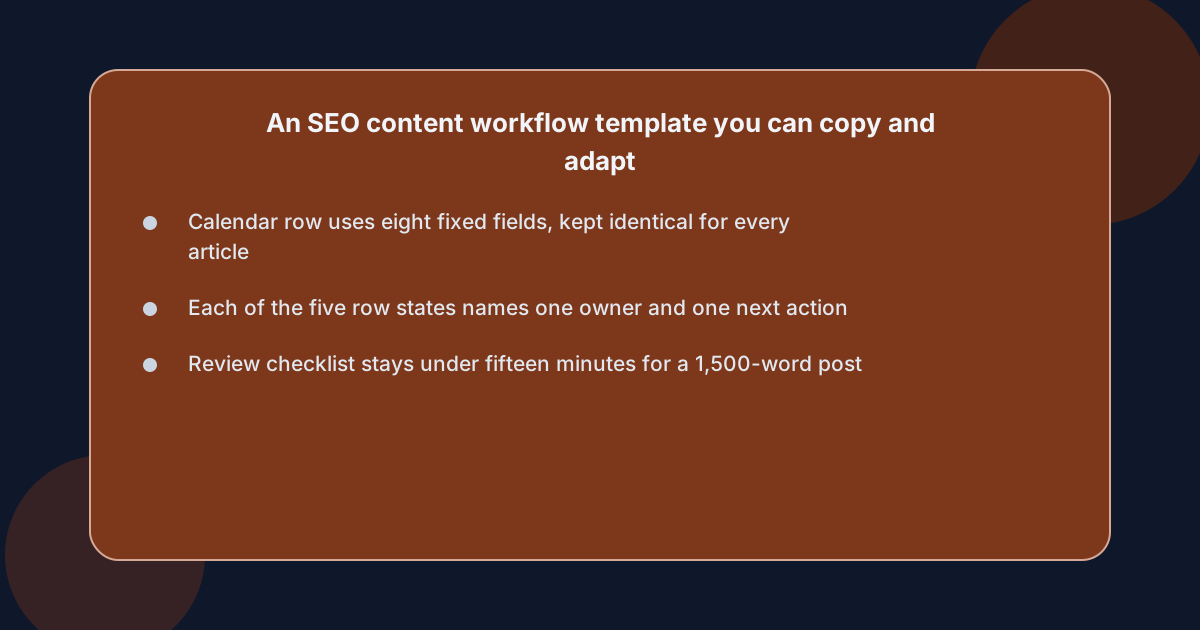 A workable template fits on a single page and is the same for every row, regardless of who is writing or reviewing. The point of a template is not to constrain the writer; it is to make the next step obvious to whoever owns it, so the workflow does not depend on memory. Below is the version that holds up on a small team, with each field tied to a decision the workflow has already made.
The calendar row carries eight fields:
- The target query is written the way a person types it into a search box, with the same wording the brief and the meta title will use.
- The search intent is one of three values: informational, commercial, or transactional, and it decides the shape of the post before the outline is written.
- The supporting terms are the two to four related questions the post should also answer, drawn from the same query cluster, and they are checked at the 14-day revisit.
- The outline is three to six headings, in order, with the target query placed in the first or second heading.
- The meta title and meta description are written for the search result, not for the brand, and they are within Google's current rendering limits (roughly 60 characters for the title and 155 for the description).
- The internal links list names the pages the post will link to and the page that will link back, so neither side of the link is decided in the draft.
- The format and depth field names the shape — guide, comparison, tutorial, or listicle — and the approximate word count band.
- The publishing date is a fixed day of the week, not a vague "early next month".
The state field is the trigger column. A row is in one of five states at any moment: planned, drafted, in review, scheduled, or published-with-revisit-pending. Each state has a single owner and a single next action:
- "Planned" is owned by whoever runs the calendar and the next action is "wait for the publishing date".
- "Drafted" is owned by the writer and the next action is "submit to the first reviewer".
- "In review" is owned by the first reviewer and the next action is "approve or return with comments".
- "Scheduled" is owned by the publisher and the next action is "publish on the date".
- "Published-with-revisit-pending" is owned by the calendar owner and the next action is "re-read against search console at day 14".
The review checklist is the same for every post and lives next to the calendar, not inside it. It has three sections, in order. The structural section checks the target query placement, the outline match, the internal links, and the meta data. The factual section checks the named claims against the source linked next to them, with a hard rule that any claim without a source is either removed or rewritten as a general statement. The voice section is a single read for tone, length, and the question of whether the post answers what the reader was actually searching for. The checklist is short enough to be done in fifteen minutes for a 1,500-word post, and the time budget is part of the workflow — if a post needs longer than that, the brief was wrong, not the reviewer.
For teams that need a starting point, the seo content automation template for a small operation is one post per week, one reviewer on the structural pass, one on the factual pass when the topic carries claims, and a 14-day revisit built into the calendar. The cadence scales to two posts a week only when the second reviewer's slots are protected, and to daily publishing only when the brief is fully populated and the review pass is split. Anything between those two speeds is a workflow that runs on enthusiasm and stops the first time the calendar gets tight.
How to keep the workflow alive after the first three months
The first three months are the easy part. The team has energy, the calendar is full, and every post feels like progress. The hard part is month four, when the early posts are old enough to have ranking data and new enough to need a refresh, the calendar is starting to fill with topics the writer is tired of, and the reviewer is reading drafts that look the same as the last ten. Most workflows die here, not because the writing got worse, but because the planning layer stopped.
The first survival habit is a monthly calendar review. Once a month, the calendar owner reads the last four weeks of published posts against the search console: which queries earned impressions, which posts got clicked, and which supporting terms showed up that the post did not target. Each post is then re-categorised — keep, refresh, or retire — and the calendar for the next four weeks is rebuilt from that signal. A workflow that does this once a month for a quarter will have a noticeably different calendar in month four than it had in month one, because the data is feeding back into the plan.
The second survival habit is a quarterly brief audit. Once a quarter, the eight fields in the calendar row are read against the actual drafts that came out of them. If the outlines are being ignored, the brief was too prescriptive or not prescriptive enough. If the meta titles are routinely rewritten at review, the brief did not train the writer on what a meta title is for. If the internal links are routinely missing, the brief did not list them, or the writer did not have access to the pages. The audit is not a blame exercise; it is a calibration pass on the template, and it is the only way the workflow gets sharper instead of staler.
The third survival habit is a hard rule on cadence. The cadence set in month one is reviewed at the end of month three against the actual delivery rate. If the team has hit the cadence for ten consecutive weeks, the cadence can be tightened by one post per week. If the team has missed the cadence for two consecutive weeks, the cadence is loosened by one post per week, regardless of how the writing looks. A workflow that adjusts its cadence to reality every quarter is a workflow that does not collapse under the first holiday season.
The last survival habit, and the one most teams skip, is a written exit rule for each role. What happens to the calendar when the writer leaves. What happens to the review pass when the reviewer goes on leave. What happens to the publishing step when the CMS changes. These are not dramatic events, but they are the ones that quietly kill a workflow built around specific people. Writing the exit rule before it is needed is the cheapest insurance a small team can buy.
For teams scaling beyond the founder-and-one-writer stage, the workflow for marketing teams is the same template with a queue between two reviewers and a calendar owner who is neither the writer nor the reviewer — that role is the one that holds the workflow together when the people in it change.
A final decision small teams tend to put off is how often the calendar itself should be repopulated. The honest answer is that cadence is a budget decision before it is a quality decision, and the cadence question deserves its own page because it sits upstream of the workflow — pick the slowest rhythm the team can hold for six months, and only tighten it after the data says you can. The workflow above is what that rhythm looks like once it has been chosen, and the sign up page is where teams that want the template pre-loaded can start.
Frequently asked questions
How often should a small marketing team publish blog posts for SEO?
A small marketing team should publish at the slowest cadence it can hold for six consecutive months, not the fastest one that looks impressive in week one. For a one-person team, that is usually one post per week; for a two-person team with a protected review slot, two posts per week. The cadence is reviewed at the end of month three against the actual delivery rate and adjusted up or down by one post per week, never by more.
Who should review SEO content before it goes live?
The reviewer should be one person for a one-person team, split into a structural reviewer and a factual reviewer for a two-person team. The writer should never be the only reviewer of their own post, because the writer is blind to the parts of the brief they wrote. The reviewer's job is to run a written checklist against the brief, not to rewrite the post in their own voice.
What is the difference between a content calendar and a content workflow?
A content calendar is a list of dates and titles; a content workflow is the production line that turns each row in the calendar into a published post. The workflow includes the brief, the draft, the review pass with its checklist, the publishing step, and the 14-day revisit against the search console. A calendar without a workflow is a wishlist; a workflow without a calendar is a process with no schedule.
How long should an SEO content review take?
A structural review against the brief should take ten to fifteen minutes for a 1,500-word post; a factual review should take another ten to fifteen minutes. If a review is taking longer than that, the brief was incomplete and the reviewer is making decisions that should have been made in the planning row. The fix is to improve the brief, not to give the reviewer more time.
What should a small team do when the SEO content workflow starts to slip?
The first step is to look at the calendar, not the posts. A workflow that is slipping is almost always slipping because the cadence was set above the team's real capacity, or because a review slot is unprotected. The fix is to loosen the cadence by one post per week for the next month and to find the bottleneck — usually the second reviewer's queue — before tightening it again.