
SEO for Product Pages: Turn Search Demand into Qualified Leads

A product page already reaches people with buying intent. The right SEO for product pages strategy helps those visitors understand the offer, trust the brand, and take the next step without forcing them to decode a wall of marketing claims.
Search demand becomes qualified leads only when ranking and conversion work together. A page can earn a position, yet still fail if its evidence is vague, its information architecture confuses shoppers, or its next step is difficult to find.
Table of contents
- Key takeaways
- What makes a product page rank for high-intent searches?
- Which on-page elements should every product page include?
- How do you write product descriptions that convert search visitors?
- How do you organize product pages to avoid overlapping search intent?
- Frequently asked questions
- Sources
Key takeaways
- A high-intent product page should match one dominant search need, not every phrase associated with the product.
- Titles, product specifications, evidence, internal links, and a visible conversion path form the minimum viable product page SEO foundation.
- Effective product page copywriting explains the buyer’s problem before describing the product.
- Strong product page conversion SEO removes uncertainty at the point of decision, especially around fit, delivery, returns, and implementation.
- Product page SEO and ecommerce SEO strategy should be managed as a portfolio, with overlaps resolved before new pages are published.
What makes a product page rank for high-intent searches?
A product page ranks for high-intent searches when it satisfies the query, demonstrates credible relevance, and offers a clear path to the next action. Search visibility is not a separate layer from conversion; it is built from the same content that helps a buyer decide.
High-intent searches usually indicate that a person has moved from general research toward a specific solution. Searches containing terms such as “buy,” “pricing,” “comparison,” “features,” or “alternative” generally call for more than a generic introduction. They expect enough detail to compare the product with the alternatives already in mind.
That creates three ranking and conversion requirements:
- Relevance: The page must directly address the product, category, or use case represented by the query.
- Credibility: The visitor needs concrete evidence that the claims are accurate and the product can deliver.
- Actionability: The page must make the next step obvious without forcing the visitor to reconstruct it from scattered links.
Does search intent determine which page should rank?
Yes. Search intent determines which page should rank because a product page and a guide answer different questions, even when they mention the same product. A buyer searching for a specific solution is likely looking for concrete details; someone comparing approaches needs broader explanation.
Matching intent also prevents keyword cannibalization. If two pages target the same query with similar depth, search engines must guess which one to display, and your internal link equity becomes less decisive.
Use the query as the organizing principle. Decide what the searcher wants to know, then choose the page format that provides that answer most completely:
- A product page for a specific offer
- A comparison page for alternatives
- A guide for a broader problem
- A category page for browsing several related products
The phrase “product page SEO” is sometimes used too narrowly. It includes deciding which product deserves a page, what role that page plays in the site, and which internal links support it.
Which on-page elements should every product page include?
Every product page should include a descriptive title, a concise value proposition, specifications, visual evidence, trust signals, a clear next step, and links to the pages that support the buying decision. Each element answers a question the visitor is likely to have.
For a SaaS product, those questions may concern integrations, implementation, security, and support. For an ecommerce product, they may concern materials, dimensions, delivery, and returns. The format differs, but the underlying principle remains constant.
Which elements affect visibility and conversion?
Several elements affect both visibility and conversion, but their job is not identical. Metadata helps search engines understand and present the page; body content helps the visitor evaluate it.
| Element | Primary job | Common mistake |
|---|---|---|
| Title tag and H1 | Communicate the page’s subject | Using the brand name without describing the offer |
| Meta description | Earn attention in search results | Copy that repeats the title without adding a reason to click |
| Product summary | Explain the value quickly | Leading with company history |
| Specifications | Confirm product fit | Hiding essential details in images |
| Images or product visuals | Show what the customer will receive | Using decorative images without explanatory captions |
| Evidence | Reduce perceived risk | Adding testimonials without relevance or context |
| Internal links | Guide visitors toward useful information | Linking only to unrelated commercial pages |
| Conversion element | Offer a clear next step | Using several competing calls to action |
| Structured data | Help search engines interpret the page | Marking up information that is not visible on the page |
Google’s documentation on product structured data explains that product information can help search engines understand a page and is used in eligible shopping experiences. The technical implementation matters, but the underlying content must still match what the page promises.
How should trust signals be used?
Trust signals should sit beside the claims they support. A security section belongs near information about data handling; delivery details belong near the purchase decision; customer evidence belongs near the problem the product solves.
Generic trust badges are less useful than specific, verifiable facts. “Trusted by thousands” needs a source and a relevant explanation. A customer quotation is stronger when it identifies the kind of challenge the reader is facing.
For organizations operating in the European Union, legal and privacy claims require particular care. The EU General Data Protection Regulation, adopted in 2016, applies to the processing of personal data under defined conditions, so privacy language should reflect the actual data practices rather than a reusable marketing phrase.
When should a product page link to supporting content?
A product page should link to supporting content whenever the visitor needs evidence that would make the main page too long or dilute its focus. Supporting pages should explain legal terms, technical details, comparisons, implementation processes, or broader use cases.
The link should help the visitor complete a specific task. A link labeled “Read the full technical guide” is useful when the guide contains installation details. A generic “Learn more” label hides that value and weakens the transition.
This is also where content planning becomes operational. An SEO content plan should connect each page to one target query, search intent, supporting terms, outline, metadata, internal links, format, and publishing date. That discipline prevents teams from creating several product pages for the same need.
How do you write product descriptions that convert search visitors?
Product descriptions that convert search visitors follow a buyer-centered sequence: identify the problem, explain the relevant benefit, prove the claim, remove purchase friction, and present the next step. Persuasion comes from relevance and clarity, not from adjectives alone.
Search visitors have usually arrived with a question. Their background may include a comparison, a previous research session, or a specific problem they need to solve. The description should confirm that the product fits that context.
How should product page copywriting start?
Product page copywriting should start with the buyer’s problem in language that matches the query, then connect that problem to a specific capability and outcome. The opening should make sense to a cold reader and a search snippet.
Compare these approaches:
Generic: “Our innovative platform is designed to transform the way modern businesses work.”
Buyer-centered: “When customer questions arrive across multiple channels, your team loses time rebuilding context. This shared workspace keeps each conversation, customer record, and next action in one place.”
The second version explains what is happening, who experiences it, and what changes. It also creates a natural foundation for specifications and proof.
Which details make a description credible?
Credible descriptions use concrete details that help the buyer test whether the offer fits. The right details depend on the purchase, but they should be specific rather than universal.
For software, useful details may include:
- Who the product is designed for
- The jobs it performs
- How it fits into an existing workflow
- Implementation requirements
- Data, security, and support details
- Which integrations or adjacent workflows matter
For physical products, they may include:
- Materials and dimensions
- Compatibility or sizing
- Care and maintenance
- Packaging and included components
- Delivery and return conditions
Do not fill the page with every available specification. Include the details that affect the decision, and place less decisive information in linked supporting material.
How can product page conversion SEO reduce uncertainty?
Product page conversion SEO reduces uncertainty by answering practical objections at the moment they arise. The most effective proof appears beside the feature or outcome it supports.
A structured comparison table can help when buyers are choosing between options, but only if the criteria reflect genuine decisions. Rows such as “best features,” “great value,” and “excellent support” add no information. Useful rows expose differences in workflow, scale, maintenance, implementation, or suitability.
The conversion element should be singular and prominent. A visitor who must decide among several unrelated actions may delay or leave. Make the primary action visually distinct and place it where the supporting evidence has established relevance.
When should a product page use urgency?
Use urgency only when it reflects a genuine condition, such as an inventory limit, a dated offer, or a documented deadline. False scarcity damages trust, especially when the claim can be checked by returning to the page later.
The principle extends to copy generally. Specificity is more persuasive than intensity because it gives the buyer something verifiable to evaluate. If you are deciding between teams, agencies, freelancers, and software, compare what each route is accountable for—not merely which sounds fastest.
xt4b is one option among those routes: it finds searches a site does not answer, plans posts against those gaps, and publishes them to a blog on the customer’s domain. It is not the right route for a business whose immediate priority is optimizing a small existing product catalogue; those teams may get more value from focused template work and customer research.
How do you organize product pages to avoid overlapping search intent?
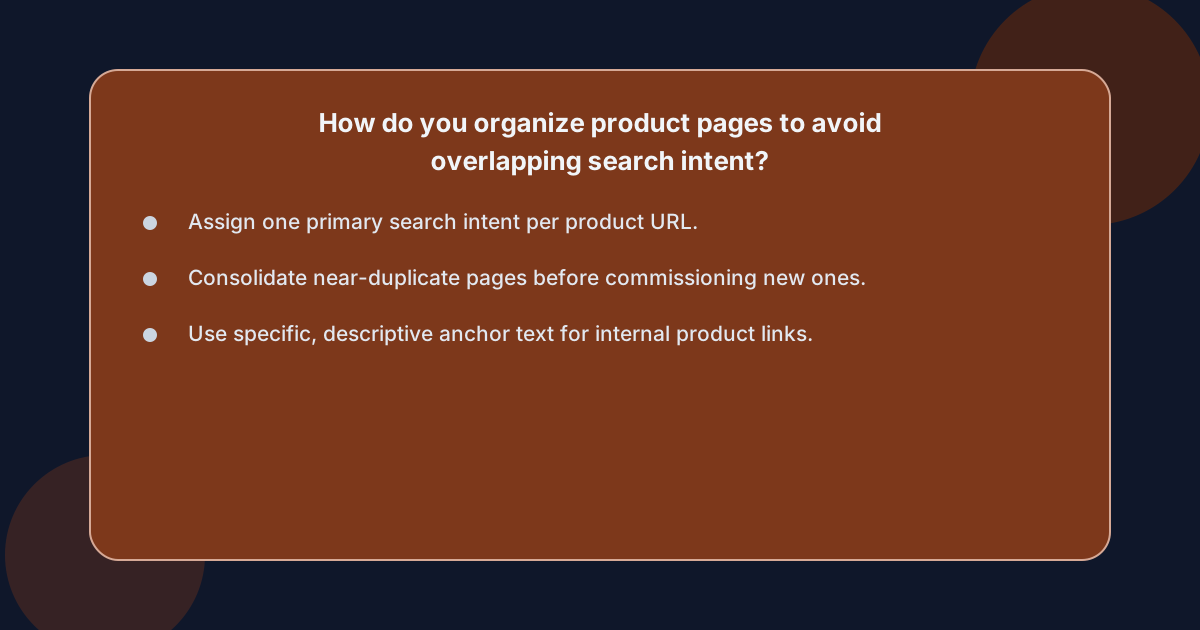 Organize product pages by assigning one primary search intent to each URL, mapping close variants to the strongest existing page, and linking related products through descriptive, context-specific anchors. Overlap should be resolved before another page is commissioned.
Crawl and indexation solve a different problem. A page can be indexed perfectly and still compete with another page for the same query. Intent overlap is therefore an information-architecture issue, not merely a technical configuration problem.
How should you map products to search demand?
Map products to search demand using a worksheet that records the target query, intent, product fit, current ranking URL, and intended canonical destination. A simple process can prevent expensive duplication.
Use this sequence:
- Export the existing product and category URLs.
- Collect the queries associated with each URL from Search Console.
- Group queries that attract the same audience and satisfy the same need.
- Identify pages that compete for overlapping terms.
- Choose the page that best matches the dominant intent.
- Redirect, consolidate, or clearly differentiate the weaker page.
- Add internal links that reinforce the chosen relationships.
The worksheet becomes part of the broader ecommerce SEO strategy. It shows whether the catalogue reflects demand or merely reflects internal organization.
When should similar products get their own pages?
Similar products deserve separate pages when they serve materially different search needs, use cases, audiences, or specifications. If the only difference is color or size, a parent product page with clear variants may be more useful than multiple near-identical URLs.
Consider a software product with plans for individuals and large teams. If both plans satisfy the same search need and the choice depends mostly on scale, one page with a clear plan comparison may outperform two pages targeting “product pricing” and “enterprise pricing.” If the enterprise offer addresses a distinct evaluation process or implementation requirement, a separate page can be justified.
A useful test is to imagine the searcher's next question. If the same question follows regardless of variant, consolidate. If the answer changes substantially, give the variant its own page with distinct evidence and internal links.
How do internal links reinforce product page relevance?
Internal links reinforce relevance by connecting a product page to the specific resources that substantiate its claims and help the visitor evaluate the purchase. Anchor text should describe the destination’s content accurately.
Avoid generic anchors and repeated boilerplate. “Pricing” is better than “click here,” while “compare the plan limits” is better still when it accurately reflects the linked page. Descriptive anchors also help readers with assistive technology understand where a link will take them.
When the catalogue includes a broader editorial layer, that layer should support rather than compete with product pages. A blog for ecommerce can answer use-case questions, explain implementation details, and link visitors to the relevant product page. The product page should remain the destination for evaluation and purchase.
How often should product pages be reviewed?
Review product pages on a schedule tied to performance and commercial importance. High-value pages that receive substantial impressions or meaningful traffic deserve more frequent attention than pages with little demand.
A practical review checks:
- Whether the page still matches its target query
- Whether impressions are converting into clicks
- Whether clicks are producing meaningful next steps
- Whether specifications or claims have changed
- Whether supporting evidence is current
- Whether internal links point to the most useful destinations
- Whether another page has begun to compete for the same intent
Do not change a page only because it has not ranked. Diagnose the constraint first: weak relevance, limited authority, missing evidence, technical barriers, or an unclear conversion path. Each cause requires a different intervention.
Frequently asked questions
How many keywords should a product page target?
A product page should target one primary search intent, with closely related terms used naturally within it. Attempting to cover many unrelated intents weakens the page’s focus and can create competition between your own URLs.
How long should a product description be?
The appropriate length depends on purchase complexity and the information needed to make a decision. A simple product may need a concise description, while software or high-consideration products often require more detail, structured specifications, evidence, and links to supporting resources.
Is product page SEO the same as ecommerce SEO?
Product page SEO and ecommerce SEO overlap but operate at different levels. Product page SEO focuses on individual pages and their ability to match, rank, and convert; ecommerce SEO strategy also covers category pages, site architecture, facets, duplication, and internal linking across the store.
Should product pages include customer reviews?
Customer reviews can provide useful evidence when they address relevant purchase questions and are presented with enough context to be credible. Reviews are not a substitute for clear specifications, accurate claims, or practical information about fit and implementation.
How do I know whether a product page has keyword cannibalization?
Keyword cannibalization usually appears when several URLs receive impressions for the same query, or when two pages target nearly identical intents without a clear distinction. Review query-to-URL mappings in Search Console, compare landing pages, and consolidate or differentiate the weaker pages based on the dominant intent.