
What to Automate in SEO (and What to Keep Human)

Most SEO advice on automation sounds like a feature list. The real question for a SaaS founder in 2026 is narrower: which parts of SEO should run on autopilot so the blog compounds, and which parts will quietly destroy rankings if you take a human out of the loop? This guide lays out a working framework for deciding what to automate in SEO, the tasks that stay human-only, and the grey zone in between — written for a small in-house team that owns the blog channel and has neither the time to run a full content pipeline nor the budget to hire one.
Table of contents
- Key takeaways
- Where SEO automation actually compounds
- What to keep human, even in 2026
- The grey zone: tasks you should assist, not fully automate
- A simple test: automate, assist or keep human
- How this changes as your SaaS blog scales
- Frequently asked questions
- Sources
Key takeaways
- Automate the mechanical, repeatable layer of SEO: rank tracking, site audits, internal-link suggestions, schema generation, and content scheduling.
- Keep humans in the loop on anything that defines the brand: positioning, original analysis, claims that need a name behind them, and editorial judgement about what to publish next.
- Treat AI as an assistant, not a replacement, for briefs, outlines, rewrites, and metadata drafts — the human approves, the human edits, and the human is accountable.
- Use a single test to decide each task: if a wrong answer costs you a ranking, keep a human in; if a wrong answer only costs you time, automate it.
- Cadence matters more than volume: a SaaS blog that ships one strong post a week on a fixed schedule compounds faster than one that ships five on a random calendar.
Where SEO automation actually compounds
Automation compounds where the work is mechanical, repeatable and verifiable: rank tracking across hundreds of keywords, scheduled site audits that flag broken links and crawl errors, schema markup generation, internal-link suggestions based on existing topical clusters, and content scheduling against a publishing calendar. None of these tasks improve with human creativity — they improve with consistency, and consistency is exactly what software is good at.
The second compounding layer is research. Pulling the queries a site already earns impressions for, comparing them against what is already published, and flagging the gap is a pattern-matching job that AI now does in minutes. A human doing the same task by hand, with spreadsheets, will spend a day on what an automated pipeline surfaces in a single morning. The savings are not the point. The point is that the human can spend the rest of the day on the work the pipeline cannot do: deciding which gap is worth closing, and what the post should actually say.
The third layer is publishing infrastructure. Drafts that move from brief to review to scheduled publish, with the right metadata attached and the right image slot reserved, are automation at its most boring and most useful. The reader never sees this layer, which is exactly the point — a SaaS blog that runs on a fixed calendar beats one that runs on someone's available Tuesday afternoon.
A useful exercise before you automate anything: write down the eight decisions a single post has to make before it goes live — target query, search intent, supporting terms, outline, meta title, meta description, internal links, format and depth. The ones that are the same shape every time are your automation candidates. The ones that change meaning depending on the post are not.
What to keep human, even in 2026
Some SEO work does not survive being automated, and trying to automate it is how blogs start publishing posts that look right and feel wrong. Google's own search guidance treats AI-generated content as acceptable when it is helpful, original, and meets E-E-A-T standards, and treats low-value automation, scaled content abuse, and ranking manipulation as spam — the line is not the tool, it is the result. That means the parts of a post where a reader decides whether to trust the brand have to be human.
Three categories stay human in practice.
Positioning and point of view. The post has to say something the reader cannot get from a generic answer. That is a brand decision, not a research task, and it cannot be templated without the template showing.
Original analysis and first-hand data. A founder reading a competitor comparison wants to know what the writer actually saw, not what a model inferred from public pages. If the post cites a number from a study, an internal metric, or a customer interview, a human has to own that citation.
Editorial judgement about what to publish next. The gap analysis might surface fifty queries; a human decides which five are worth the next two months. The pattern-matching is automated, the call is not.
The common failure mode is not "the AI wrote a bad post." It is "the AI wrote a perfectly fine post that the team shipped without anyone reading it carefully, and six months later the site has a hundred perfectly fine posts that no one would defend in a sales call." That is the part you keep human.
The grey zone: tasks you should assist, not fully automate
Most SEO workflows are not binary. A draft is a draft, a brief is a brief, and a meta description is a meta description — each one is a thing a model can produce in seconds, and a thing a human should approve before it ships. This is the assist layer, and it is where most of the actual work happens.
Briefs and outlines. AI produces a competent first draft of a brief against a target query — the intent classification, the headings, the questions to answer. The human reads it, reorders what is wrong, and removes what the model added because it sounded like a heading. The cost of a wrong brief is one bad post, so the review is cheap.
Meta titles and descriptions. AI drafts both in seconds, against a target query and a character limit. A human edits for voice and for the click — the model does not know which phrasing matches the brand, and it does not know which one the reader will pick in a SERP crowded with competitors.
Rewrites and updates. When a post underperforms fourteen days after publishing, the update is usually a structural change: a new section, a sharper intro, a different example. AI proposes the change, the human decides whether the change is honest. This is the right place to test a flat monthly pricing model of 20€ per website, per language, per month — the assist layer is where predictable spend matters most.
Internal-link suggestions. AI proposes links from a draft to existing pages on the site; the human checks that the link actually serves the reader, not just the crawl budget. A bad internal link is a small ranking loss; a misleading one is a trust loss.
The pattern across all four: the model drafts, the human decides, the post ships. Remove the human and the work still gets done, but the result is no longer something the brand would put its name on.
A simple test: automate, assist or keep human
Before you add a new task to your automation list, run it through three questions. If a wrong answer only costs you time, automate. If a wrong answer costs you a ranking, assist. If a wrong answer costs you a customer, keep it human.
Here is the test applied to the tasks that come up most often.
- Rank tracking across a fixed keyword set. A wrong number costs you an hour of confusion. Automate.
- Scheduled site audits for broken links and crawl errors. A missed alert costs you a page. Automate, with a human reading the weekly digest.
- Schema markup on a new post. A wrong schema costs you a rich result. Assist — the model drafts, a human reviews.
- Meta title and description for a new post. A weak one costs you the click. Assist.
- The point of view in the introduction. A generic one costs you the reader. Keep human.
- Original analysis with a number attached to it. A wrong number costs you the post, and possibly the trust. Keep human.
- Internal-link suggestions between existing posts. A bad link costs you a session. Assist.
- Editorial decision about which query to publish next. A wrong call costs you two months. Keep human.
The test is not perfect, and the categories overlap — a "keep human" task can have an automated pre-step, and an "automate" task still gets a periodic human audit. The point is that you make the decision explicitly, for each task, instead of letting the default of "the model can do this" slide into a workflow that no one is reading.
How often should a SaaS blog publish, and what should it publish?
Cadence beats volume for small teams. One strong post a week, on a fixed day, with a brief that names the query and the intent, compounds faster than five posts in a good month and none in a slow one. The job of an SEO content plan is to make that cadence possible — the calendar is the product, the post is the output. A useful rule of thumb: a SaaS blog should publish only as many posts as it can defend in a sales call. The moment the team cannot answer "what does this post argue?" the cadence is too high.
How this changes as your SaaS blog scales
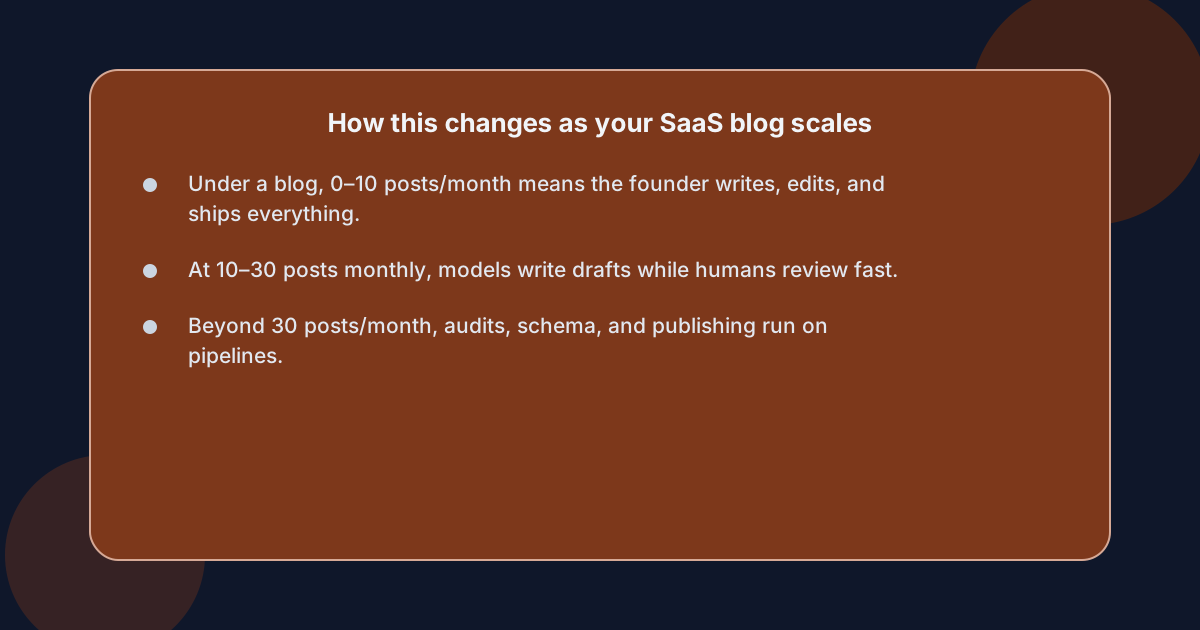 The right balance of automation and human work shifts as the blog grows, and the shift is mostly about which tasks move from "keep human" to "assist" as the team builds the muscle to review them.
At zero to ten posts a month, almost everything is human. The founder writes the briefs, the founder edits the drafts, and there is no automation layer worth the setup cost. The job at this stage is to ship, to learn what the audience reads, and to build a small library of posts that actually earn traffic. Most SaaS blogs that fail at this stage do not fail because they automated too little — they fail because they automated too much, and the posts sound like every other post on the topic.
At ten to thirty posts a month, the assist layer starts to pay off. A model drafts briefs against the gaps the site has not covered, the human edits the brief before any writing starts, the model drafts the post, and the human reviews the draft. The cadence is high enough that the review step has to be fast, which means the briefs have to be good, which is the part that justifies the pipeline.
At thirty posts a month and above, the automation layer becomes load-bearing. The site audit runs on a schedule, the rank tracker flags movements daily, the schema is generated per post, and the editorial team spends its time on the work that does not scale: positioning, original analysis, and the calls about what the blog is for. This is the stage where an SEO content plan stops being a Notion page and becomes a pipeline — and where a tool that runs the plan, the writing, the review pass, the images, and the publishing on a flat monthly line starts to make more sense than paying per word.
The practical test for whether your blog has outgrown its current setup is simple. If a single human can still read every draft before it ships, you are at the assist stage and probably do not need a full pipeline. If a single human cannot, the gap between the two is exactly the work an automated content pipeline is meant to close — by writing the post against a brief the team has already approved, by checking the draft, and by publishing to the blog on a day the calendar set. The line between "automate" and "keep human" is the line between the work that compounds without you and the work that compounds only because of you.
Frequently asked questions
What SEO tasks should be automated first?
The mechanical layer: rank tracking across a fixed keyword set, scheduled site audits for broken links and crawl errors, schema markup generation, internal-link suggestions, and content scheduling. These tasks improve with consistency, not with creativity, and they free the team to spend time on the work that does not scale.
What should not be automated in SEO?
The work that defines the brand: positioning and point of view, original analysis with a number behind it, the editorial decision about which query to publish next, and any post where a wrong claim would cost you trust rather than a ranking. AI can draft the structure, but a human has to own the claim.
Can AI-generated content rank on Google?
Yes, if it is helpful, original, and meets E-E-A-T standards, according to Google's own search guidance. What Google treats as spam is not the use of AI — it is low-value automation, scaled content abuse, and content written primarily to manipulate rankings. The tool does not decide the outcome; the result does.
What is human-in-the-loop SEO?
A workflow where a model drafts the work and a human approves it before it ships. The model produces the brief, the outline, the draft, the meta title, and the meta description; the human reads each one, edits what is wrong, and signs off. The human is the bottleneck on quality, the model is the bottleneck on speed.
How much SEO content should a SaaS blog publish?
As many posts as the team can defend in a sales call. For most small in-house teams, that is one strong post a week on a fixed day, written against a brief that names the query, the intent, and the supporting terms. Cadence compounds; volume without cadence does not.
Sources
- Google's AI Content Guidelines Explained (2026) | Layer3Labs
- Google AI Content Guidelines 2026: AI Mode, SEO & Spam Policy | Eyesift
- Google and AI Content: What to Know (& What to Do) | SEO.com
- SEO Automation: 17 Tasks Streamlined for Enhanced Efficiency | Backlinko
- SEO automation: 21 tasks to automate with AI & traditional tools | Search Engine Land