
Automated SEO Content vs an Agency: Which One Actually Fits You in 2026?

Table of contents
- Key takeaways
- What "automated SEO content" actually means in 2026
- How do agencies price SEO content compared to automated services?
- Where agencies win, and where they stall
- Where an automated pipeline wins, and where it falls short
- Automated SEO content vs agency: a side-by-side checklist
- Which model fits a founder, an in-house marketer, or a consultant?
- Questions to ask before you sign either one
- Do you keep the cadence yourself, or hand it to something that keeps it for you?
- Frequently asked questions
- Sources
Key takeaways
- Per-word pricing tells you nothing. Cost moves with how much decision-making is in the brief, not with the length of the post — the same article can cost three times more from one vendor and still be the cheaper option if it covers the query.
- An agency is bought for thinking, not for paragraphs. Where the brief is clear, an automated pipeline runs faster and cleaner; where the brief is unclear, no automation will invent the right query for you.
- Ownership is the line that splits the two. If the content lives on your domain, on your schedule and in your Search Console, you can switch the engine later. If it does not, you are renting traffic.
- Switching from an agency is rarely sudden. Most teams move one site, one language, or one post type at a time — the question is which posts you stop paying agency rates for first.
- A 40-person SaaS does not need a content hire yet. What it needs is a plan, a publishing rhythm and the search data to see what is earning — in that order.
What "automated SEO content" actually means in 2026
Automated SEO content, in 2026, is a pipeline that decides the query, the outline, the metadata and the publish date before a single paragraph is drafted, then writes and ships the post on that schedule. The "automation" is not in the writing — large language models have been writing competently for years. The automation is in the eight decisions per post that an editor or strategist would otherwise make by hand, every time, for every article: the target query, the search intent, the supporting terms, the outline, the meta title and description, the internal links, the format and the publish date. They are settled once, on the plan, and the draft follows the spec.
That distinction matters when you compare an automated SEO content vs agency service, because an agency charges for the strategist's hours and the editor's eye, not for the keystrokes of the writer. An automated pipeline shifts the cost from "pay someone to decide" to "pay a system to enforce a decision you already approved." A useful reference for how the decisions stack up is the breakdown of what an SEO content plan should contain — every row in a real plan is one of those eight decisions, locked before any writing begins.
The second thing the word "automated" usually hides is where the post ends up living. Some services host the content on a network you do not own and call it SEO. Some generate a PDF and call it a deliverable. The honest version, in 2026, is a pipeline that publishes to a hostname you control, with canonical URLs, structured data and the sitemap updated in the same operation — so the equity accrues to your domain, not to a vendor's media property. How an automated SEO content service actually works walks through that plumbing in plain language.
What it is not, in 2026, is a prompt pasted into a chatbot and a draft copy-pasted into WordPress. The market is past that phase, and the vendors still selling it are the ones giving automation a bad name.
How do agencies price SEO content compared to automated services?
Agencies price SEO content per article, per retainer or per word, and the number moves with how much thinking is baked into the brief — automated services price per post, per site or per month, and the number moves with how much of the eight decisions the vendor has already made for you. None of the four agency pricing models is wrong, but they buy different things, and the cheapest line on a quote is almost always the one with the least brief behind it. A complete walk-through of what those four models cover and where they leak is in what SEO content actually costs, and the comparison there is useful as a backdrop to this section.
Per-word is the most quoted and the least informative. A rate per word tells you nothing about whether the writer read your site, ran a query analysis, or matched the outline to the search intent. Per-article pricing is better, because it forces a brief to exist — query, intent, outline, sources, images — and two per-article quotes become comparable when the brief is the same. Monthly retainers trade a lower per-piece rate for a calendar commitment, and the trap is the month where two posts are ready and the third is not. In-house is the most predictable until the writer leaves and the calendar goes with them.
Automated services flatten all of that. The price is usually a monthly subscription per site or a per-article fee set by the plan, and what you are paying for is the eight decisions — the query research, the outline, the metadata, the links — plus the publishing on a date. The cost line is rarely the per-word rate, because no one is charging per word: the cost is the decision work that an agency would otherwise bill in hours. The honest comparison is not "what does one article cost" but "what does a year of publishing on a schedule cost, including the brief behind every post."
A practical test: send the same one-page brief to two agencies and one automated service, with the query, the intent, the outline and the publish date already written, and ask each of them to quote. The number that arrives back tells you which vendor was paying for the brief you sent and which was planning to charge you for writing one themselves.
Where agencies win, and where they stall
Agencies win on the brief before the first draft, on stakeholder management, and on the work no plan can yet automate — and they stall on schedule, on ownership and on the per-month cost of a calendar you cannot see. The honest way to look at an SEO content agency alternative is not "agency bad, automation good" — it is to name the work each one is genuinely good at, and the work each one charges you for but does not actually do.
Where an agency wins:
- The brief. A senior strategist who has worked in your category will spot a query an automated pipeline will miss — the comparison post that does not exist yet, the alternative-phrasing question your buyers actually type, the supporting term your competitors have not covered. That thinking is real, and it is the reason agency retainers cost what they do.
- Stakeholder work. If the post needs sign-off from a product marketing lead, a subject-matter expert and a legal reviewer, an agency that has done this for ten clients knows how to herd those cats. Most automated pipelines do not.
- Edge cases. New product launches, PR-driven posts that have to ship the same day, technical deep-dives that need a real practitioner to read the draft. An automated pipeline will produce a competent version; an agency with a senior writer on the call will produce a sharper one.
Where the same agency stalls:
- The schedule. The retainer buys you a calendar, not a date. "Two posts per month" is a frequency, not a commitment — the actual publish date drifts, and the third post in a slow month never quite appears.
- The reporting. By the end of the month, you receive a PDF. The clicks, the impressions, the queries the post is ranking for — none of it is in your Search Console view; it is in the agency's dashboard. The post lives on your domain, but the measurement does not.
- The hand-off. When the retainer ends, the plan, the outline library and the editorial calendar walk out the door with the agency. You keep the URLs; you lose the institutional memory of why each post was written.
That hand-off is the single biggest hidden cost in the agency model, and it is the reason the question of when to switch from agency to automated content almost always comes up at the end of a retainer, not in the middle of one.
Where an automated pipeline wins, and where it falls short
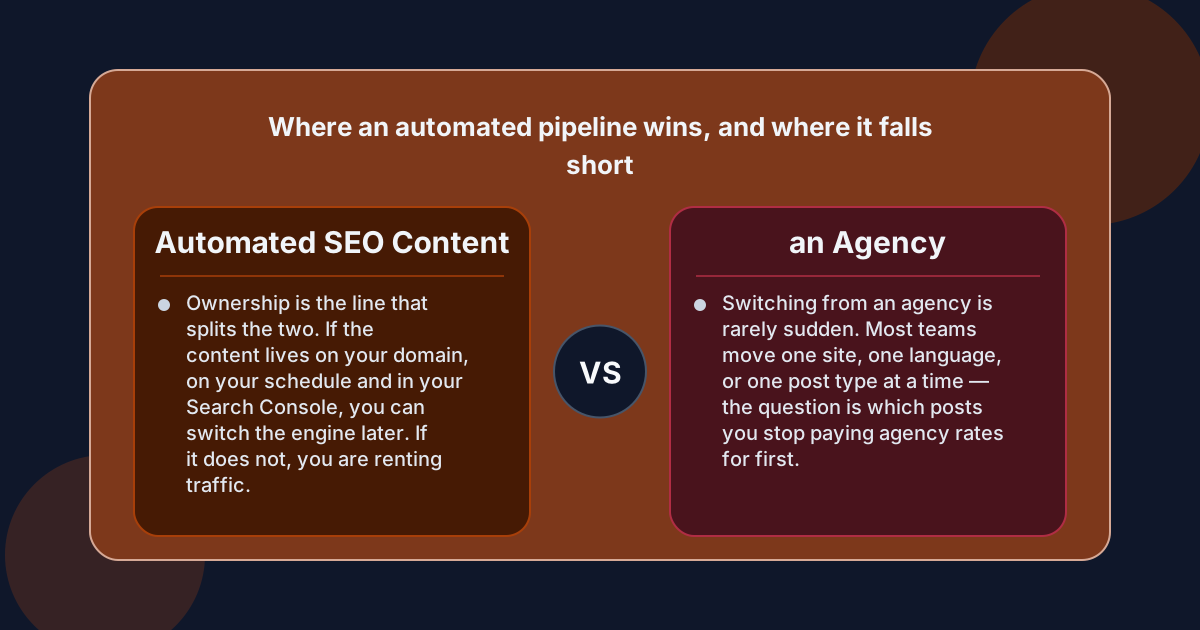 An automated pipeline wins on cadence, on ownership and on the cost of a year of publishing — and it falls short on the brief that needs a strategist's category knowledge and on the post that needs a human reader. The same comparison that gives agencies their strengths gives automation its, and the way to read the two sections together is as a single map: each model is good at the work the other cannot do.
Where automation wins:
- Cadence. The publish date is a property of the plan, not a promise from a writer. A missed date is a visible row on a calendar, not an apology in a Slack thread. For a content function that is supposed to compound over twelve months, that predictability is the whole product.
- Ownership. The content is published on a hostname you control, with canonical URLs, structured data and the sitemap updated in the same run. The plan, the editorial calendar and the post-performance data stay in your account when you stop subscribing — which means switching engines is a configuration change, not a migration. A description of what a one-person marketing team runs is in an SEO content workflow for a one-person marketing team.
- Cost shape. A subscription per site or a per-article fee set by the plan does not move with how much the writer struggled with the brief. Over a year, the per-post cost of an automated pipeline is usually lower than the agency equivalent, and it is comparable to one in-house hire once you account for tooling, editing and management.
Where automation falls short:
- The brief that needs a human strategist. If the query is genuinely new to the market — a category your company invented, a comparison your buyers do not yet type, a positioning play that has to land a specific argument — no pipeline will invent the right question. An agency with a senior strategist on the call will, and that is worth paying for.
- The post that needs a real practitioner. Technical deep-dives, opinionated essays, founder stories, posts that have to carry a real point of view — these read better when a person has read them, and the marginal value of that human reader is highest on the posts that are hardest to reverse-engineer from existing content on the web.
- The hand-off. Automated pipelines still need a person to approve the plan before it ships. The automation runs the cadence; the human owns the direction. Teams that hand the plan over without reading it tend to publish competently and mean nothing, which is a worse outcome than publishing less.
The honest read is that neither model wins the whole job. Agencies win the brief; pipelines win the schedule; in-house hires win the institutional memory. The choice between automated SEO content vs in-house writer is the same choice, framed differently: which part of the work are you trying to remove from your calendar.
Automated SEO content vs agency: a side-by-side checklist
Use this checklist to compare any two proposals — agency, automated pipeline or in-house hire — on the work that actually decides whether the post ranks, not on the line items the vendor wants you to compare. Twelve questions, each one aimed at a different failure mode, ordered from the brief at the top of the funnel to the report at the bottom.
On the brief before writing:
- Is the target query decided before the draft is written, or is the writer choosing it?
- Is the search intent named — informational, commercial, transactional — and does the outline match it?
- Are the supporting terms listed, so the post answers the related questions without competing with its own primary query?
- Is the meta title and description written for the search result, not for the brand?
On the writing and the publish:
- Is the outline approved before the draft, and does the draft follow it?
- Does each post link to pages the site already serves, in particular the pages the site sells from?
- Is the publish date committed on the plan, or is it a "target"?
- Does the post land on a hostname the buyer owns, with canonical URLs and a sitemap update in the same run?
On measurement and ownership:
- Are clicks, impressions and average position visible in the buyer's own Search Console, or only in a vendor dashboard?
- Does the plan, the editorial calendar and the post-performance data stay in the buyer's account when the contract ends?
- Is the per-article cost comparable across vendors when the same brief is sent to all of them?
- What happens in the month when two posts are ready and the third is not?
A vendor that answers "yes" to eight or more of these is running a content function. A vendor that answers "yes" to four or fewer is selling deliverables and calling it SEO. The automated SEO content vs agency decision is rarely about the vendor's brand — it is about which set of those twelve answers the buyer is willing to pay for.
Which model fits a founder, an in-house marketer, or a consultant?
The model that fits depends on what the buyer owns before the engagement starts — the plan, the publishing rights, the search data, or none of it — and on which part of the work they would rather pay someone else to do. A founder with a product to ship and no content hire, a marketer inside a 40-person SaaS with a content function to run, and a consultant running content for several small clients each face the same three options, but the right answer is not the same for any two of them.
A founder, early on. The marketing team is the founding team, and the blog is the thing that slips. The job that needs to run is the plan, the cadence and the publishing on a hostname the company owns — not the hiring of a content lead who will leave in eighteen months. For that shape, the comparison of automated SEO content vs in-house writer lands at the same place: hand the plan and the schedule to a system that runs on dates, keep the strategy in the founder's hands, and re-evaluate at the point where the company can afford a real content hire. A practical sequence for the first ninety days is in SEO content for startups.
An in-house marketer at a 40-person SaaS. The job is to run a calendar across several post types and languages, to keep the reporting honest, and to know which posts to stop spending on. The question is not "agency or automation" — it is which parts of the calendar to insource and which to hand off. A useful anchor is to look at how long SEO content actually takes to show results when sizing the program, and to decide which of the eight decisions per post each tool is genuinely making.
A consultant running content for several clients. The job is to keep several sites moving on their own calendars, with the agency's editorial overhead replaced by a per-site plan and a per-site publish rhythm. The trade-off is the same one the founder faces, multiplied by the number of clients — and the SEO content agency alternative framing is the one that fits a consultancy whose billings are by site, not by post.
The honest summary: the question is not which vendor is better, it is which part of the eight decisions per post the buyer wants to make themselves. Whoever makes the rest of them, on a plan they have already approved, is the right vendor.
Questions to ask before you sign either one
Before you sign either an agency or an automated pipeline, ask the same six questions of both — the answers reveal which vendor is buying the brief you sent and which is planning to charge you for writing one themselves. These are the questions that turn a sales call into a comparison you can act on, and the order matters: the questions at the top test the brief, the ones in the middle test the writing, and the ones at the bottom test what stays yours when the contract ends.
On the brief:
- Who decides the target query — me or you? If the vendor's answer is "you decide," the brief is yours and the cost is the work that follows it. If the answer is "we decide," the cost includes the strategy hours and the vendor's preference, and the price should reflect that.
- What does the outline look like before the draft is written? A vendor that writes first and outlines after is selling writing; a vendor that outlines first is selling decisions. The second is what you want to pay for.
On the writing and the publish:
- Where does the post live, and who owns the hostname? If the answer is "our blog network" or "a page on our site," you are renting traffic, not building it. The post has to live on a hostname you control, with canonical URLs, structured data and a sitemap update in the same run.
- What is the publish date on the plan, and what happens when it slips? A committed date is a property of the plan. A target date is a promise, and the third post in a slow month is the place the promise usually breaks.
On measurement and ownership:
- Where do I see the clicks, the impressions and the queries each post is earning? If the answer is "in our dashboard," the measurement is rented too. The honest answer is "in your own Search Console," with the data visible from day one.
- What do I keep when the contract ends — the plan, the calendar, the post-performance data? If the answer is "the URLs," you are buying deliverables; if the answer is "the plan and the data," you are buying a content function you can run yourself or hand to the next vendor.
A vendor who answers all six clearly, on a single page, is the one worth signing. A vendor who answers the first two and waves at the rest is the one who will cost more than the quote suggests, and the question of what SEO content actually costs is usually the one that comes up at the end of that contract, not in the middle.
Do you keep the cadence yourself, or hand it to something that keeps it for you?
The decision that actually settles the automated SEO content vs agency question is the one about who owns the calendar — and the product that answers it is Xt4b, which keeps a dated plan for the connected site and publishes each piece on its date, on a hostname the buyer owns. The eight decisions per post are settled on the plan, the posts are drafted to the approved outline, and the publishing happens on the date the buyer has already read, so the founder is handing over the schedule and the publishing rights, not the editorial direction. The plan, the calendar and the search data stay in the buyer's account when the engagement ends, which means the next engine is a configuration change rather than a migration. For a 40-person B2B SaaS that has already worked with an agency and wants to keep the cadence without paying agency rates for it, running each client's blog from one plan is the closest description of what the next year looks like.
Frequently asked questions
Is automated SEO content as good as an agency in 2026?
Yes, on the parts of the work the automation is genuinely doing — the eight decisions per post and the publishing on a date — and no, on the parts the automation cannot do for you, which is the brief that needs a strategist's category knowledge and the post that needs a human reader. The honest answer is that the comparison is not "which writes better" — it is which work the buyer wants to pay a vendor to do, and which work the buyer wants to keep in-house.
How much does an automated SEO content pipeline cost compared to an agency?
An automated pipeline is usually priced per site per month or per article, with the cost line tied to the eight decisions per post rather than to the number of words; an agency is usually priced per article, per retainer or per word, with the cost line tied to the strategy and editing hours that go into each piece. A useful rule of thumb is to send the same one-page brief to both kinds of vendor and compare what comes back — the spread on the quote tells you which vendor was paying for the brief you sent.
When should a team switch from an agency to automated content?
Most teams switch at the end of a retainer, not in the middle of one, because the institutional memory of the plan and the calendar tends to walk out the door with the agency. The cleanest trigger is when the buyer has a plan they have already approved, a publishing rhythm they can describe in a sentence, and a search-console view they want to keep on their own account. Teams running several clients at once tend to switch one site at a time, and teams running one site tend to switch one language at a time.
Can automated SEO content replace an in-house writer?
It can replace the parts of the in-house role that are about running the cadence — the planning, the metadata, the publishing on a date — and it cannot replace the parts that are about the brief that needs a strategist or the post that needs a real practitioner. For a 40-person SaaS that does not yet have a content hire, an automated pipeline is usually a closer fit than a freelance writer, because the cost line is the eight decisions rather than the keystrokes.
What should be in the brief before any vendor writes a single paragraph?
The target query, the search intent, the supporting terms, the outline, the meta title and description, the internal links, the format and the publish date — the eight decisions per post that decide whether the draft will rank. A vendor that wants to start writing before those eight are written is selling paragraphs; a vendor that wants them on the page first is selling a content function.